Loading
Form preview
  • US Legal Forms
  • Form Library
  • More Forms
  • More Uncategorized Forms
  • Knee Assessment Form

Get Knee Assessment Form

How it works

  1. Open form

    Open form follow the instructions

  2. Easily sign form

    Easily sign the form with your finger

  3. Share form

    Send filled & signed form or save

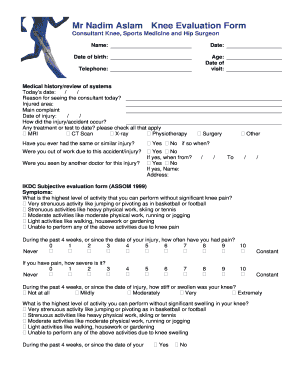
How to fill out the Knee Assessment Form online

Filling out the Knee Assessment Form online is an important step toward receiving proper evaluation and treatment for knee-related issues. This guide provides a clear step-by-step process for accurately completing the form, ensuring that all relevant information is conveyed to your healthcare provider.

Follow the steps to complete your Knee Assessment Form online effectively.

  1. Press the ‘Get Form’ button to access the Knee Assessment Form and open it in your preferred online editor.
  2. Begin by entering your personal information. Fill in your name, date, date of birth, age, and contact details to help identify your record and facilitate communication.
  3. In the medical history section, specify the reason for your visit, the injured area, your main complaint, and the date of injury. This information is critical for the consultant's understanding of your situation.
  4. Indicate any treatments or tests you have received up to this point by checking all relevant boxes, including MRI, CT Scan, X-ray, physiotherapy, or surgery.
  5. Answer questions regarding previous similar injuries and whether you were out of work due to the injury. This context can be crucial for assessing your case.
  6. Provide details of any previous consultations with other healthcare professionals for the same injury, including dates and contact details.
  7. Proceed to complete the IKDC Subjective Evaluation Form by assessing your symptoms. Rate the highest level of activity you can perform without significant knee pain or swelling.
  8. In the function section, rate your knee's functionality both before and after the injury on a scale from 0 to 10, elaborating on your daily activity limitations.
  9. Complete the Lysholm and Gilquist Scale section by circling the number that best describes your experiences related to limping, support, locking, instability, pain, swelling, stair climbing, and squatting.
  10. Review all completed sections for accuracy. Once satisfied with the entries, save your changes. You may also download, print, or share the form as needed.

Begin filling out your Knee Assessment Form online today to ensure you receive the best care for your knee issues.

Get form

Experience a faster way to fill out and sign forms on the web. Access the most extensive library of templates available.
Get form

Related content

Range of Joint Motion Evaluation Chart
INSTRUCTIONS: For each affected joint, please indicate the existing limitation of motion...
Learn more
knee evaluation form
KNEE EVALUATION FORM. Date: Pt Name: Pt Number: Diagnosis: Referred by: Visit #:. Time in:...
Learn more
MANUAL MUSCLE TESTING PROCEDURES For MMT8 ...
Jun 18, 2007 — Test: The patient extends the knee through range of motion and the...
Learn more

Related links form

ARP Standard Operating Procedure CATEX Determinations Effective October 1 2014 This SOP Addresses GUARANTY OF PAYMENT OF RENT UNDER LEASE STANDARD OPERATING PROCEDURES District Health Information Harold Muriel Berkman Charitable Foundation Scholarship

Questions & Answers

Get answers to your most pressing questions about US Legal Forms API.

Contact support

Knee pain is assessed through a combination of patient history, physical examination, and specific tests. Health professionals evaluate pain intensity, location, and any restrictions in mobility. A Knee Assessment Form can be key in gathering this information, ensuring that all factors are considered for accurate diagnosis and treatment planning.

Self-assessing a knee injury begins with observing any swelling, bruising, or pain while moving the knee. You can use a Knee Assessment Form to note any limitations in your motion or difficulty performing regular activities. This documentation can be helpful if you seek medical advice to ensure you convey your concerns effectively.

To get your knees checked, schedule an appointment with a healthcare provider who specializes in musculoskeletal conditions. During the examination, you will discuss your symptoms, followed by physical assessments that might include a Knee Assessment Form to document your knee’s condition effectively. This comprehensive approach will help your provider offer the best treatment options.

To self assess a knee injury, start by checking for pain, swelling, or instability in the knee joint. Move your knee gently to evaluate its range of motion and notice any discomfort during movement. Using a Knee Assessment Form can help you document your symptoms and limitations, providing valuable insights for a healthcare provider.

To assess a knee, one should first observe the overall alignment and any visible swelling or bruising. Next, check the range of motion by having the patient bend and straighten the knee. This process can be streamlined using a Knee Assessment Form, which prompts for relevant details and assists in systematic evaluation.

A knee injury typically involves damage to the structures within or surrounding the knee joint, including ligaments, tendons, cartilage, and bones. Common types of injuries include sprains, strains, fractures, and tears. Accurately describing a knee injury often requires detailed information about the incident and symptoms, which can be effectively documented using a Knee Assessment Form.

To perform the knee test, start with a physical examination that includes assessing joint stability and range of motion. Common tests, such as the Lachman test or the Pivot Shift test, can help evaluate the integrity of the ligaments. Record your findings accurately on a Knee Assessment Form to ensure a comprehensive overview of the knee's condition and aid in the assessment process.

To assess osteoarthritis (OA) in the knee, evaluate the patient's history, do a physical examination, and assess pain levels during movement. It is crucial to identify any limitations in range of motion and observe for signs like crepitus or joint swelling. Documenting this assessment in a Knee Assessment Form allows for a structured approach in evaluating progress or changes in the patient's condition.

The knee assessment scale is a tool used to quantitatively evaluate knee function and pain levels. It typically uses a scoring system to assess various factors such as mobility, stability, and overall function. Including your observations in a Knee Assessment Form can enhance the clarity and utility of the data gathered using this scale.

A knee assessment involves evaluating the knee's stability, range of motion, and the presence of swelling or deformity. Start by inspecting the knee visually, then perform range of motion tests, and check for strength and stability through specific movements. Using a Knee Assessment Form will help in organizing your findings and tracking changes over time.

Get This Form Now!

Use professional pre-built templates to fill in and sign documents online faster. Get access to thousands of forms.
Get form
If you believe that this page should be taken down, please follow our DMCA take down processhere.

Industry-leading security and compliance

US Legal Forms protects your data by complying with industry-specific security standards.
  • In businnes since 1997
    25+ years providing professional legal documents.
  • Accredited business
    Guarantees that a business meets BBB accreditation standards in the US and Canada.
  • Secured by Braintree
    Validated Level 1 PCI DSS compliant payment gateway that accepts most major credit and debit card brands from across the globe.
Get Knee Assessment Form
Get form
  • Adoption
  • Bankruptcy
  • Contractors
  • Divorce
  • Home Sales
  • Employment
  • Identity Theft
  • Incorporation
  • Landlord Tenant
  • Living Trust
  • Name Change
  • Personal Planning
  • Small Business
  • Wills & Estates
  • Packages A-Z
  • Affidavits
  • Bankruptcy
  • Bill of Sale
  • Corporate - LLC
  • Divorce
  • Employment
  • Identity Theft
  • Internet Technology
  • Landlord Tenant
  • Living Wills
  • Name Change
  • Power of Attorney
  • Real Estate
  • Small Estates
  • Wills
  • All Forms
  • Forms A-Z
  • Form Library
  • Legal Hub
  • About Us
  • Help Portal
  • Legal Resources
  • Blog
  • Affiliates
  • Contact Us
  • Delete My Account
  • Site Map
  • Industries
  • Forms in Spanish
  • Localized Forms
  • State-specific Forms
  • Forms Kit
  • Real Estate Handbook
  • All Guides
  • Notarize
  • Incorporation services
  • For Consumers
  • For Small Business
  • For Attorneys
  • USLegal
  • FormsPass
  • pdfFiller
  • signNow
  • altaFlow
  • DocHub
  • Instapage
Form Packages
  • Adoption
  • Bankruptcy
  • Contractors
  • Divorce
  • Home Sales
  • Employment
  • Identity Theft
  • Incorporation
  • Landlord Tenant
  • Living Trust
  • Name Change
  • Personal Planning
  • Small Business
  • Wills & Estates
  • Packages A-Z
Form Categories
  • Affidavits
  • Bankruptcy
  • Bill of Sale
  • Corporate - LLC
  • Divorce
  • Employment
  • Identity Theft
  • Internet Technology
  • Landlord Tenant
  • Living Wills
  • Name Change
  • Power of Attorney
  • Real Estate
  • Small Estates
  • Wills
  • All Forms
  • Forms A-Z
  • Form Library
Customer Service
  • Legal Hub
  • About Us
  • Help Portal
  • Legal Resources
  • Blog
  • Affiliates
  • Contact Us
  • Delete My Account
  • Site Map
  • Industries
  • Forms in Spanish
  • Localized Forms
  • State-specific Forms
  • Forms Kit
Legal Guides
  • Real Estate Handbook
  • All Guides
Prepared for you
  • Notarize
  • Incorporation services
Our Customers
  • For Consumers
  • For Small Business
  • For Attorneys
Our Sites
  • USLegal
  • FormsPass
  • pdfFiller
  • signNow
  • altaFlow
  • DocHub
  • Instapage
Social Media
Call us now toll free:
+1 833 426 79 33
As seen in:
© Copyright 1999-2026 airSlate Legal Forms, Inc. 3720 Flowood Dr, Flowood, Mississippi 39232
  • Your Privacy Choices
  • Terms of Service
  • Privacy Notice
  • Content Takedown Policy
  • Bug Bounty Program