How it works
  • Open form

    Open form follow the instructions

  • Easily sign form

    Easily sign the form with your finger

  • Share form

    Send filled & signed form or save

How to fill out the Unit 8 Blood Lymphatic Cardiovascular Systems online

Filling out the Unit 8 Blood Lymphatic Cardiovascular Systems form online can be straightforward if you follow the right steps. This guide provides you with a comprehensive overview and detailed instructions to help you accurately complete the form.

Follow the steps to successfully fill out the form.

  1. Click ‘Get Form’ button to obtain the form and open it in the editor.
  2. Begin by entering your name and period in the designated fields at the top of the form.
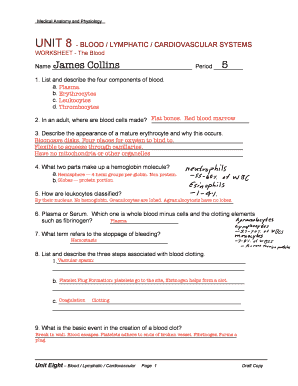
  3. Next, address the first question by listing and describing the four components of blood: plasma, erythrocytes, leukocytes, and thrombocytes. Provide detailed explanations based on your knowledge or reference materials.
  4. For question two, specify where blood cells are made in adults, noting the term 'red bone marrow'.
  5. Proceed to question three, describing the appearance of a mature erythrocyte and its attributes, such as being biconcave disks and the presence of binding sites for oxygen.
  6. Continue through the form by answering the subsequent questions systematically, ensuring you provide comprehensive responses for classifications of leukocytes, the concept of hemostasis, and the steps of blood clotting.
  7. Once all questions have been answered, review your entries for accuracy, clarity, and completeness.
  8. Finally, save your changes, and you may choose to download, print, or share the form as needed.

Complete your Unit 8 Blood Lymphatic Cardiovascular Systems form online today for a better understanding of these essential systems.

Get form

Experience a faster way to fill out and sign forms on the web. Access the most extensive library of templates available.

Related content

Blood and Lymphatic Vessel Formation - PMC...

by VL Bautch · 2015 · Cited by 113 — Blood and lymphatic vessels deliver oxygen and...

Learn more
Anatomy and Physiology II Syllabus - Anne Miller

7. Explain how nutrients and wastes are exchanged at the capillary level. 8. Explain the...

Learn more
Instructions for Use - accessdata.fda.gov

Other included events classified as disorders of: Blood & Lymphatic System...

Learn more
Questions & Answers

Get answers to your most pressing questions about US Legal Forms API.

Contact support

What are the major functions of the cardiovascular system?

The cardiovascular system delivers oxygen, nutrients, hormones, and other important substances to cells and organs in the body. It plays an important role in helping the body meet the demands of activity, exercise, and stress. It also helps maintain body temperature, among other things.

Together, the blood, heart, and blood vessels form the circulatory system. The lymphatic system (lymph, lymph nodes and lymph vessels) supports the circulatory system by draining excess fluids and proteins from tissues back into the bloodstream, thereby preventing tissue swelling.

Functions of the cardiovascular system Circulates OXYGEN and removes Carbon Dioxide. Provides cells with NUTRIENTS. Removes the waste products of metabolism to the excretory organs for disposal. Protects the body against disease and infection. Clotting stops bleeding after injury.

The primary function of the cardiovascular and lymphatic systems is to maintain an adequate and steady supply of nutrients to and facilitate the removal of waste products from all organs and tissues of the body.

The cardiovascular system consists of the heart, blood vessels, and blood. This system has three main functions: Transport of nutrients, oxygen, and hormones to cells throughout the body and removal of metabolic wastes (carbon dioxide, nitrogenous wastes).

The cardiovascular system is sometimes called the blood-vascular, or simply the circulatory, system. It consists of the heart, which is a muscular pumping device, and a closed system of vessels called arteries, veins, and capillaries.

The cardiovascular system has three main functions: transport of oxygen, carbon dioxide and nutrients. clotting of open wounds. regulation of body temperature.

The cardiovascular system consists of the heart, veins, arteries, and capillaries. These components make up two circulatory systems: the systemic and pulmonary circulatory systems. The cardiac cycle consists of two phases: systole (relaxation) and diastole (contraction).

Get This Form Now!

Use professional pre-built templates to fill in and sign documents online faster. Get access to thousands of forms.

If you believe that this page should be taken down, please follow our DMCA take down process here.

Get Unit 8 Blood Lymphatic Cardiovascular Systems