Loading

Open form follow the instructions

Easily sign the form with your finger

Send filled & signed form or save
How to fill out the Asset Transfer Tax Declaration online
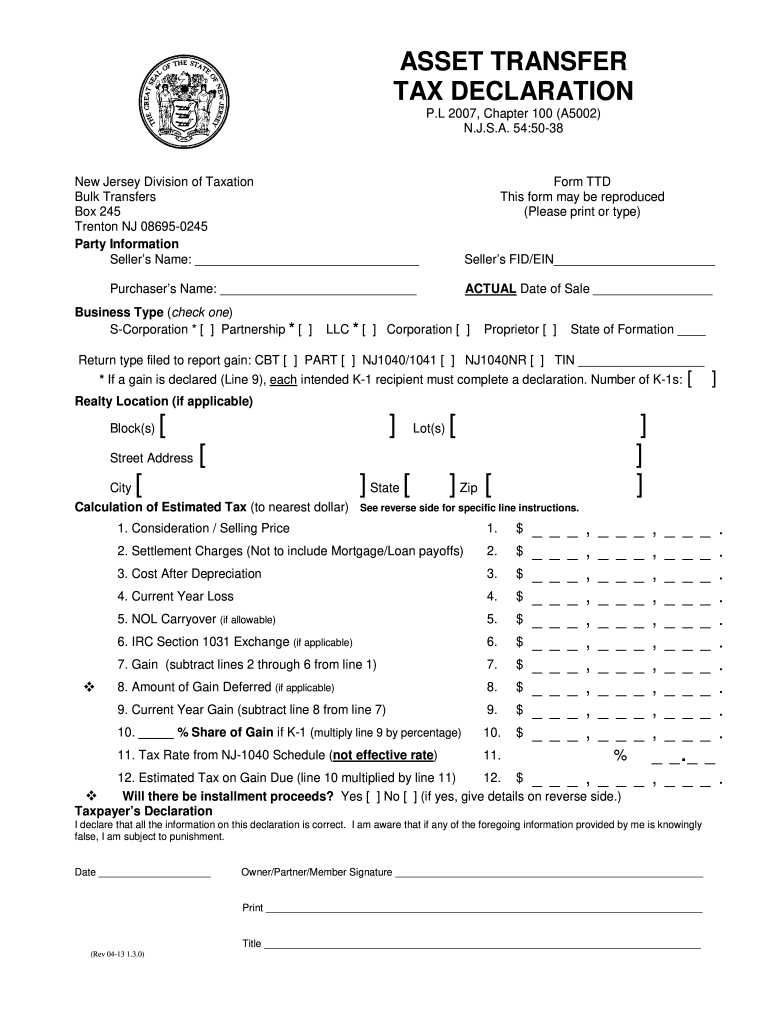
The Asset Transfer Tax Declaration form is a crucial document for reporting the transfer of business assets and calculating any associated tax obligations. This guide will help you complete the form online with clear, step-by-step instructions tailored to your needs.
Follow the steps to complete the Asset Transfer Tax Declaration form.
- Click ‘Get Form’ button to obtain the Asset Transfer Tax Declaration and open it in your preferred online editor.
- Enter the seller’s name in the designated field, followed by their Federal Identification Number (FID) or Employer Identification Number (EIN). Next, input the purchaser’s name and the actual date of sale.
- Select the business type by checking the appropriate box: S-Corporation, Partnership, LLC, Corporation, or Proprietor. Indicate the state of formation in the provided space.
- Choose the return type that will be filed to report the gain by checking the corresponding box for CBT, PART, NJ1040/1041, or NJ1040NR. Fill in the Taxpayer Identification Number (TIN) if applicable.
- Provide the realty location, including the block and lot numbers, as well as the street address, city, state, and zip code, if applicable.
- Fill in the estimated tax calculation fields: start with the selling price or consideration in line 1. For line 2, enter the total settlement charges, excluding mortgage or loan payoffs.
- Complete lines 3 to 9 based on your property’s financial details. Ensure you enter accurate amounts for cost after depreciation, current year loss, NOL carryover, and any applicable IRC Section 1031 Exchange.
- Calculate the current year gain by subtracting the deferred amount (if applicable) from the initial gain you computed. Input the gain share if K-1 recipients are involved.
- Enter the tax rate from the NJ-1040 schedule and calculate the estimated tax on the gain due by multiplying line 10 by line 11.
- Indicate whether there will be installment proceeds by checking yes or no. If you selected yes, provide additional details on the reverse side of the form.
- Review the taxpayer’s declaration statement carefully. Ensure all information is accurate, and sign and date the form as the owner, partner, or member. Print your name and title in the provided spaces.
- Once all fields are completed, save your changes, and download the form for your records. Consider printing or sharing the form as necessary.
Start filling out your Asset Transfer Tax Declaration online today to ensure compliance and accuracy.
Experience a faster way to fill out and sign forms on the web. Access the most extensive library of templates available.
Related content
Both the seller and purchaser of a group of assets that makes up a trade or business must...
There are numerous tax related aspects to consider when transferring assets. Some tax...
This section identifies the real estate to be transferred. Com- plete fully, including the...
Get answers to your most pressing questions about US Legal Forms API.
Is a transfer of assets taxable?
Yes, a transfer of assets can be taxable, depending on the nature of the transfer and applicable tax laws. Tax liabilities may arise from capital gains or transfer taxes, which vary by jurisdiction. To ensure compliance and accurate calculations, rely on an Asset Transfer Tax Declaration to outline the necessary information regarding the transaction.
What is considered a transfer of assets?
A transfer of assets includes any transaction where ownership of an item, property, or right is passed from one party to another. This can involve selling, gifting, or exchanging assets. To properly document these changes, consider utilizing an Asset Transfer Tax Declaration, which helps clarify the terms and tax responsibilities involved.
Is a transfer of assets reportable?
Yes, a transfer of assets is generally reportable, especially if it involves significant financial implications or changes in asset ownership. This requirement helps regulatory bodies monitor transactions and ensure compliance with tax laws. Completing an Asset Transfer Tax Declaration accurately can simplify this reporting process.
How important is a tax declaration in the Philippines?
In the Philippines, a tax declaration is essential for accurately reporting income, property, and transactions to the Bureau of Internal Revenue. This document supports legal ownership and ensures compliance with tax obligations. Consequently, utilizing the correct Asset Transfer Tax Declaration can streamline this reporting process.
What is transfer of assets in income tax?
Transfer of assets in income tax refers to the procedure of moving ownership of property or rights from one individual or entity to another. This transfer can have tax implications for both the sender and receiver. To navigate these complexities, an accurate Asset Transfer Tax Declaration is crucial to determine any potential tax liabilities.
What is the purpose of asset declaration?
The purpose of asset declaration is to provide transparency regarding an individual's or entity's financial situation. It helps authorities assess an individual’s wealth, determine tax liabilities, and prevent financial discrepancies. For those preparing an Asset Transfer Tax Declaration, a clear and complete declaration can facilitate legitimate financial dealings and compliance with regulatory requirements.
How to file an asset declaration?
Filing an asset declaration requires a few key steps. First, fill out the asset declaration form with accurate details about your property and finances. Once completed, you may need to submit the form to your local tax authority or the relevant agency responsible for asset declarations in your state. Utilizing resources from US Legal Forms can streamline this process and help ensure compliance with the necessary legal standards.
How to fill an asset declaration form online?
Filling an asset declaration form online typically involves accessing a reliable legal document platform like US Legal Forms. Begin by selecting the appropriate form based on your state's requirements. After gathering your financial information, enter it into the form fields. Review your entries carefully before submitting your Asset Transfer Tax Declaration to ensure everything is accurate and comprehensive.
What is a bulk sale in NJ?
A bulk sale in New Jersey refers to the transfer of a significant portion of assets or inventory rather than a single sale. This often triggers specific tax obligations, including the need for an Asset Transfer Tax Declaration. It is essential to consult tax regulations or legal experts familiar with NJ laws to navigate this process effectively and ensure all requirements are fulfilled.
How to fill a declaration of assets and liabilities?
To fill a declaration of assets and liabilities, start by gathering all necessary documents that outline your financial situation. List your assets, such as real estate, vehicles, and bank accounts, alongside your liabilities, like loans and credit card debt. Utilizing a structured template, which can often be found on platforms like US Legal Forms, simplifies this process and ensures you don't miss any important details. Remember, accuracy is crucial for a valid Asset Transfer Tax Declaration.
Use professional pre-built templates to fill in and sign documents online faster. Get access to thousands of forms.
If you believe that this page should be taken down, please follow our DMCA take down process here.