How it works
  • Open form

    Open form follow the instructions

  • Easily sign form

    Easily sign the form with your finger

  • Share form

    Send filled & signed form or save

How to fill out the Conventional Mortgage Underwriting Checklist online

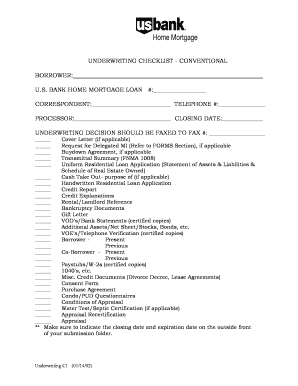
Completing the Conventional Mortgage Underwriting Checklist online is an essential step in securing a mortgage. This guide provides clear and detailed instructions to help you navigate each section of the form effectively.

Follow the steps to successfully complete the checklist.

  1. Click ‘Get Form’ button to obtain the checklist and open it in the appropriate editing environment.
  2. Begin by filling out the borrower section. Enter the U.S. bank home mortgage loan number, correspondent's name, and contact telephone number.
  3. Complete the processor's name and set the closing date for the transaction in the designated fields.
  4. Provide the fax number where the underwriting decision should be sent.
  5. If applicable, include a cover letter alongside other required documents such as the request for delegated mortgage insurance.
  6. Ensure the transmittal summary and uniform residential loan application are included and properly filled out.
  7. Detail any cash take-out purposes in the respective field, if applicable.
  8. Upload a handwritten residential loan application, credit report, and any necessary credit explanations.
  9. Provide rental/landlord references, bankruptcy documents, gift letters, and certified copies of bank statements and verification of deposits.
  10. Insert information regarding any additional assets or verification of employment, ensuring all documents are certified copies.
  11. Include paystubs, W-2s, and any additional income documents, ensuring they are certified.
  12. Mention any miscellaneous credit documents such as divorce decrees or lease agreements, if applicable.
  13. Attach any consent forms and purchase agreements needed for processing.
  14. Fill out condo or planned unit development questionnaires, appraisals, and any conditions related to the appraisal.
  15. If applicable, include water test and septic certification documents, followed by appraisal recertification documentation.
  16. Once all fields are completed accurately, ensure to indicate the closing date and expiration date on the outside front of your submission folder.
  17. Finally, save your changes, and choose to download, print, or share your completed checklist as needed.

Start completing your documents online today for a streamlined mortgage application process.

Get form

Experience a faster way to fill out and sign forms on the web. Access the most extensive library of templates available.

Related content

Underwriting Package Checklist Don't forget to...

The checklist includes: Loan Applicant Profile, Reservation Accepted, Income Worksheet...

Learn more
Fha Manual Underwriting Checklist

manual underwriting checklist is a critical tool for mortgage professionals and homebuyers...

Learn more
France's Encryption War Escalates: GrapheneOS...

Nov 26, 2025 — Strategic Questions: Can you maintain strong encryption while operating...

Learn more
Questions & Answers

Get answers to your most pressing questions about US Legal Forms API.

Contact support

What are the C's in finance?

The C's in finance encompass character, capacity, and collateral, each playing a critical role in underwriting decisions. Character assesses the borrower's reliability according to their credit report and payment history. Capacity evaluates the borrower's income and ability to manage debt, while collateral examines the value of the property at stake. These elements are essential when you utilize a Conventional Mortgage Underwriting Checklist for a more thorough evaluation.

In finance, the 3 C's typically refer to character, capacity, and capital. Character evaluates the borrower's creditworthiness based on their credit history and reliability in repaying loans. Capacity determines the individual's ability to repay based on their financial situation, and capital refers to the assets and resources a borrower can leverage. Understanding the 3 C's of finance can help you navigate your Conventional Mortgage Underwriting Checklist more effectively.

The 3 C's of mortgage underwriting, which are Collateral, Credit, and Capacity, are fundamental in assessing the risk of lending. Lenders analyze these areas to ensure borrowers can fulfill their payment obligations. Integrating your understanding of these elements into your use of the Conventional Mortgage Underwriting Checklist can make a significant difference in your application.

The 4 C's required for mortgage underwriting are Credit, Capacity, Capital, and Collateral. Each component plays a critical role in determining a borrower's eligibility for a mortgage. By addressing these factors, you can simplify your approach to the Conventional Mortgage Underwriting Checklist and better prepare yourself for the approval process.

The three C's of mortgage underwriting include Collateral, Credit, and Capacity. Each 'C' serves an essential role in evaluating the risk associated with a mortgage applicant. Understanding these components can help you navigate the Conventional Mortgage Underwriting Checklist more effectively, ensuring that you meet lender requirements.

Underwriters primarily evaluate the three Cs: Character, Capacity, and Capital. Character reflects the borrower's credit history and reliability, while Capacity assesses their ability to make repayments. Capital indicates the financial resources that the borrower is willing to invest. Understanding these concepts will enhance your familiarity with the Conventional Mortgage Underwriting Checklist, making your application stronger.

When writing a letter of explanation for a mortgage underwriter, begin by clearly stating the purpose of the letter. Provide context for any discrepancies in your financial history, such as gaps in income or recent credit inquiries. Use a professional tone, and ensure your letter complements the Conventional Mortgage Underwriting Checklist by answering potential underwriter questions. This transparency can greatly influence the approval outcome.

The 3 Cs of conventional finance underwriting are Character, Capacity, and Capital. These components help underwriters evaluate the risk associated with lending to borrowers. By understanding these factors, you can better prepare your documentation to align with the Conventional Mortgage Underwriting Checklist. It simplifies your journey toward mortgage approval.

The 5 Cs of credit underwriting include Character, Capacity, Capital, Collateral, and Conditions. Together, these components help assess a borrower’s creditworthiness. Understanding these elements enhances your knowledge of the Conventional Mortgage Underwriting Checklist. This knowledge can streamline your mortgage process and improve your chances of approval.

About 8% of mortgage loans are denied in the underwriting process, so you've got about a 1 in 12 chance of having your mortgage denied after it once looked good enough to be approved.

Get This Form Now!

Use professional pre-built templates to fill in and sign documents online faster. Get access to thousands of forms.

If you believe that this page should be taken down, please follow our DMCA take down process here.

Get Conventional Mortgage Underwriting Checklist