Loading

Open form follow the instructions

Easily sign the form with your finger

Send filled & signed form or save
How to fill out the Family Empowerment Scale online
This guide provides comprehensive instructions for completing the Family Empowerment Scale online. It aims to empower users by offering clear and supportive steps tailored to your needs.
Follow the steps to fill out the Family Empowerment Scale effectively.
- Press the ‘Get Form’ button to acquire the Family Empowerment Scale and open it in the designated online editor.
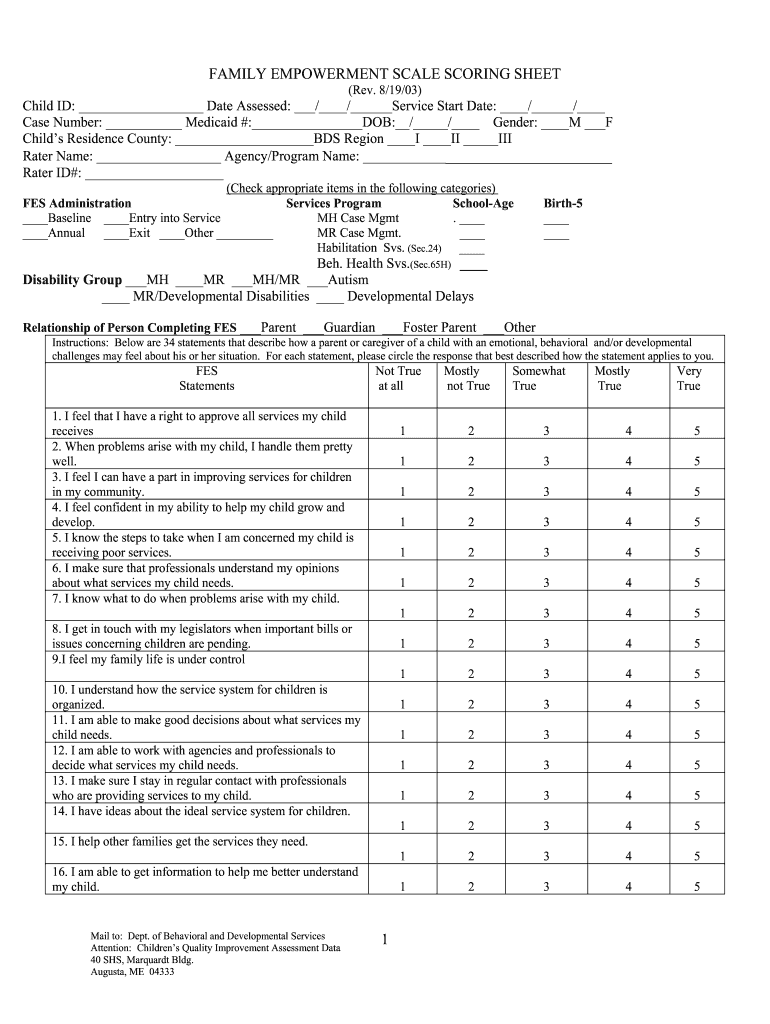
- Begin by filling in the Child ID and Date Assessed fields accurately. These identifiers help track the assessment process for your child.
- Complete the service details, including the Case Number, Medicaid Number, and Date of Birth. Ensure you also indicate the child's Gender and Residence County.
- Next, provide the information for the Rater. Record your name, Agency/Program Name, and Rater ID. This helps in identifying who has completed the assessment.
- Select the appropriate options for the FES Administration category. Check the boxes that correspond with the child’s service status, such as Baseline or Annual, ensuring accurate categorization.
- Indicate the specific Disabilities Group relevant to your child by selecting the appropriate option, such as Mental Health (MH) or Autism.
- In the relationship section, indicate your role by selecting from the options provided, ensuring to reflect your correct relationship to the child.
- Proceed to the main section containing the 34 statements. For each statement, circle the response that best describes your feelings regarding each statement.
- Once all items have been answered, review your responses for accuracy. Make edits if necessary to ensure that your feedback reflects your feelings correctly.
- Finally, save your changes, and you may have the option to download, print, or share the completed Family Empowerment Scale as needed.
Complete and submit your Family Empowerment Scale online to ensure your child's needs are met.
Experience a faster way to fill out and sign forms on the web. Access the most extensive library of templates available.
Related content
by M Kageyama · 2016 · Cited by 34 — The Family Empowerment Scale (FES) was originally...
The Family Empowerment Scale (FES) is a research tool with questions about family, child...
• Hard to scale for large groups • Demands patience and communication skills from...
Get answers to your most pressing questions about US Legal Forms API.
What is the family relationship scale?
The family relationship scale evaluates the quality and strength of relationships among family members. This scale considers factors like communication, trust, and support, which are essential for healthy family dynamics. By incorporating the Family Empowerment Scale into this evaluation, families can enhance their interactions and emotional bonds. This leads to a more unified family environment where each member feels valued and supported.
What are the three levels of empowerment?
The three levels of empowerment often refer to individual, organizational, and community empowerment. Each level highlights different aspects of how empowerment operates within various contexts, including family dynamics. Focusing on these levels allows families to recognize how they can grow together while also fostering connections with broader systems. Utilizing the Family Empowerment Scale can help families navigate these levels more effectively.
What is the empowerment scale?
The empowerment scale is a tool that assesses an individual’s or group’s ability to make choices and effect change in their lives. In the context of families, the Family Empowerment Scale provides insights into how effectively families support each other's growth and autonomy. Using this scale can help families identify their needs and create actionable steps toward improvement. It offers a structured way to foster a more empowered family unit.
How do you measure empowerment?
Measuring empowerment involves assessing autonomy, decision-making, and resource access within a family system. Tools like the Family Empowerment Scale provide structured methodologies to evaluate these aspects effectively. By collecting data on family interactions, members can identify strengths and areas for development. This measurement is essential for growth and ensures that families work together towards a common goal.
What is the Menon empowerment scale?
The Menon empowerment scale is a specialized tool designed to measure empowerment in various contexts, including families. It emphasizes individual and collective decision-making roles within the family structure. By applying this scale, families can identify their levels of empowerment and work towards fostering a more supportive environment. Integration of this scale with the Family Empowerment Scale can provide deeper insights.
What is the family process scale?
The family process scale refers to a framework that assesses the dynamics and interactions within a family. It focuses on evaluating communication, problem-solving, and emotional support among family members. By utilizing the Family Empowerment Scale, families can better understand their processes and improve collaboration. This can lead to more harmonious relationships and greater collective strength.
What are the five levels of empowerment?
The Family Empowerment Scale identifies five levels of empowerment, which range from the most foundational to the most advanced. Each level reflects increasing independence and decision-making capabilities within a family unit. Understanding these levels helps families recognize their strengths and areas for growth. This process ultimately leads to enhanced family functioning and support.
What are the objectives of family empowerment?
Family Empowerment aims to strengthen parenting skills and prevent exacerbation of emotional problems in asylum-seeker families.
What is the definition of family empowerment?
These authors define empowerment as the perception that families have about their skills, degree of self-confidence, and knowledge about the care and development of their child with special needs, in order to achieve satisfactory family functioning.
What is Roger's empowerment Scale?
The Empowerment Scale was developed by Rogers et al. (1997) to measure personal empowerment among consumers of mental health services. It contains items on a four-point scale with response options from 1 “strongly agree” to 4 “strongly disagree”.
Use professional pre-built templates to fill in and sign documents online faster. Get access to thousands of forms.
If you believe that this page should be taken down, please follow our DMCA take down process here.