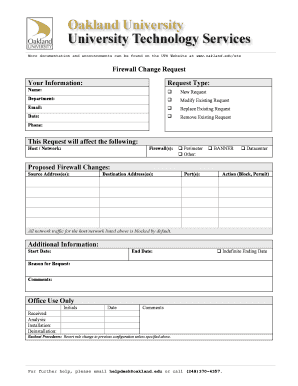
Ify Existing Request Email: Replace Existing Request Date: Remove Existing Request Phone: This Request will affect the following: Host / Network: Firewall(s): Perimeter Other: BANNER Datacenter Proposed Firewall Changes: Source Address(es): Destination Address(es): Port(s): Action (Block, Permit) All network traffic for the host/network listed above is blocked by default. Additional Information: Start Date: End Date: Indefinite Ending Date Reason.
Open form follow the instructions
Easily sign the form with your finger
Send filled & signed form or save
How to fill out the Firewall Request Form online
Completing a Firewall Request Form accurately is essential for effective network management. This guide will provide you with clear, step-by-step instructions to help you fill out the form online with ease.
Follow the steps to complete your Firewall Request Form successfully.
- Click ‘Get Form’ button to obtain the form and open it in the editor.
- Fill in your information. Provide your name, department, email, phone number, and the date. Ensure that the request type is selected based on your needs: 'New Request', 'Modify Existing Request', 'Replace Existing Request', or 'Remove Existing Request'.
- Indicate the host or network this request will affect. Select from the available options, including 'Perimeter', 'Datacenter', or specify 'Other'.
- List the proposed firewall changes. Specify the source address(es), destination address(es), and port(s) relevant to your request. Choose the action you want to take: 'Block' or 'Permit'.
- Fill in the additional information section. Enter the start date, end date, or select 'Indefinite Ending Date' if applicable. Provide a reason for your request in the corresponding field, and add any comments that may help clarify your need.
- For office use only, the initials and date will be filled by the appropriate personnel. Ensure that all necessary information for processing your request is accurate.
- Once all fields are filled out correctly, you can save your changes, download, print, or share the form as needed.
Complete your Firewall Request Form online today for a streamlined network management process.
Experience a faster way to fill out and sign forms on the web. Access the most extensive library of templates available.
Related content
Jun 21, 2007 — 3 Prioritization of Firewall Change Requests. The Firewall Change Request...
Firewall Change Request. Request Type: ❑. ❑. ❑. ❑. New Request. Modify Existing...
Date. Manager Name. Branch. Type of Device. Describe the need for this device. Date...
Get answers to your most pressing questions about US Legal Forms API.
How do I put a file in the firewall?
To put a file in the firewall, you typically need to establish a process that allows file transfer through secure means. First, consult your firewall settings or the relevant documentation. Utilizing a Firewall Request Form can clarify your intentions and help safeguard the transfer of files, ensuring compliance with your organization’s security policies.
How to raise a firewall request?
To raise a firewall request, complete the Firewall Request Form with all the required details about the access you need. Submitting this form allows the IT team to review your request and make informed decisions. This step ensures that your requirements are met while adhering to security protocols.
How to raise a firewall?
Raising a firewall typically refers to enhancing your network security by configuring or updating firewall settings. To do this, you should review existing policies and identify any gaps in security. Using a Firewall Request Form can help communicate your needs to administrators and facilitate the necessary changes to better protect your network.
How do I export firewall policy?
To export a firewall policy, you generally need to access the firewall management interface where your policies are configured. Look for the option that allows you to export settings or policies, and follow the prompts to create a file of the current configurations. By doing so, you ensure you have a backup, which can simplify future changes or help with compliance.
How to open a firewall request?
Opening a firewall request involves filling out a Firewall Request Form, which serves as a detailed account of your desired access. You should provide necessary information, including the type of request, any relevant documentation, and your contact details. This process is vital to ensure your request is processed efficiently and accurately.
How to give something firewall access?
To give something firewall access, you must complete a Firewall Request Form that details the access permissions needed. This form should include essential information, such as the application or service requiring access, and its intended use. Submitting this request helps network administrators evaluate the request and respond accordingly.
What is a firewall request?
A firewall request is a formal process used to obtain permission for specific network traffic to pass through a firewall. This request typically involves specifying the type of access needed and the reason for the request. By submitting a Firewall Request Form, users can ensure that their needs are addressed while maintaining network security.
What is a firewall used for?
A firewall is primarily used to protect networks from unauthorized access and threats. It ensures safe communication by filtering incoming and outgoing traffic based on predefined security rules. By implementing effective firewall measures, organizations can secure sensitive data and enhance their overall cybersecurity posture.
What is a firewall change request?
A firewall change request is a document that initiates modifications to existing firewall settings. It provides clear details about the proposed changes, rationale, and any associated risks. By submitting a Firewall Request Form, you formally request the approval needed to proceed with these changes within your network infrastructure.
What are the 4 firewall rules?
The four common firewall rules include: allow, deny, log, and reject. The allow rule lets specific traffic pass through, while the deny rule blocks it. Logging captures information about the traffic for analysis, and the reject rule communicates back to the sender that their traffic has been blocked. Understanding these rules is crucial when completing your Firewall Request Form.
Use professional pre-built templates to fill in and sign documents online faster. Get access to thousands of forms.
If you believe that this page should be taken down, please follow our DMCA take down process here.