Open form follow the instructions
Easily sign the form with your finger
Send filled & signed form or save
How to fill out the admission orders online
Filling out admission orders online is a crucial step in ensuring effective patient care in the psychiatric setting. This guide provides a clear and structured approach to correctly complete the admission orders form, making the process straightforward for all users.
Follow the steps to accurately complete the admission orders form
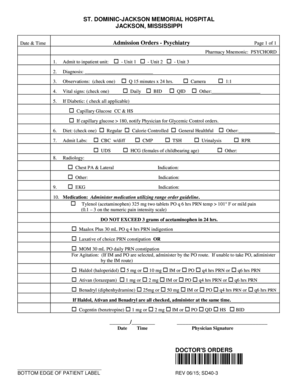
- Press the ‘Get Form’ button to access the admission orders form and open it in the online editor.
- Enter the date and time at the top of the form to document when the admission occurs.
- Indicate the unit into which the patient will be admitted by selecting from Unit 1, Unit 2, or Unit 3.
- In the diagnosis section, fill in the patient's diagnosis clearly.
- For observations, select the frequency of observations by checking either 'Q 15 minutes x 24 hrs' or another option if applicable.
- Indicate the required frequency for vital signs by selecting either 'Daily' or 'BID'.
- If the patient is diabetic, check all appropriate options that apply to the patient’s care, including specific testing and monitoring needs.
- Specify the diet required for the patient by selecting one of the available options.
- List all necessary admit labs, ensuring to check pertinent boxes for tests such as CBC w/diff, CMP, TSH, or others as needed.
- Indicate any required radiology procedures along with the respective indications.
- Administer medication as per the guidelines outlined, selecting medications and dosages as needed while ensuring to comply with specific instructions.
- Finally, include your signature, date, and time at the bottom of the form to authenticate the admission orders.
- Once all sections are completed, save your changes, and download or print the form if necessary, ensuring a copy is available for records.
Complete the admission orders form online to ensure efficient patient management today.
Experience a faster way to fill out and sign forms on the web. Access the most extensive library of templates available.
Related content
Jan 30, 2014 — The order to admit as an inpatient (“practitioner order”) is a...
Admission orders include: service, diagnosis, condition, allergies, vital signs, activity...
This section includes example Hospital Admission Orders, Physician Orders, and pertinent...
Get answers to your most pressing questions about US Legal Forms API.
What should be documented on admission?
Documentation on admission should include patient demographics, medical history, presenting complaints, and initial examination findings. Additionally, any specific Admission Orders, including diagnostic tests and treatment plans, must be noted. Proper documentation is crucial for effective communication among the healthcare team. This information serves as the foundation for ongoing patient care.
What is the most common admissions type offered by colleges?
The most common type of admission offered by colleges is regular admission, usually with specific deadlines for application submission. Colleges may also provide early admission options for students eager to secure spots. Clear admission guidelines help prospective students understand what to prepare for their applications. Utilizing resources like uslegalforms can aid in organizing necessary documentation.
How to write a doctor's order?
When writing a doctor's order, it's essential to include patient identification and a clear description of the treatment or medication needed. Be specific about dosage, frequency, and duration to eliminate confusion. Incorporating detailed Admission Orders within these notes ensures that all medical staff understand the expectations for patient care. This clarity is vital for patient safety.
What are the four types of patients?
The four types of patients are acute, chronic, critical, and transitional patients. Acute patients require immediate care during sudden health changes, while chronic patients need ongoing management for long-term conditions. Critical patients present life-threatening situations that demand urgent attention, and transitional patients are those moving from one care setting to another. Tailored Admission Orders are crucial across all patient types to deliver suitable care.
What are the 4 types of admissions?
The four primary types of admissions are elective, emergency, direct, and transfer admissions. Elective admissions occur when treatment is planned in advance, while emergency admissions happen during unexpected health events. Direct admissions allow patients to enter a facility without prior assessment, and transfer admissions involve moving a patient from one facility to another. Clear Admission Orders are essential for each type to facilitate smooth transitions.
What is the type of admission?
Types of admission can vary based on the patient's needs and circumstances. Common types include elective admissions, urgent admissions, and emergency admissions. Each type of admission requires different Admission Orders to address the urgency and nature of care needed. Recognizing the type allows for more efficient management of patient care.
How to do an admission note?
To write an admission note, start with a clear patient identification, including demographics and medical history. Following this, document the reason for admission and any relevant examination findings. Finally, include a section for Admission Orders, which outlines the necessary treatments and evaluations for the patient. This structured approach helps ensure comprehensive care.
What are the 4 types of patient assignment?
The four types of patient assignment include primary care, specialty care, hospital admissions, and outpatient care. Each type of assignment has its specific procedures and requirements. Understanding these categories helps ensure proper Admission Orders, tailored to each patient's needs. This classification allows healthcare providers to allocate resources effectively.
What are the 4 types of patient assignments?
The four types of patient assignments include primary care, team-based care, cross-functional assignments, and specialized care. Each type plays a vital role in optimizing patient management and resource allocation. Understanding these assignments can enhance workflow and improve patient outcomes. Clear Admission Orders are essential for effective patient transitions.
What is the pneumonic for admission orders?
A common mnemonic for remembering the components of Admission Orders is 'MASHES,' which stands for Medications, Assessments, Standard orders, History, Education, and Social aspects. This tool can assist healthcare providers in ensuring they cover all critical aspects during patient admission. Utilizing a systematic approach to Admission Orders enhances care consistency.
Use professional pre-built templates to fill in and sign documents online faster. Get access to thousands of forms.
If you believe that this page should be taken down, please follow our DMCA take down process here.