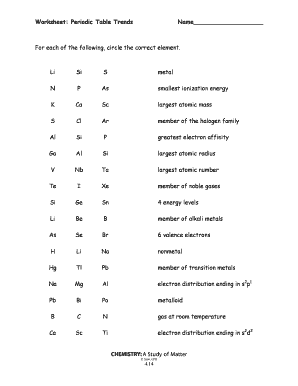
Worksheet: Periodic Table TrendsName For each of the following, circle the correct element.LiSiSmetalNPAssmallest ionization energyKCaSclargest atomic massSClArmember of the halogen familyAlSiPgreatest.

How it works
  • Open form

    Open form follow the instructions

  • Easily sign form

    Easily sign the form with your finger

  • Share form

    Send filled & signed form or save

How to fill out the Periodic Table Trends Worksheet online

The Periodic Table Trends Worksheet is a valuable resource for understanding key concepts in chemistry. This guide provides clear and supportive instructions to help you complete the worksheet effectively and accurately.

Follow the steps to fill out the Periodic Table Trends Worksheet online

  1. Press the ‘Get Form’ button to access the Periodic Table Trends Worksheet and open it in your preferred online document editor.
  2. Begin filling in your name at the top of the worksheet.
  3. For each element listed, read the associated description carefully before selecting the correct answer. Circle the appropriate element based on the indicated trend.
  4. Continue through the worksheet, making sure to address each element and its respective trend as described.
  5. Review your selections to ensure accuracy, and make any necessary adjustments.
  6. Once you have completed the worksheet, you can save your changes, download the document, print it for your records, or share it as needed.

Start completing your Periodic Table Trends Worksheet online today!

Get form

Experience a faster way to fill out and sign forms on the web. Access the most extensive library of templates available.

Related content

Worksheet On Periodic Trends

Worksheet on periodic trends is an essential educational tool for students and educators...

Learn more
Worksheet On Periodic Trends

Worksheet on periodic trends is an essential educational tool for students and educators...

Learn more
Monitoring and Remediation Optimization System...

Mar 2, 2006 — 1) DETERMINE FREQUENCY BY RECENT TRENDS. Sampling frequency can be...

Learn more
Questions & Answers

Get answers to your most pressing questions about US Legal Forms API.

Contact support

How do you identify trends on the periodic table?

Moving left to right on the periodic table causes an increase in atomic number (number of protons) as well as electron affinity and electronegativity. Atomic radius, however, will decrease when moving left to right. As more protons are added to the nucleus, they have a stronger attraction to the electrons.

Atomic size increases down a group. The increasing trend occurs because as you go down a group more energy levels cause the atom to be larger. Shielding also affects the size; the electrons in lower energy levels cause less pull to those electrons outside of it.

Down a group, the number of energy levels (n) increases, so there is a greater distance between the nucleus and the outermost orbital. This results in a larger atomic radius.

Trend-wise, as one moves from left to right across a period in the modern periodic table, the ionization energy increases as the nuclear charge increases and the atomic size decreases. The decrease in the atomic size results in a more potent force of attraction between the electrons and the nucleus.

Periodic Trends: Electronegativity, Ionization Energy, Atomic Radius - TUTOR HOTLINE.

Major trends are electronegativity, ionization energy, electron affinity, atomic radius, and metallic character. The existence of these trends is due to the similarity in atomic structure of the elements in their group families or periods and because of the periodic nature of elements.

There are four main periodic trends: electronegativity, atomic size, ionization energy, and electron affinity.

Get This Form Now!

Use professional pre-built templates to fill in and sign documents online faster. Get access to thousands of forms.

If you believe that this page should be taken down, please follow our DMCA take down process here.

Get Periodic Table Trends Worksheet