Loading
Form preview
  • US Legal Forms
  • Form Library
  • More Forms
  • More Multi-State Forms
  • Blower Door Test Report 2020

Get Blower Door Test Report 2020-2026

How it works

  1. Open form

    Open form follow the instructions

  2. Easily sign form

    Easily sign the form with your finger

  3. Share form

    Send filled & signed form or save

How to fill out the Blower Door Test Report online

This guide provides clear instructions on filling out the Blower Door Test Report online, ensuring that users understand the necessary components and requirements. Completing this report accurately is essential for compliance with the Michigan Residential Code and for successful approval by the Building Official.

Follow the steps to effectively complete your Blower Door Test Report online.

  1. Click ‘Get Form’ button to obtain the Blower Door Test Report and open it in the online editor.
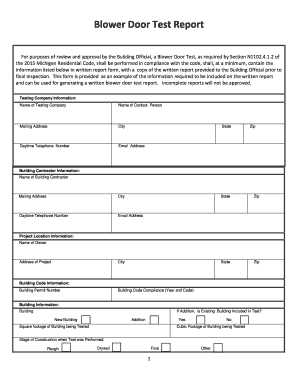
  2. Fill in the testing company information, including the name of the testing company, contact person's name, mailing address, city, daytime telephone number, email address, state, and zip.
  3. Provide the building contractor information, which includes the name of the building contractor, mailing address, city, daytime telephone number, email address, state, and zip.
  4. Complete the project location information by entering the name of the owner, the address of the project, and the city.
  5. Input building code information, which consists of the building permit number and compliance with the applicable building code year and code.
  6. Specify the building information by indicating whether the structure is new or an addition. Enter the square footage and cubic footage of the building being tested.
  7. Select the stage of construction when the test was performed by choosing from available options: Rough, Drywall, Final, or Other.
  8. Enter test and equipment information, including the manufacturer and model of the test equipment used, the date of the last calibration, and the name of the person or organization that performed the calibration.
  9. Include tester certification details and input the test standard and procedure used, including any deviations from standard testing practices and reasons for those deviations.
  10. Record the test conclusion and results, including the signature of the certified tester and the date of the test.
  11. Review all filled sections for accuracy, and once everything is complete, save your changes, download the report, or print it for sharing with the relevant parties.

Take the steps to complete your Blower Door Test Report online today.

Get form

Experience a faster way to fill out and sign forms on the web. Access the most extensive library of templates available.
Get form

Related content

Blower Door Tests
Home energy professionals use a blower door as a diagnostic tool to determine how much air...
Learn more
Residential Building Air Leakage (Blower Door)...
Results shall be reported as Air Changes per Hour at 50 Pascals (ACH50) and shall be...
Learn more
TECHNICAL REPORT
Commercial HVAC leak testing blower door equipment often includes a control module that...
Learn more

Related links form

Employment Application Pet Extreme 00381470DOC Walmart Law Enforcement Brandon Gieselman Memorial 4-H And FFA Scholarship Application - Thcf Patient Health Questionnaire PHQ-9 Patient Name Date

Questions & Answers

Get answers to your most pressing questions about US Legal Forms API.

Contact support

Passing a blower door test is achievable with proper preparation and sealing techniques. Many homeowners find success by identifying air leaks and making necessary corrections ahead of time. By taking these steps, you increase your chances of receiving a favorable Blower Door Test Report.

A good score on a blower door test generally falls between 0.3 to 1.0 air changes per hour, but this can vary based on the building type. Lower scores indicate better air tightness, which contributes to energy efficiency and comfort. Consult your Blower Door Test Report to understand how your scores compare against accepted standards.

The basic formula used in a blower door test calculates the air change rate, expressed as air changes per hour (ACH). This is determined by multiplying the fan flow rate by a correction factor and dividing by the building's volume. Your Blower Door Test Report will outline these calculations clearly and concisely.

During a blower door test, a technician uses a specialized fan to measure the amount of air that escapes from your building. They will set the fan to create a slight pressure difference between the inside and outside. This process helps determine how well your building is sealed, and the results will be detailed in your Blower Door Test Report.

To pass a blower test, concentrate on sealing any noticeable air leaks before the test begins. Consider using weatherstripping on doors and windows, caulking gaps, and insulating your ducts properly. The tighter your home or building is, the more favorable your Blower Door Test Report will be.

Passing a blower door test requires ensuring your structure is airtight. First, identify and seal any leaks in your building envelope, including windows, doors, and ductwork. By correcting these leaks, you can achieve a lower air change rate, which will reflect positively in your Blower Door Test Report.

The standard blower door test involves using a fan to measure the airtightness of buildings by creating a controlled pressure difference. Technicians follow specific protocols, ensuring consistent and reliable results. The outcome, compiled in your Blower Door Test Report, helps homeowners, builders, and inspectors assess airflow and energy efficiency.

To calculate the blower door test, you need to set up the equipment properly and seal all openings in the building. The blower then measures airflow at a set pressure, which you can find in your Blower Door Test Report. This calculated airflow reveals how well your building retains air, guiding your improvement efforts.

A good ACH, or Air Changes per Hour score, is generally considered to be between 0.35 and 0.5 for residential buildings. This range suggests that your home is adequately sealed, enhancing comfort and energy efficiency. You can find your ACH score detailed in your Blower Door Test Report, giving you a clear picture of air circulation within your home.

A good blower door test indicates that your building is energy efficient, with minimal air leakage. Typically, values of CFM50 below 1,000 for residential buildings demonstrate a strong performance. A detailed Blower Door Test Report will highlight these values, guiding your energy-saving initiatives.

Get This Form Now!

Use professional pre-built templates to fill in and sign documents online faster. Get access to thousands of forms.
Get form
If you believe that this page should be taken down, please follow our DMCA take down processhere.

Industry-leading security and compliance

US Legal Forms protects your data by complying with industry-specific security standards.
  • In businnes since 1997
    25+ years providing professional legal documents.
  • Accredited business
    Guarantees that a business meets BBB accreditation standards in the US and Canada.
  • Secured by Braintree
    Validated Level 1 PCI DSS compliant payment gateway that accepts most major credit and debit card brands from across the globe.
Get Blower Door Test Report
Get form
  • Adoption
  • Bankruptcy
  • Contractors
  • Divorce
  • Home Sales
  • Employment
  • Identity Theft
  • Incorporation
  • Landlord Tenant
  • Living Trust
  • Name Change
  • Personal Planning
  • Small Business
  • Wills & Estates
  • Packages A-Z
  • Affidavits
  • Bankruptcy
  • Bill of Sale
  • Corporate - LLC
  • Divorce
  • Employment
  • Identity Theft
  • Internet Technology
  • Landlord Tenant
  • Living Wills
  • Name Change
  • Power of Attorney
  • Real Estate
  • Small Estates
  • Wills
  • All Forms
  • Forms A-Z
  • Form Library
  • Legal Hub
  • About Us
  • Help Portal
  • Legal Resources
  • Blog
  • Affiliates
  • Contact Us
  • Delete My Account
  • Site Map
  • Industries
  • Forms in Spanish
  • Localized Forms
  • State-specific Forms
  • Forms Kit
  • Real Estate Handbook
  • All Guides
  • Notarize
  • Incorporation services
  • For Consumers
  • For Small Business
  • For Attorneys
  • USLegal
  • FormsPass
  • pdfFiller
  • signNow
  • altaFlow
  • DocHub
  • Instapage
Form Packages
  • Adoption
  • Bankruptcy
  • Contractors
  • Divorce
  • Home Sales
  • Employment
  • Identity Theft
  • Incorporation
  • Landlord Tenant
  • Living Trust
  • Name Change
  • Personal Planning
  • Small Business
  • Wills & Estates
  • Packages A-Z
Form Categories
  • Affidavits
  • Bankruptcy
  • Bill of Sale
  • Corporate - LLC
  • Divorce
  • Employment
  • Identity Theft
  • Internet Technology
  • Landlord Tenant
  • Living Wills
  • Name Change
  • Power of Attorney
  • Real Estate
  • Small Estates
  • Wills
  • All Forms
  • Forms A-Z
  • Form Library
Customer Service
  • Legal Hub
  • About Us
  • Help Portal
  • Legal Resources
  • Blog
  • Affiliates
  • Contact Us
  • Delete My Account
  • Site Map
  • Industries
  • Forms in Spanish
  • Localized Forms
  • State-specific Forms
  • Forms Kit
Legal Guides
  • Real Estate Handbook
  • All Guides
Prepared for you
  • Notarize
  • Incorporation services
Our Customers
  • For Consumers
  • For Small Business
  • For Attorneys
Our Sites
  • USLegal
  • FormsPass
  • pdfFiller
  • signNow
  • altaFlow
  • DocHub
  • Instapage
Social Media
Call us now toll free:
+1 833 426 79 33
As seen in:
© Copyright 1999-2026 airSlate Legal Forms, Inc. 3720 Flowood Dr, Flowood, Mississippi 39232
  • Your Privacy Choices
  • Terms of Service
  • Privacy Notice
  • Content Takedown Policy
  • Bug Bounty Program