Loading
Form preview
  • US Legal Forms
  • Form Library
  • More Forms
  • More Uncategorized Forms
  • Solo And Ensemble Adjudication Form

Get Solo And Ensemble Adjudication Form

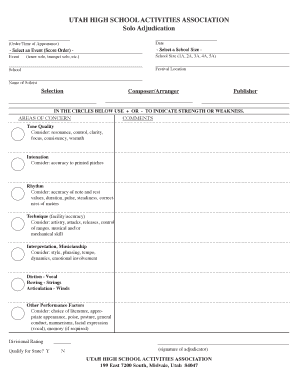
Vent School Size (1A, 2A, 3A, 4A, 5A) (tenor solo, trumpet solo, etc.) Festival Location School Name of Soloist Selection Composer/Arranger Publisher IN THE CIRCLES BELOW USE + OR - TO INDICATE STRENGTH OR WEAKNESS. AREAS OF CONCERN Tone Quality Consider: resonance, control, clarity, focus, consistency, warmth COMMENTS Intonation Consider: accuracy to printed pitches Rhythm Consider: accuracy of note and rest values, duration, pulse, steadiness, correctness of meters Technique (faci.

How it works

  1. Open form

    Open form follow the instructions

  2. Easily sign form

    Easily sign the form with your finger

  3. Share form

    Send filled & signed form or save

How to fill out the Solo And Ensemble Adjudication Form online

Completing the Solo And Ensemble Adjudication Form online is a crucial step for participants and adjudicators in ensuring a smooth adjudication process. This guide provides a clear, step-by-step approach to walk you through filling out the form effectively.

Follow the steps to accurately complete the form online.

  1. Press the ‘Get Form’ button to access the form and open it in your preferred editing software.
  2. Begin by entering the date of the adjudication. This should reflect the actual date the performance takes place.
  3. Select the order and time of appearance for the performance from the options provided in the designated field.
  4. Choose the appropriate school size from the dropdown list, including options such as 1A, 2A, 3A, 4A, and 5A.
  5. Select the event related to the performance, specifying if it is a tenor solo, trumpet solo, or another type.
  6. Provide the festival location where the adjudication is taking place, ensuring accuracy for proper documentation.
  7. Fill in the name of the soloist, clearly stating the individual's full name for identification purposes.
  8. Enter the selection being performed, including the name of the piece to be evaluated.
  9. List the composer or arranger of the piece and include the publisher's name in the respective fields.
  10. In the designated circles, use '+' or '-' to indicate the strengths or weaknesses in each of the performance areas, such as tone quality and intonation.
  11. Provide detailed comments for each performance area, guiding the evaluative feedback on tone quality, rhythm, technique, and interpretation.
  12. Mark the divisional rating box and answer whether the participant qualifies for state by selecting 'Y' for yes or 'N' for no.
  13. Finally, ensure that the adjudicator's signature is included to validate the evaluation before saving, downloading, printing, or sharing the completed form.

Complete your Solo And Ensemble Adjudication Form online today to ensure a successful adjudication process.

Get form

Experience a faster way to fill out and sign forms on the web. Access the most extensive library of templates available.
Get form

Related content

Final Music IAAP Implementation Guide
The NYSSMA Solo Adjudication can be used to complete the IAAP Mandatory Portfolio ... An...
Learn more
WHITE COUNTY 4-H MUSIC PROJECT RECITAL ...
RECITAL ADJUDICATION FORM. PIANO-HARP SOLO/ENSEMBLE. CONTESTANT...
Learn more
Katzelia/Lore
Oct 12, 2025 —...
Learn more

Related links form

The Role Of Ethiopian Orthodox Church In The Development Of Adult Bb - Etd Aau Edu Hjr192 Word Sense Disambiguation Using Semantic Similarity For Query Bb - Etd Aau Edu Thesis On Ethiotelecom Form

Questions & Answers

Get answers to your most pressing questions about US Legal Forms API.

Contact support

Typically, a solo and ensemble piece should last between 5 to 15 minutes, although this can vary based on the specific event rules. It is important to check the guidelines provided for each competition or festival. Keeping track of time is crucial, and the Solo And Ensemble Adjudication Form will often require judges to note performance durations.

The stages of adjudication generally include preparation, observation, scoring, and feedback. Initially, prepare by understanding the criteria for evaluation. During the observation stage, carefully watch the performance, then use the Solo And Ensemble Adjudication Form to score and provide insights at the end.

To perform adjudication effectively, focus on clear criteria and objective analysis. Begin by familiarizing yourself with the performance standards and the Solo And Ensemble Adjudication Form. This form will guide your observations and help you provide constructive feedback that benefits the performers.

The point of solo and ensemble is to showcase individual talent and group synergy in performance arts. It allows participants to develop their skills and receive constructive feedback from a qualified judge. Utilizing a Solo And Ensemble Adjudication Form can enhance the evaluation process, ensuring that every performer receives helpful insights.

To adjudicate a debate properly, focus on clarity, fairness, and understanding. Begin by assessing the arguments presented by both sides and then evaluate their effectiveness based on criteria such as logic, evidence, and rebuttal. Using a Solo And Ensemble Adjudication Form can streamline this process by providing a structured way to record your observations and scores.

The three types of adjudication include performance, competition, and educational adjudication. Each type serves a different purpose but often utilizes the same framework provided by the Solo And Ensemble Adjudication Form. Performance adjudication focuses on quality, competition adjudication emphasizes ranking, and educational adjudication aims to provide guidance and learning opportunities. Understanding these types can improve your judging skills.

The steps of adjudication generally involve planning, recording, assessment, and feedback. Start by reviewing the Solo And Ensemble Adjudication Form to understand required metrics. During the performance, take detailed notes to assess each element. Afterward, provide constructive feedback that helps performers improve their skills.

The adjudication process typically includes five key steps: preparation, observation, evaluation, feedback, and follow-up. First, you prepare by reviewing the Solo And Ensemble Adjudication Form. Next, observe the performance closely, evaluate against the established criteria, and provide feedback. Finally, consider following up with performers to discuss their development and encourage future growth.

Judging solo and ensemble performances starts with a clear understanding of the criteria specified in the Solo And Ensemble Adjudication Form. Evaluate aspects such as technique, expression, and ensemble cohesiveness. It's important to listen critically and provide fair, insightful feedback that helps performers understand their areas for improvement. Your role is crucial in guiding their musical journey.

Adjudicating a set piece requires a thorough understanding of the performance standards outlined in the Solo And Ensemble Adjudication Form. Begin by listening attentively to the performance, noting the strengths and weaknesses. Provide constructive feedback that encourages improvement while remaining objective. This balanced approach helps performers grow and excel in their craft.

Get This Form Now!

Use professional pre-built templates to fill in and sign documents online faster. Get access to thousands of forms.
Get form
If you believe that this page should be taken down, please follow our DMCA take down processhere.

Industry-leading security and compliance

US Legal Forms protects your data by complying with industry-specific security standards.
  • In businnes since 1997
    25+ years providing professional legal documents.
  • Accredited business
    Guarantees that a business meets BBB accreditation standards in the US and Canada.
  • Secured by Braintree
    Validated Level 1 PCI DSS compliant payment gateway that accepts most major credit and debit card brands from across the globe.
Get Solo And Ensemble Adjudication Form
Get form
  • Adoption
  • Bankruptcy
  • Contractors
  • Divorce
  • Home Sales
  • Employment
  • Identity Theft
  • Incorporation
  • Landlord Tenant
  • Living Trust
  • Name Change
  • Personal Planning
  • Small Business
  • Wills & Estates
  • Packages A-Z
  • Affidavits
  • Bankruptcy
  • Bill of Sale
  • Corporate - LLC
  • Divorce
  • Employment
  • Identity Theft
  • Internet Technology
  • Landlord Tenant
  • Living Wills
  • Name Change
  • Power of Attorney
  • Real Estate
  • Small Estates
  • Wills
  • All Forms
  • Forms A-Z
  • Form Library
  • Legal Hub
  • About Us
  • Help Portal
  • Legal Resources
  • Blog
  • Affiliates
  • Contact Us
  • Delete My Account
  • Site Map
  • Industries
  • Forms in Spanish
  • Localized Forms
  • State-specific Forms
  • Forms Kit
  • Real Estate Handbook
  • All Guides
  • Notarize
  • Incorporation services
  • For Consumers
  • For Small Business
  • For Attorneys
  • USLegal
  • FormsPass
  • pdfFiller
  • signNow
  • altaFlow
  • DocHub
  • Instapage
Form Packages
  • Adoption
  • Bankruptcy
  • Contractors
  • Divorce
  • Home Sales
  • Employment
  • Identity Theft
  • Incorporation
  • Landlord Tenant
  • Living Trust
  • Name Change
  • Personal Planning
  • Small Business
  • Wills & Estates
  • Packages A-Z
Form Categories
  • Affidavits
  • Bankruptcy
  • Bill of Sale
  • Corporate - LLC
  • Divorce
  • Employment
  • Identity Theft
  • Internet Technology
  • Landlord Tenant
  • Living Wills
  • Name Change
  • Power of Attorney
  • Real Estate
  • Small Estates
  • Wills
  • All Forms
  • Forms A-Z
  • Form Library
Customer Service
  • Legal Hub
  • About Us
  • Help Portal
  • Legal Resources
  • Blog
  • Affiliates
  • Contact Us
  • Delete My Account
  • Site Map
  • Industries
  • Forms in Spanish
  • Localized Forms
  • State-specific Forms
  • Forms Kit
Legal Guides
  • Real Estate Handbook
  • All Guides
Prepared for you
  • Notarize
  • Incorporation services
Our Customers
  • For Consumers
  • For Small Business
  • For Attorneys
Our Sites
  • USLegal
  • FormsPass
  • pdfFiller
  • signNow
  • altaFlow
  • DocHub
  • Instapage
Social Media
Call us now toll free:
+1 833 426 79 33
As seen in:
© Copyright 1999-2026 airSlate Legal Forms, Inc. 3720 Flowood Dr, Flowood, Mississippi 39232
  • Your Privacy Choices
  • Terms of Service
  • Privacy Notice
  • Content Takedown Policy
  • Bug Bounty Program