Loading
Open form follow the instructions
Easily sign the form with your finger
Send filled & signed form or save
How to fill out the DOMESTIC VIOLENCE ASSESSMENT WORKSHEET online
Filling out the Domestic Violence Assessment Worksheet online is an essential step for providing necessary information for support and intervention. This guide aims to assist users in completing the form accurately and effectively.
Follow the steps to complete the form online:
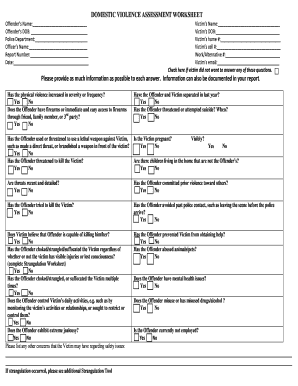
- Click ‘Get Form’ button to access the Domestic Violence Assessment Worksheet and open it in the editor.
- Begin by entering the offender’s name and date of birth in the designated fields.
- Next, provide the police department's name and the officer's name handling the case.
- Fill in the report number and the date of the incident.
- Enter the victim’s details next, including their name, date of birth, home phone number, cell phone number, work or alternative contact number, and email address.
- If the victim prefers not to answer any questions, check the box provided.
- Respond to the questions regarding the severity of physical violence, access to firearms, separation status, and threats by selecting 'Yes' or 'No' as applicable.
- Continue answering subsequent questions about threats to the victim, use of weapons, and other risk factors.
- In the section regarding safety concerns, list any additional issues the victim may have.
- Answer questions regarding the presence of children in the home and any restrictions the offender has placed on the victim.
- Complete all fields carefully and ensure all necessary information is provided.
- Finally, review your inputs for accuracy and clarity before saving changes, downloading, printing, or sharing the completed form.
Complete the Domestic Violence Assessment Worksheet online today to help ensure safety and support.
Experience a faster way to fill out and sign forms on the web. Access the most extensive library of templates available.
Related content
Information can also be documented in your report. Has the physical violence increased in...
IPV is different from violent crimes committed against strangers. As a result of the close...
Domestic violence likely to have a negative impact on the child. •. Use of guns, knives...
Get answers to your most pressing questions about US Legal Forms API.
What is the form used to assess domestic abuse?
The form most commonly used to assess domestic abuse is the Domestic Violence Assessment Worksheet. This structured document collects relevant data about the victim's experiences, offering insights into the nature of the abuse. Utilizing this form can significantly aid in ensuring the safety and well-being of those affected.
How is domestic violence measured?
Domestic violence is measured through various assessment tools, including the Domestic Violence Assessment Worksheet. This worksheet evaluates the frequency and severity of abusive behaviors, helping to assess risk levels accurately. By understanding these measurements, professionals can devise more effective intervention strategies.
What is the hits screening tool for domestic violence?
HITS stands for Hurt, Insult, Threaten, and Scream; this screening tool is designed to screen for domestic violence effectively. It comprises four simple questions that help identify whether an individual has experienced abuse. This tool complements the Domestic Violence Assessment Worksheet and enhances comprehensive evaluations of safety.
What are the 11 questions asked to determine domestic violence?
The Domestic Violence Assessment Worksheet includes 11 key questions tailored to uncover the extent of abuse. These questions delve into the complexities of the relationship, identifying physical, emotional, and psychological abuse. By answering these questions, professionals can gather vital information to provide appropriate help to victims.
What are the 11 questions of the lethality assessment?
The lethality assessment comprises 11 critical questions designed to evaluate the risk of homicide in domestic violence situations. These questions address factors like threats, access to weapons, and instances of strangulation. Utilizing the Domestic Violence Assessment Worksheet can aid in making informed decisions about intervention and support for those at high risk.
Who can do a dash assessment?
Anyone trained in recognizing signs of domestic violence can conduct a DASH assessment. Typically, social workers, law enforcement, and healthcare professionals administer this assessment. The goal is to ensure that individuals receive the necessary support and protection based on the findings of the Domestic Violence Assessment Worksheet.
What is the assessment tool used to identify domestic violence?
The Domestic Violence Assessment Worksheet is commonly employed to identify signs of domestic violence. It serves as a guide for victims and professionals, enabling them to pinpoint various forms of abuse. By utilizing this tool, we can better understand the complexities and nuances of each case.
What is the name of the assessment tool for domestic violence?
The primary tool used for evaluating domestic violence situations is known as the Domestic Violence Assessment Worksheet. This worksheet helps professionals gather essential information to understand the dynamics of abuse. It provides a structured method for assessing risk and safety for individuals involved in domestic violence cases.
Who can complete a dash?
A DASH, or Domestic Abuse, Stalking and Honour-Based Violence assessment, can be completed by any individual who believes they experience or are at risk of domestic violence. It is often completed by trained professionals, such as social workers or law enforcement, who assist clients in navigating their circumstances. The DOMESTIC VIOLENCE ASSESSMENT WORKSHEET can complement the DASH to provide additional context around the individual's situation.
How to do a violence risk assessment?
Conducting a violence risk assessment involves collecting detailed information about past behaviors, current threats, and potential warning signs. Use the DOMESTIC VIOLENCE ASSESSMENT WORKSHEET to systematically document these factors. Engaging a professional trained in assessing violence risks can provide further clarity and guidance in this process.
Use professional pre-built templates to fill in and sign documents online faster. Get access to thousands of forms.
If you believe that this page should be taken down, please follow our DMCA take down process here.