Open form follow the instructions
Easily sign the form with your finger
Send filled & signed form or save
How to fill out the Interactions Among Living Things Answer Key online
This guide provides clear instructions on how to effectively complete the Interactions Among Living Things Answer Key online. By following these steps, users will gain a comprehensive understanding of the document's structure and content.
Follow the steps to successfully fill out the answer key online.
- Click ‘Get Form’ button to obtain the form and open it in the editor.
- Begin by entering your name, date, and class in the designated fields at the top of the document. This information personalizes your form.
- Proceed to the section labeled 'Understanding Main Ideas.' Here, read the questions carefully and respond to them on a separate sheet as instructed.
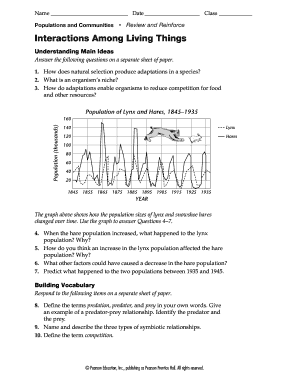
- Next, analyze the provided graph related to the populations of lynx and hares. Use the information from the graph to answer questions four to seven. Ensure your answers are based on the trends indicated in the graph.
- Move on to the 'Building Vocabulary' section. Again, respond to the questions on a separate sheet, providing definitions and examples where required.
- Once all sections are completed, review your answers for accuracy and completeness. Make any necessary adjustments.
- Finally, save the document, and as needed, download, print, or share your completed answer key.
Start completing your Interactions Among Living Things Answer Key online today!
Experience a faster way to fill out and sign forms on the web. Access the most extensive library of templates available.
Related content
Interactions of living things refer to the complex relationships that exist between...
Interactions among living things contribute to ... Interactions of Living Things Answer...
Safety and Security. iGEM is Staying Out of Danger. This section provides an overview of...
Get answers to your most pressing questions about US Legal Forms API.
What is an example of a relationship between organisms?
Here are eight examples of mutualistic relationships. Pistol shrimps and gobies. ... Aphids and ants. ... Woolly bats and pitcher plants. ... Coral and algae. ... Oxpeckers and large mammals. ... Clownfish and anemones. ... Honeyguides and humans. ... The senita cactus and senita moth.
What are all of the types of relationships between organisms?
There are five types of interactions between different species as listed below: Competition & Predation. Commensalism. Parasitism. Mutualism. Amensalism.
What are the 4 types of relationships between organisms?
There are four main symbiotic relationships: mutualism, commensalism, parasitism, and competition. To explore these relationships, let's consider a natural ecosystem such as the ocean. Oceanic environments are known for their species diversity.
What are 5 kinds of interactions among living things?
There are five types of interactions between different species as listed below: Competition & Predation. Commensalism. Parasitism. Mutualism. Amensalism.
What are the three types of relationships between organisms found within an ecosystem?
The term "symbiosis" includes a broad range of species interactions but typically refers to three major types: mutualism, commensalism and parasitism. Mutualism is a symbiotic interaction where both or all individuals benefit from the relationship. Mutualism can be considered obligate or facultative.
What are the interactions among living things answer?
An important and essential interaction among living things involves the flow of energy within an environment. All living organisms need energy to survive! Energy moves through an environment through food chains and food webs.
What are the 4 types of symbiotic relationships?
There are four main types of symbiotic relationships: mutualism, commensalism, parasitism and competition.
What is the interaction between living things and non living things?
An ecosystem is a community made up of living and nonliving things interacting with each other. Nonliving things do not grow, need food, or reproduce. Some examples of important nonliving things in an ecosystem are sunlight, water, air, wind, and rocks. Living things grow, change, produce waste, reproduce, and die.
Use professional pre-built templates to fill in and sign documents online faster. Get access to thousands of forms.
If you believe that this page should be taken down, please follow our DMCA take down process here.