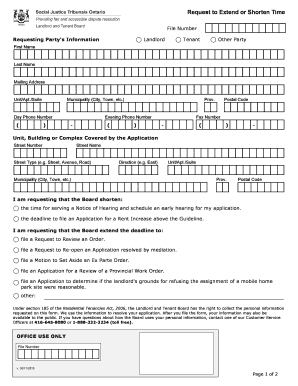
Request to Extend or Shorten Time File Number Requesting Party 's Information Landlord Tenant Other Party First Name Last Name Mailing Address Unit/Apt./Suite Municipality (City, Town, etc.) Day Phone.
Open form follow the instructions
Easily sign the form with your finger
Send filled & signed form or save
How to fill out the Request To Extend Or Shorten Time online
Filling out the Request To Extend Or Shorten Time form is an essential process for individuals looking to modify deadlines related to landlord-tenant applications. This guide provides clear steps to complete the online form with ease, ensuring that all necessary information is accurately provided.
Follow the steps to complete your form accurately
- Click ‘Get Form’ button to obtain the form and open it in the editor.
- Begin with filling in the file number, which is a unique identifier for your case. Make sure to double-check the number for accuracy.
- Provide your information in the 'Requesting Party's Information' section. Indicate whether you are a landlord, tenant, or another party by checking the appropriate box.
- Enter your first name, last name, mailing address, unit/apartment/suite number, city or town, province, day and evening phone numbers, postal code, and fax number. Ensure all information is complete to avoid delays.
- In the section titled 'Unit, Building or Complex Covered by the Application', provide the relevant street number, street name, street type, direction, municipality, province, and postal code for the property in question.
- Clearly indicate whether you are requesting the board to shorten or extend the time. Choose the appropriate option based on your situation and check the corresponding boxes.
- Elaborate on the specific reason for your request in the designated section. Providing a concise and clear explanation will enhance the likelihood of your request being granted.
- If your reasoning requires additional space, feel free to attach extra sheets as necessary.
- Complete the signature section, indicating who is signing the document, along with their first name, last name, LSUC number if applicable, phone number, signature, and date.
- After verifying that all fields are accurately filled out, you can save your changes, download, print, or share the form as needed.
Complete your Request To Extend Or Shorten Time online today and ensure your application is processed promptly.
Experience a faster way to fill out and sign forms on the web. Access the most extensive library of templates available.
Related content
The assigned judge, on terms that are just, may shorten or extend the time within which...
Extending Time. (1) In General. When an act may or must be done within a specified time...
The April storyline, introduced in 2017, is a minor addition to the April event. Within...
Get answers to your most pressing questions about US Legal Forms API.
What is the N9 or N11 form in Ontario?
The N9 form is a tenant's notice to end a lease, while the N11 form represents a mutual agreement to terminate the tenancy. Each form holds significance in the tenant's rights and responsibilities. If you find yourself needing more time related to either of these forms, look into the request to extend or shorten time option to adapt to your unique situation.
What is an N7 form in Ontario?
The N7 form is used by landlords to address issues such as tenant harassment or damage to property, officially notifying tenants of these concerns. This form outlines steps the tenant must take to rectify the situation. Understanding how to request to extend or shorten timelines in relation to N7 issues can ensure that both parties are fully aware of their responsibilities.
How long is the wait for LTB in Ontario?
The wait time for the Landlord and Tenant Board (LTB) can vary significantly, often stretching from a few weeks to several months, depending on the case's complexity. It's important for both landlords and tenants to stay informed about any pending hearings, as this affects decision-making processes. If you find you need more time for preparation, requesting to extend your timeline can be beneficial.
What notice form do I need to give for end of tenancy in Ontario?
To terminate a tenancy, tenants generally need to use the N9 form to inform the landlord of their decision to leave. This form ensures that both the landlord and tenant are aligned on the details of the departure. If you require adjustments to your timeline, you may consider how a request to extend or shorten time can affect your moving plans.
What is a N9 form for a tenant in Ontario?
The N9 form is a request initiated by a tenant to officially notify the landlord of their intent to leave the rental property. This form provides necessary details such as the intended end date of tenancy. Should issues arise and you need to request to extend or shorten your timeline, referring to the N9 can help clarify your intentions.
What is the N11 form for rent in Ontario?
The N11 form serves as a mutual agreement between the landlord and tenant to terminate a rental agreement. Both parties must sign this form, indicating their consent to end the tenancy. In situations where you may need to request to extend or shorten the time for this process, using the N11 form can streamline your communication with the other party.
What is a N2 form in Ontario?
The N2 form is used by landlords to notify tenants about the intent to increase rent due to renovations or repairs. This form outlines the reasons for the increase and provides the tenant with essential information about their rights. If you need to request additional time for issues related to rent increases, you can use this form to initiate the process.
What is a certificate of service for the Ontario Landlord and Tenant Board?
A certificate of service is a document that confirms a landlord or tenant has delivered important notices or documents to the other party. This is crucial in rental disputes, as it proves that both parties are informed about the proceedings. If you need to request an extension or shorten a timeline, ensuring proper service can help support your case.
How much notice must a landlord give a tenant to move out in Ontario?
Landlords are required to give their tenant at least 60 days written notice to the end of the term or rent period using the Landlord and Tenant Board Form N12.
Can you evict a tenant for a family member to move in Ontario?
Personal Use by the Landlord or Landlord's Family. Section 48(1) of the RTA permits the landlord to give notice of termination to a tenant if the landlord, in good faith, requires the unit for residential occupation for a period of at least one year by the landlord, a specified family member or a caregiver.
Use professional pre-built templates to fill in and sign documents online faster. Get access to thousands of forms.
If you believe that this page should be taken down, please follow our DMCA take down process here.