Loading

Open form follow the instructions

Easily sign the form with your finger

Send filled & signed form or save
How to fill out the Adhd Teacher Follow Up Vanderbilt online
Filling out the Adhd Teacher Follow Up Vanderbilt form is essential for evaluating children's behavior in an educational setting. This guide provides step-by-step instructions to help you complete the form accurately and effectively.
Follow the steps to complete the Adhd Teacher Follow Up Vanderbilt form.
- Press the ‘Get Form’ button to obtain the form and access it in your online editor.
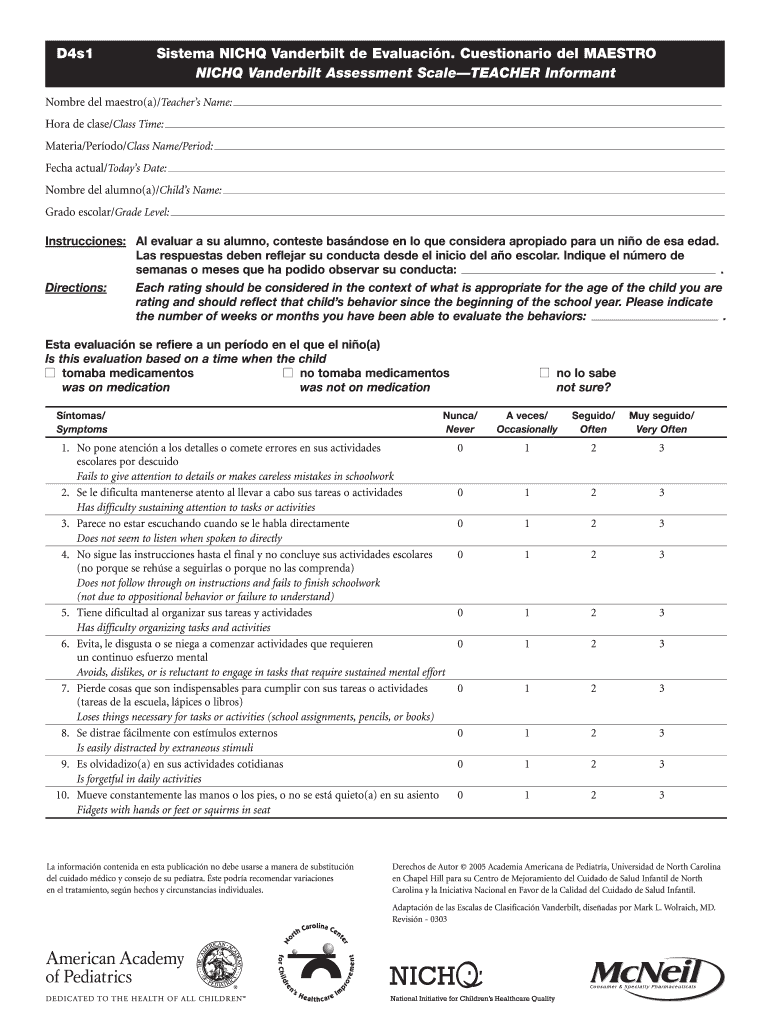
- Begin by filling in the required information, such as the teacher's name, class time, class name, today's date, child's name, and grade level.
- As you assess the child’s behavior, respond to each symptom listed in the form, considering what is appropriate for the child’s age. Ensure your answers reflect the child's behavior since the start of the school year.
- Indicate the duration you have observed the child’s behavior by specifying the number of weeks or months in the designated section.
- For each symptom, select the appropriate frequency by choosing from the options: Never, Occasionally, Often, Very Often.
- Continue to the performance section, where you will assess the child’s academic performance across subjects such as reading, mathematics, and written expression.
- Provide comments in the space provided to offer qualitative feedback about the child's performance or behavior.
- Once you have completed the form, review all entries for accuracy, then save your changes.
- Finally, download, print, or share the completed form as needed, and return it to the designated office as instructed.
Complete your forms online today to streamline the evaluation process.
Experience a faster way to fill out and sign forms on the web. Access the most extensive library of templates available.
Related content
Teacher's Name: Class Time: Class Name/Period: Today's Date: ______ Child's Name: Grade...
Directions: Each rating should be considered in the context of what is appropriate for the...
The parent and teacher follow-up scales have the first 18 core. ADHD symptoms and the...
Get answers to your most pressing questions about US Legal Forms API.
Who fills out the Vanderbilt questionnaire?
The Vanderbilt questionnaire is typically filled out by both parents and teachers. This collaboration provides a well-rounded view of the child's behavior in different environments. Teachers offer valuable insights into academic performance and social interactions, while parents can shed light on home behaviors. Thus, using the ADHD Teacher Follow Up Vanderbilt helps unify these perspectives for a thorough understanding.
Is the Vanderbilt ADHD assessment accurate?
The Vanderbilt ADHD assessment is widely regarded for its accuracy and reliability in assessing ADHD symptoms. It gathers detailed information about a child's behavior and academic performance from multiple perspectives. Parents and teachers both play a role in completing this assessment, enhancing its validity. Using the ADHD Teacher Follow Up Vanderbilt can ensure comprehensive insights into your child's situation.
How do you talk to your teacher about ADHD?
When discussing ADHD with your teacher, it's crucial to be clear and open about your child's needs. Start by explaining any specific challenges your child faces in the classroom. Providing context will help the teacher understand and support your child better. You can mention how the ADHD Teacher Follow Up Vanderbilt can aid in understanding these needs more thoroughly.
What is the Vanderbilt rating scale for ADHD?
The Vanderbilt rating scale for ADHD is a standardized tool used by teachers to assess a child's behaviors related to ADHD symptoms. It includes various questions focusing on academic, social, and behavioral domains. This scale helps identify patterns that may indicate ADHD and guides interventions. Leveraging the ADHD teacher follow up Vanderbilt ensures all parties are informed and involved in your child's support and development.
Is the Vanderbilt assessment only for ADHD?
The Vanderbilt assessment primarily targets ADHD but also screens for other behavioral issues, such as oppositional defiant disorder. Its multifaceted approach provides a broader view of a child's behavior, offering insights beyond ADHD alone. By utilizing this tool, teachers can give nuanced feedback. Engage with the recommendations of the ADHD teacher follow up Vanderbilt to address your child's overall wellbeing.
How to ask a teacher about ADHD?
To ask a teacher about ADHD, start with a respectful conversation focusing on your child's behavior. Approach them with specific examples of concerns and ask for their observations using the Vanderbilt assessment tool. Building a collaborative relationship is essential for effective communication. This dialogue is a key part of the ADHD teacher follow up Vanderbilt process.
What is a good ADHD score?
A good ADHD score on the Vanderbilt scale means lower scores under the threshold for concern, ideally below 15. Scores in this range suggest fewer behavioral issues that align with ADHD. However, every child is unique, and discussions with teachers can provide context to the results. The ADHD teacher follow up Vanderbilt allows parents to navigate any support or intervention needed.
What score on Vanderbilt indicates ADHD?
A score above 16 on the Vanderbilt ADHD rating scale generally indicates potential ADHD. It's important to remember that these scores reflect input from teachers regarding your child's behavior in the classroom. As a follow-up, consider involving your child’s teachers in a deeper analysis of the results. This approach reinforces the value of the ADHD teacher follow up Vanderbilt process.
What is a 46 ADHD score?
A score of 46 on the Vanderbilt scale significantly suggests the presence of ADHD symptoms. This score indicates a higher frequency of behaviors associated with ADHD. For parents, this serves as a crucial starting point to seek further assessments and resources. Engage teachers in discussions around the ADHD teacher follow up Vanderbilt to ensure a collaborative approach in addressing your child's needs.
What score is considered ADHD?
A score of 16 or higher in the ADHD symptom areas on the Vanderbilt scale often indicates a concern for ADHD. Teachers typically evaluate various behaviors, and the results guide further steps. If your child scores in this range, consider communicating with educational professionals to explore the next steps in the ADHD teacher follow up Vanderbilt process for your child's support.
Use professional pre-built templates to fill in and sign documents online faster. Get access to thousands of forms.
If you believe that this page should be taken down, please follow our DMCA take down process here.