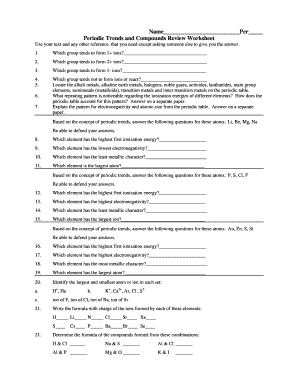
Name Per Periodic Trends and Compounds Review Worksheet Use your text and any other reference that you need except asking someone else to give you the answer. 1. Which group tends to form 1+ ions?.
Open form follow the instructions
Easily sign the form with your finger
Send filled & signed form or save
How to fill out the Periodic Trends And Compounds Review Worksheet Answer Key online
This guide provides clear and comprehensive instructions for filling out the Periodic Trends And Compounds Review Worksheet Answer Key online. Follow these steps to successfully navigate the form and input your answers accurately.
Follow the steps to complete the worksheet online.
- Click ‘Get Form’ button to obtain the form and open it in the editor.
- Begin by entering your name and period at the top of the worksheet in the designated fields.
- Proceed to the first question and provide your answer regarding which group tends to form 1+ ions.
- Continue with the subsequent questions, answering which groups form 2+ ions, 1- ions, and identifying groups that tend not to react.
- As you answer questions regarding periodic trends, reference the periodic table provided or access an online version as needed.
- For the sections requiring patterns regarding ionization energies and electronegativity, take your time to analyze the trends using your understanding of the periodic table.
- Once you have answered all questions, review your responses for accuracy and completeness.
- Finally, save your changes, and choose to download, print, or share the completed form as necessary.
Start completing your Periodic Trends And Compounds Review Worksheet Answer Key online today!
Experience a faster way to fill out and sign forms on the web. Access the most extensive library of templates available.
Related content
Yes, understanding periodic trends allows chemists to predict how elements will react...
Understanding the properties of atoms is fundamental to grasping the organization and...
by SH Walk · 1997 · Cited by 23 — This draft manual was developed by the U.S...
Get answers to your most pressing questions about US Legal Forms API.
Which statement best describes group 2 elements as they are considered in order from top to bottom?
Group 2 elements, known as alkaline earth metals, become more reactive as you move down the group. This trend is due to the decreasing ionization energy, making it easier for these elements to lose electrons. To better grasp this concept, engage with the Periodic Trends And Compounds Review Worksheet Answer Key, which can help clarify these properties.
What are the key trends of the periodic table?
Key trends on the periodic table include variations in atomic size, ionization energy, and reactivity of elements. These trends reveal insights into the properties of both metals and nonmetals as you navigate through the table's groups and periods. The Periodic Trends And Compounds Review Worksheet Answer Key serves as a valuable resource for learning these trends.
What is the development of the periodic table?
The development of the periodic table dates back to the 19th century, when scientists like Dmitri Mendeleev began organizing elements based on atomic mass. Later advancements included the arrangement by atomic number, which improved its accuracy. For comprehensive details, refer to the Periodic Trends And Compounds Review Worksheet Answer Key.
What trends are there on the periodic table?
The periodic table showcases several important trends, such as the increase in ionization energy and electronegativity across a period. Additionally, the atomic radius generally decreases across a period. Utilizing the Periodic Trends And Compounds Review Worksheet Answer Key can enhance your grasp of these patterns.
How is a periodic table arranged?
The periodic table is arranged by increasing atomic number from left to right and top to bottom. Each row represents a period, while each column signifies a group with similar properties. This organizational structure is essential for understanding chemical behavior, which you can study further using the Periodic Trends And Compounds Review Worksheet Answer Key.
What are the trends of the periodic table?
Trends of the periodic table involve how certain properties of elements change as you move across or down the table. For instance, metals typically become less reactive as you move right across a period. By reviewing the Periodic Trends And Compounds Review Worksheet Answer Key, you can gain a deeper understanding of these trends.
What are some key features of the periodic table?
Key features of the periodic table include its organization into periods and groups, which represent different electron configurations. Elements are arranged by increasing atomic number, which reflects their properties. You can easily find information on these features in the Periodic Trends And Compounds Review Worksheet Answer Key.
What are the three main periodic trends?
The three main periodic trends are atomic radius, ionization energy, and electronegativity. Atomic radius usually decreases across a period and increases down a group. Ionization energy tends to increase across a period and decrease down a group. Understanding these trends will help you complete the Periodic Trends And Compounds Review Worksheet Answer Key.
How do you read the notes on the periodic table?
On the periodic table, elements are listed in order of increasing atomic number. Elements in the same row are in the same period. This means they have similar physical properties, such as how well they bend or conduct electricity. Elements in the same column are in the same group.
How do you remember the trends on the periodic table?
The periodic trends tell you in which direction of the periodic table do you have increasing values for different chemical properties. The mnemonic is bear: B E A R. And each letter stands for different chemical properties.
Use professional pre-built templates to fill in and sign documents online faster. Get access to thousands of forms.
If you believe that this page should be taken down, please follow our DMCA take down process here.