Loading
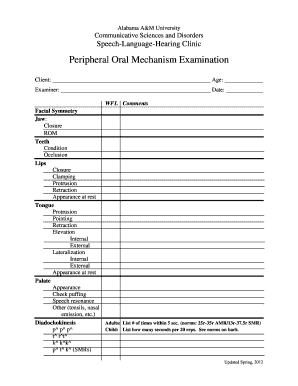
Get Oral Mechanism Exam
How it works
-

Open form follow the instructions
-

Easily sign the form with your finger
-

Send filled & signed form or save
How to use or fill out the Oral Mechanism Exam online
This guide provides detailed instructions on how to accurately fill out the Oral Mechanism Exam online. By following these steps, you can ensure that all necessary information is collected efficiently and thoroughly.
Follow the steps to complete your Oral Mechanism Exam online.
- Click ‘Get Form’ button to obtain the form and open it in your editor.
- Begin by entering the client's name in the designated field. Ensure that the spelling is correct to maintain accurate records.
- Next, input the client's age into the appropriate section. This information is critical for age-related assessments.
- Fill in the examiner's name, ensuring it reflects the individual administering the exam.
- Enter the date of the examination in the specified format, as this will help in tracking and referencing the evaluation.
- Proceed to the Facial Symmetry section. Assess and record observations related to the jaw, lips, tongue, and palate based on the outlined criteria.
- In the Cheek Puffing and Speech Resonance sections, provide your assessment while ensuring to note any additional observations in the 'Other' field.
- Complete the Diadochokinesis section for adults and children as per the provided instructions. For children, ensure to follow the guidelines for accurate repetition counting.
- Review all entries for clarity and accuracy before finalizing the document. This is crucial to ensure that the information is complete.
- Save your changes. You can choose to download, print, or share the completed Oral Mechanism Exam form as needed.
Complete your Oral Mechanism Exam online today for efficient documentation and record-keeping.
Related links form
This is a thorough examination of a child's oral structures and functions that are necessary for speech production. It is designed to be administered in conjunction with, or as follow-up to, speech sound testing. Atypical observations may be used to identify the cause of speech disorders.