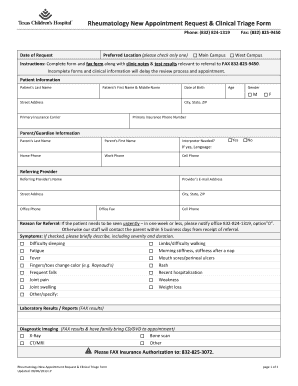
S: Complete form and fax form along with clinic notes & test results relevant to referral to FAX 832-825-9450. Incomplete forms and clinical information will delay the review process and appointment. Patient Information Patient's Last Name Patient's First Name & Middle Name Date of Birth Age Gender M Street Address F City, State, ZIP Primary Insurance Carrier Primary Insurance Phone Number Parent/Guardian Information Parent's Last Name Parent's First Name Interpreter Needed? Yes No.
Open form follow the instructions
Easily sign the form with your finger
Send filled & signed form or save
How to fill out the Rheumatology Triage Form online
Filling out the Rheumatology Triage Form online is a crucial step in securing timely care for patients. This guide provides clear, step-by-step instructions to help users complete the form accurately and efficiently.
Follow the steps to complete the form correctly.
- Click ‘Get Form’ button to access the Rheumatology Triage Form and open it in your preferred document editor.
- Enter the date of request at the top of the form to indicate when you are submitting your information.
- Select your preferred location by checking either the Main Campus or West Campus option to ensure proper routing of your request.
- Fill in your patient information, including last name, first name, middle name, date of birth, age, and gender. Ensure all details are correct for accurate identification.
- Provide the patient's street address, city, state, and ZIP code to establish residency and facilitate future communications.
- Specify the primary insurance carrier and the insurance phone number to assist in the billing process.
- If applicable, complete the parent or guardian information, including their name, contact numbers, and whether an interpreter is needed.
- Input the referring provider's details, such as their name, email address, and contact information to streamline communication between healthcare providers.
- Clearly state the reason for referral, indicating urgency if needed, and include any symptoms the patient is experiencing, along with their severity and duration.
- List any relevant laboratory results or diagnostic imaging reports, indicating which documents should be faxed and brought to the appointment.
- Fax the completed form, alongside relevant clinic notes and test results, to the provided fax number to ensure the review process is not delayed.
- Finally, review the form for completeness, then save changes to your document. You may choose to download, print, or share the completed form as needed.
Take action now by completing the Rheumatology Triage Form online to ensure timely assistance.
Experience a faster way to fill out and sign forms on the web. Access the most extensive library of templates available.
Related content
by K Layton · 2016 · Cited by 4 — Our findings suggest the specialty provider triage...
by KR Layton · 2015 · Cited by 4 — In order to address the shortage of providers and...
Sep 20, 2018 — granular form of Jadenu was approved. Due to. 6 increased bioavailability...
Get answers to your most pressing questions about US Legal Forms API.
What is triage in medical condition?
In a medical context, triage involves categorizing patients according to the seriousness of their conditions at the time they arrive for care. This process is crucial in emergency settings and outpatient clinics alike. By using a Rheumatology Triage Form, providers can classify and respond to patients with rheumatic symptoms efficiently, ensuring timely treatment and better health outcomes.
What is the meaning of triage?
Triage is the process of sorting and prioritizing patients based on the urgency of their medical needs. This method optimizes healthcare delivery by ensuring that those who require immediate attention receive it first. A Rheumatology Triage Form serves as an effective tool in this process, helping healthcare providers quickly evaluate and address patients with rheumatological concerns.
Which country is best for rheumatology?
The best country for rheumatology often depends on access to specialized clinics, advanced medical treatments, and experienced healthcare professionals. Countries like the United States, Germany, and Canada are known for their strong healthcare systems and research in rheumatology. Access to resources like a Rheumatology Triage Form can make navigating treatment options more straightforward, ensuring patients receive the best care possible.
Can you self-refer to a rheumatologist?
In some cases, you may be able to self-refer to a rheumatologist, depending on your insurance plan and local laws. However, it is often more effective to first consult with your primary care doctor, who can guide you on the best course of action. Utilizing a Rheumatology Triage Form can help you present your symptoms clearly, making it easier for your physician to support your referral.
What is a rheumatology emergency?
A rheumatology emergency involves sudden and severe symptoms related to rheumatological conditions, such as extreme joint pain, swelling, or systemic symptoms like fever and fatigue. These situations often require immediate evaluation and intervention. It is essential to have access to a Rheumatology Triage Form, as it helps healthcare providers quickly assess the urgency of your case and initiate appropriate care.
How do I ask for a referral to a rheumatologist?
To ask for a referral to a rheumatologist, discuss your symptoms and concerns with your primary care doctor. Explain why you believe a referral is necessary, and be clear about your medical history. A well-documented Rheumatology Triage Form can facilitate this conversation, providing the necessary details to help your doctor understand your situation better.
What is rheumatology triage?
Rheumatology triage is a specialized form of clinical triage that focuses on patients with rheumatologic conditions. This process helps determine the urgency and type of care needed for patients suffering from joint, muscle, and autoimmune disorders. A properly completed Rheumatology Triage Form allows healthcare providers to make informed decisions swiftly, optimizing patient outcomes.
What is the meaning of clinical triage?
Clinical triage refers to the process of assessing and prioritizing patients based on the severity of their conditions. In healthcare, this ensures that patients who need immediate attention receive it quickly. Using a Rheumatology Triage Form can help healthcare providers streamline this process, ensuring timely care for patients with rheumatological issues.
What to say at a rheumatology appointment?
At a rheumatology appointment, it’s important to discuss your symptoms, any treatment responses, and concerns regarding your condition. Be open about your daily activities and how arthritis affects your quality of life. Using the Rheumatology Triage Form can help guide the conversation, ensuring all pertinent points are addressed efficiently.
How to fill out a triage assessment form?
Filling out a triage assessment form involves gathering essential patient information, including symptoms and medical history. Begin by detailing the patient's current condition and any significant changes. Using a clear format, like the Rheumatology Triage Form, can simplify this process, making it easier to analyze and act upon the data.
Use professional pre-built templates to fill in and sign documents online faster. Get access to thousands of forms.
If you believe that this page should be taken down, please follow our DMCA take down process here.