Open form follow the instructions
Easily sign the form with your finger
Send filled & signed form or save
How to use or fill out the Topographic Map Reading Practice Worksheet Answer Key online
Filling out the Topographic Map Reading Practice Worksheet Answer Key online is an important step in understanding topographic maps. This guide will provide you with clear instructions on each section of the form to ensure that you can complete it effectively.
Follow the steps to fill out the worksheet accurately.
- Click ‘Get Form’ button to obtain the form and open it in the editor.
- Locate the field for your name at the top of the form. Enter your full name as the user completing the worksheet.
- Next, find the date field. Input the current date in the format provided.
- In the period section, indicate your classroom period or study session.
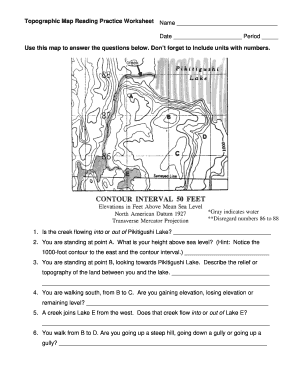
- Review the map provided in the form. Begin answering the questions one by one, making sure to refer to the map for accurate information.
- For question one, determine whether the creek is flowing into or out of Pikitigushi Lake. Write your answer clearly in the designated space.
- Continue to question two. Here, identify your height above sea level while taking note of the contour lines and intervals indicated on the map.
- Proceed to the subsequent questions, providing detailed descriptions and responses as required, such as describing the topography between points and determining elevation.
- Ensure that all answers include units where needed, especially in elevation-related questions.
- After completing all the questions, review your answers for clarity and accuracy.
- Finally, save your changes, and if necessary, download, print, or share the completed form as required.
Begin your Topographic Map Reading Practice Worksheet Answer Key online today and enhance your map reading skills!
Experience a faster way to fill out and sign forms on the web. Access the most extensive library of templates available.
Related content
Use the topographic map in your map packet to answer these questions: What is the...
Topographic maps that are bounded by lines of latitude and longitude are called. ______...
Practice cross-sectional drawings from maps. • Have a “Topographic Treasure Hunt”...
Get answers to your most pressing questions about US Legal Forms API.
What do the contour lines on a map help you understand?
Contour lines on a map help you understand the elevation changes and the shape of the terrain. Each line represents a specific elevation, with closer lines indicating steeper slopes. By analyzing these patterns, you can identify features like hills and depressions. Practicing with a Topographic Map Reading Practice Worksheet Answer Key can clarify how to read and interpret these essential lines.
What does a topography test for?
A topography test typically assesses your understanding of elevation change, landforms, and spatial relationships on maps. It measures your ability to interpret contour lines and visualize the landscape based on map data. Engaging with a Topographic Map Reading Practice Worksheet Answer Key can significantly aid in preparing for these types of assessments.
What does topography tell us?
Topography tells us about the physical features of the land, including elevations, slopes, and landforms. It provides insights into how these features affect weather patterns and ecosystems. Understanding topography can also guide infrastructure development and conservation efforts. For targeted learning, consult a Topographic Map Reading Practice Worksheet Answer Key to reinforce these insights.
What does topography determine?
Topography determines various aspects such as climate, biodiversity, and human settlement patterns. For example, hilly regions may receive more rainfall, affecting local ecosystems. Additionally, flat areas tend to be more suitable for agriculture and construction. To better grasp these relationships, use a Topographic Map Reading Practice Worksheet Answer Key as a helpful study tool.
What is the role of topography?
Topography plays a crucial role in shaping ecosystems, agriculture, and urban planning. It influences water drainage, soil types, and vegetation patterns. By understanding topography, you can make informed decisions in land use and environmental management. For learning purposes, refer to a Topographic Map Reading Practice Worksheet Answer Key that elaborates on these concepts.
How to get topographic map data?
You can obtain topographic map data from various sources, including government agencies and online mapping services. The U.S. Geological Survey (USGS) provides freely accessible maps. Additionally, consider using platforms like UsLegalForms to find worksheets and resources that help interpret and utilize topographic data effectively, including a Topographic Map Reading Practice Worksheet Answer Key.
What three factors determine topography?
Topography is influenced by three main factors: elevation, slope, and landforms. Elevation refers to how high or low land is above sea level, while slope indicates the steepness of the terrain. Landforms include features like mountains, valleys, and plains. Together, these factors shape the landscape and can be explored further using a Topographic Map Reading Practice Worksheet Answer Key.
What is the easiest way to read a topographic map?
The easiest way to read a topographic map is to start by familiarizing yourself with the legend and symbols. Look for contour lines, which represent elevation changes. By studying these line patterns, you can visualize the terrain, recognizing hills, valleys, and slopes. For additional practice, using a Topographic Map Reading Practice Worksheet Answer Key can enhance your understanding.
What does a scale of 1 24000 on a topographic map indicate?
It is given as a ratio of inches on the map corresponding to inches, feet, or miles on the ground. For example, a map scale indicating a ratio of 1:24,000 (in/in), means that for every 1 inch on the map, 24,000 inches have been covered on the ground. Ground distances on maps are usually given in feet or miles.
How do you read a contour map number?
3:12 7:30 How to Read Contour Lines on a Topographic Map - YouTube YouTube Start of suggested clip End of suggested clip And I stand on this next contour line knowing that the contour interval is 10 feet I've gone up 10MoreAnd I stand on this next contour line knowing that the contour interval is 10 feet I've gone up 10 feet in elevation. So. This line right here is the 910 foot contour.
Use professional pre-built templates to fill in and sign documents online faster. Get access to thousands of forms.
If you believe that this page should be taken down, please follow our DMCA take down process here.