Loading
Form preview
  • US Legal Forms
  • Other Templates
  • More Forms
  • More Multi-State Forms
  • Duct Leakage Test Form 2020

Get Duct Leakage Test Form 2020-2026

How it works

  1. Open form

    Open form follow the instructions

  2. Easily sign form

    Easily sign the form with your finger

  3. Share form

    Send filled & signed form or save

How to fill out the Duct Leakage Test Form online

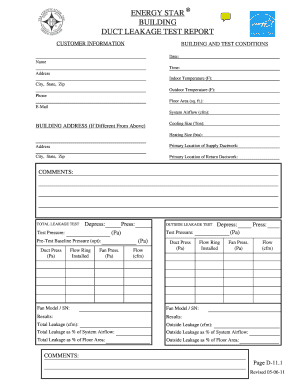
Filling out the Duct Leakage Test Form online is a straightforward process that ensures you accurately report your duct leakage testing results. This guide will provide you with step-by-step instructions to assist you in completing the form effectively.

Follow the steps to complete the Duct Leakage Test Form online.

  1. Click ‘Get Form’ button to obtain the form and open it in the online editor.
  2. Begin by entering the date at the top of the form. This is important for record-keeping and referencing your test.
  3. Fill in your name, contact phone number, and email address in the customer information section. Ensure that all details are correct and up to date.
  4. Provide the building address, including city, state, and zip code. If it differs from the customer information, be sure to indicate this clearly.
  5. Record the indoor and outdoor temperatures in Fahrenheit. This information is vital for assessing the duct system’s performance.
  6. Enter the floor area of the building in square feet, as well as the system airflow measured in cubic feet per minute (cfm).
  7. Indicate the cooling size in tons and the heating size in British thermal units (btu).
  8. Document the primary locations of the supply and return ductwork. Be specific to help in understanding the duct layout.
  9. In the comment section, feel free to add any pertinent notes about the testing conditions or observations.
  10. Proceed to the total leakage test section. Enter the depress and test pressure in Pascals (Pa).
  11. Record the pre-test baseline pressure and duct pressure in Pascals (Pa) to establish reference points.
  12. Indicate if a flow ring was installed and note the fan pressure in Pascals (Pa) as well.
  13. Move to the outside leakage test section. Repeat the entries for test pressure, flow, duct pressure, and depress.
  14. Document the fan model and serial number for each fan to provide specifics about the equipment used.
  15. Fill in the results for total leakage, outside leakage, and their respective percentages related to system airflow and floor area.
  16. Finally, review all entries for accuracy and completeness. Once confirmed, you can save your changes, download, print, or share the form.

Start filling out your Duct Leakage Test Form online today!

Get form

Experience a faster way to fill out and sign forms on the web. Access the most extensive library of templates available.
Get form

Related content

Duct Leakage Test Report Form
Company Name: Phone: I hereby verify that the above duct leakage testing results are in...
Learn more
Duct Leakage Test Results (Existing Construction)
Aug 31, 2004 — The test results shall be provided to the building official and the...
Learn more
Positive and Negative Duct Accreditation (PANDA)...
SMACNA HVAC Air. Duct Leakage Test manual, First edition,. 1985. US. Duct construction...
Learn more

Related links form

Form Omh 471 Outpatient Card Atf 53201 Fillable Form Honorarium Agreement Template

Questions & Answers

Get answers to your most pressing questions about US Legal Forms API.

Contact support

Acceptable duct leakage varies depending on the building type and local building codes; however, less than 15% is often considered ideal. Reducing duct leakage improves system efficiency and lowers energy costs. Referencing a Duct Leakage Test Form can guide you in evaluating whether your ductwork meets acceptable leakage standards.

Testing for ductwork leakage involves using a blower door test to create negative pressure in the ducts while monitoring airflow rates. This method allows for pinpointing leaks throughout the system. To facilitate documentation, use the Duct Leakage Test Form, ensuring all findings are recorded systematically.

The standard for duct pressure testing typically requires maintaining a specific pressure for a defined duration within your ductwork system. The results help determine if the ducts meet efficiency guidelines. Using a Duct Leakage Test Form assists in keeping track of pressure levels for accurate assessments.

The results of a duct leak test indicate the total airflow loss as a percentage of the total supply airflow. High leakage rates may require immediate attention to seal leaks and enhance energy efficiency. Having a Duct Leakage Test Form available allows you to easily compare results over time and provide transparent documentation to stakeholders.

Performing a leakage test involves using specialized equipment to create pressure differences in your duct system. This process highlights any leaks present in the ducts. Recording the findings on a Duct Leakage Test Form streamlines analysis, helping you identify areas needing repairs or improvements.

To conduct a duct leakage test, start by sealing all vents and register in your duct system. You will then pressurize the ducts using a blower door or a duct testing fan. Completing the Duct Leakage Test Form during this process captures vital data, allowing for effective assessment of your ductwork's integrity.

The standard for a duct leakage test typically follows guidelines set by the American Society of Heating, Refrigerating and Air-Conditioning Engineers (ASHRAE). These standards provide benchmarks to evaluate the performance of duct systems. Utilizing a Duct Leakage Test Form aligns your testing with these widely accepted industry standards.

A good duct leakage test assesses the airtightness of your ductwork system, ensuring it operates efficiently. This test identifies leaks that can waste energy and compromise indoor air quality. A reliable Duct Leakage Test Form helps you document results and track ducts' performance over time.

The procedure for duct leakage testing starts with sealing all ducts and registers. Next, use a blower fan to pressurize the system while monitoring pressure levels. By assessing the flow rate and pressure drop, you can identify any leaks. Always complete a Duct Leakage Test Form to keep organized records and improve your HVAC efficiency.

Performing an air leak test involves sealing the building and using a blower door to create a pressure difference. This allows you to measure air infiltration rates, helping you identify leaks in the ductwork. A Duct Leakage Test Form can assist you in documenting the air leakage rates discovered during your test.

Get This Form Now!

Use professional pre-built templates to fill in and sign documents online faster. Get access to thousands of forms.
Get form
If you believe that this page should be taken down, please follow our DMCA take down processhere.
Get Duct Leakage Test Form
Get form
  • Adoption
  • Bankruptcy
  • Contractors
  • Divorce
  • Home Sales
  • Employment
  • Identity Theft
  • Incorporation
  • Landlord Tenant
  • Living Trust
  • Name Change
  • Personal Planning
  • Small Business
  • Wills & Estates
  • Packages A-Z
  • Affidavits
  • Bankruptcy
  • Bill of Sale
  • Corporate - LLC
  • Divorce
  • Employment
  • Identity Theft
  • Internet Technology
  • Landlord Tenant
  • Living Wills
  • Name Change
  • Power of Attorney
  • Real Estate
  • Small Estates
  • Wills
  • All Forms
  • Forms A-Z
  • Other Templates
  • Legal Hub
  • About Us
  • Help Portal
  • Legal Resources
  • Blog
  • Affiliates
  • Contact Us
  • Delete My Account
  • Site Map
  • Industries
  • Forms in Spanish
  • Localized Forms
  • State-specific Forms
  • Forms Kit
  • Real Estate Handbook
  • All Guides
  • Notarize
  • Incorporation services
  • For Consumers
  • For Small Business
  • For Attorneys
  • USLegal
  • FormsPass
  • pdfFiller
  • signNow
  • altaFlow
  • DocHub
  • Instapage
Form Packages
  • Adoption
  • Bankruptcy
  • Contractors
  • Divorce
  • Home Sales
  • Employment
  • Identity Theft
  • Incorporation
  • Landlord Tenant
  • Living Trust
  • Name Change
  • Personal Planning
  • Small Business
  • Wills & Estates
  • Packages A-Z
Form Categories
  • Affidavits
  • Bankruptcy
  • Bill of Sale
  • Corporate - LLC
  • Divorce
  • Employment
  • Identity Theft
  • Internet Technology
  • Landlord Tenant
  • Living Wills
  • Name Change
  • Power of Attorney
  • Real Estate
  • Small Estates
  • Wills
  • All Forms
  • Forms A-Z
  • Other Templates
Customer Service
  • Legal Hub
  • About Us
  • Help Portal
  • Legal Resources
  • Blog
  • Affiliates
  • Contact Us
  • Delete My Account
  • Site Map
  • Industries
  • Forms in Spanish
  • Localized Forms
  • State-specific Forms
  • Forms Kit
Legal Guides
  • Real Estate Handbook
  • All Guides
Prepared for you
  • Notarize
  • Incorporation services
Our Customers
  • For Consumers
  • For Small Business
  • For Attorneys
Our Sites
  • USLegal
  • FormsPass
  • pdfFiller
  • signNow
  • altaFlow
  • DocHub
  • Instapage
Social Media
Call us now toll free:
+1 833 426 79 33
As seen in:
© Copyright 1999-2026 airSlate Legal Forms, Inc. 17 Station Street, Suite 303, Brookline, MA 02445
  • Your Privacy Choices
  • Terms of Service
  • Privacy Notice
  • Content Takedown Policy
  • Bug Bounty Program