
Open form follow the instructions

Easily sign the form with your finger

Send filled & signed form or save
How to fill out the Assessment Tool For Lingual Frenulum Function ATLFF online
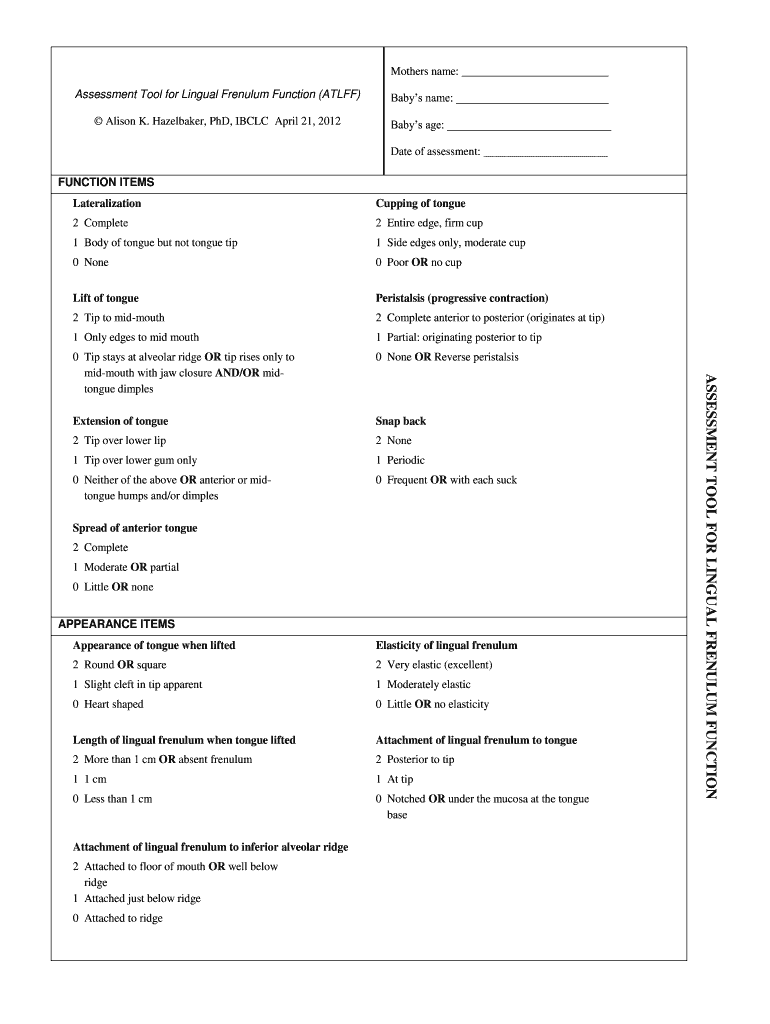
Filling out the Assessment Tool For Lingual Frenulum Function (ATLFF) online is an important step in assessing the function of the lingual frenulum. This guide will provide a clear, step-by-step approach to help you navigate and complete the form effectively.
Follow the steps to fill out the Assessment Tool For Lingual Frenulum Function online.
- Press the ‘Get Form’ button to access the Assessment Tool For Lingual Frenulum Function and open the document in your chosen editing format.
- Begin by entering the mother's name in the designated field. This is crucial for identifying the assessment.
- Next, input the baby's name, ensuring accuracy as this information is essential for the assessment.
- Fill in the baby's age, which will assist in interpreting the results appropriately.
- Record the date of the assessment to keep track of when the evaluation took place.
- Proceed to complete the function items section, where you will assess various aspects of the baby's tongue function according to the given criteria. Assign scores based on your observations.
- Next, complete the appearance items section, focusing on the characteristics of the lingual frenulum. Again, score the observations based on the provided descriptors.
- Calculate the function item score and appearance item score based on your inputs, and record these scores in the designated areas.
- Combine the scores to provide a final assessment score, which will inform treatment recommendations.
- After all fields are completed, save the changes to your document. You may also choose to download, print, or share the form as necessary.
Complete your Assessment Tool For Lingual Frenulum Function online today to ensure accurate evaluations.
Experience a faster way to fill out and sign forms on the web. Access the most extensive library of templates available.
Related content
by LH Amir · 2006 · Cited by 240 — As there is no generally agreed definition of...
The Assessment Tool for Lingual Frenulum Function (ATLFF) evaluates tongue mobility and...
Get answers to your most pressing questions about US Legal Forms API.
Is my tongue frenulum too short?
You can determine if your frenulum is too short through self-examination or with professional help. Observing any limitations in tongue movement is essential for identification. The Assessment Tool For Lingual Frenulum Function ATLFF allows for an objective evaluation to clarify whether your frenulum is functioning properly.
What is the function of the lingual frenulum?
The lingual frenulum connects the underside of the tongue to the floor of the mouth, helping to control its movement. This structure plays a crucial role in facilitating activities like speaking and swallowing. The Assessment Tool For Lingual Frenulum Function ATLFF can help assess how well this function is achieved.
How to tell if lingual frenulum is too short?
You may notice difficulties in tongue movement, especially when trying to reach the roof of the mouth or perform certain sounds if the frenulum is too short. Symptoms can also include pain or difficulty while eating. The Assessment Tool For Lingual Frenulum Function ATLFF provides a comprehensive evaluation to identify these issues.
What is a tongue tie score out of 14?
A tongue tie score out of 14 reflects how well the tongue can move based on an assessment. A lower score suggests better mobility, while a higher score indicates more restriction. With the Assessment Tool For Lingual Frenulum Function ATLFF, you can obtain this score to evaluate and understand your situation better.
What is a 14 tongue-tie score?
A 14 tongue-tie score indicates the maximum score on a specific assessment tool used to evaluate the function of the lingual frenulum. A higher score generally points to significant restrictions or issues. Utilizing the Assessment Tool For Lingual Frenulum Function ATLFF allows for accurate scoring and assessment of tongue tie severity.
What are the grades of tongue tie?
Tongue ties are typically graded based on their severity, often using a scoring system that evaluates function and mobility. The grades can range from mild to severe, reflecting the extent of restriction. The Assessment Tool For Lingual Frenulum Function ATLFF can help determine the grade of the tongue tie, guiding appropriate treatment options.
Can I get my tongue tie cut at 14?
Yes, individuals can have a tongue tie release, known as a frenectomy, at 14 or older. The procedure can alleviate discomfort and improve tongue function. If you’re considering this option, the Assessment Tool For Lingual Frenulum Function ATLFF assists in evaluating whether this procedure would benefit you.
What is considered a bad tongue tie?
A bad tongue tie significantly restricts tongue movement, affecting functions like speaking, eating, or swallowing. In severe cases, it can lead to dental issues or speech delays. The Assessment Tool For Lingual Frenulum Function ATLFF supports you in identifying the severity of the tongue tie and determining the next steps.
How do you know if a frenulum is too short?
A frenulum may be too short if it restricts tongue movement, impacting speech or eating. Signs can include difficulty sticking the tongue out or problems with certain sounds. The Assessment Tool For Lingual Frenulum Function ATLFF can help identify these limitations and provide insights into potential treatment options.
What should a lingual frenulum look like?
A healthy lingual frenulum typically appears thin, elastic, and well-positioned under the tongue. It should allow a full range of motion without restriction. Using the Assessment Tool For Lingual Frenulum Function ATLFF, you can evaluate its appearance and function to ensure it meets normal criteria.
Use professional pre-built templates to fill in and sign documents online faster. Get access to thousands of forms.
If you believe that this page should be taken down, please follow our DMCA take down process here.