Open form follow the instructions
Easily sign the form with your finger
Send filled & signed form or save
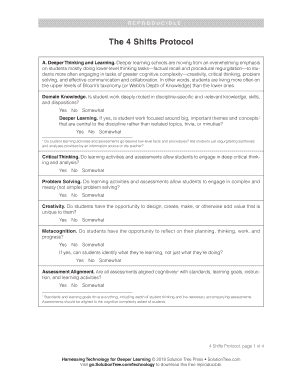
How to fill out the 4 Shifts Protocol online
The 4 Shifts Protocol is a comprehensive tool designed to enhance deeper learning by evaluating various dimensions of the educational experience. This guide provides a structured approach to filling out the protocol online, ensuring clarity and ease of understanding for all users.
Follow the steps to complete the 4 Shifts Protocol form online.
- Press the ‘Get Form’ button to acquire the protocol document and open it in the editor.
- Begin with Section A: Deeper Thinking and Learning. Here, you will assess whether student work is rooted in discipline-specific knowledge and engages in higher-order thinking tasks. Respond to each question with 'Yes', 'No', or 'Somewhat' by selecting the appropriate option next to each prompt.
- Move to Section B: Authentic Work. Evaluate if students' work reflects authentic practices used by professionals in various fields. Answer the questions similarly, selecting 'Yes', 'No', or 'Somewhat' for each item.
- Proceed to Section C: Student Agency and Personalization. This section focuses on the control students have over their learning processes. Indicate your responses based on whether students or teachers made selections regarding learning goals, activities, and assessments.
- Continue to Section D: Technology Infusion. Assess how technology enhances communication and collaboration among students. Respond to the questions using the same method as in previous sections.
- After completing all sections, review your answers for accuracy and completeness. Ensure that each selection reflects your observations accurately.
- Finally, save your changes, and choose whether to download, print, or share the completed 4 Shifts Protocol form as needed.
Begin filing the 4 Shifts Protocol online today to enhance your educational practices.
Experience a faster way to fill out and sign forms on the web. Access the most extensive library of templates available.
Related content
During the conference, we take a deep dive into the 4 Shifts Protocols, a discussion...
The ability to use the 4 Shifts Protocol to redesign lessons and units for higher student...
This article presents a dissection of the current Java Edition protocol for 1.21.8...
Get answers to your most pressing questions about US Legal Forms API.
What are protocols in teaching?
Protocols in teaching refer to established procedures that help educators deliver instructional content more effectively. These may encompass classroom routines, assessment practices, and communication strategies. By integrating insights from the 4 Shifts Protocol, teachers can improve their teaching practice and better meet student needs. Leveraging such protocols fosters an environment of continuous learning and improvement.
What are teaching protocols?
Teaching protocols are systematic procedures or guidelines that educators adopt to enhance their teaching methods. They can include lesson planning frameworks, assessment techniques, and classroom management strategies. The 4 Shifts Protocol offers a comprehensive approach to refining these methods, promoting dynamic interactions between teachers and students. Using effective teaching protocols ultimately leads to better educational outcomes.
What is a learning protocol?
A learning protocol is a structured approach that guides students in acquiring knowledge and skills. This can involve various strategies, such as collaborative discussions, peer reviews, or project-based tasks. The 4 Shifts Protocol serves as a valuable resource for developing effective learning protocols, ensuring that educational practices align with students' needs. Such protocols facilitate deeper understanding and retention of information.
What is the 4 shift protocol?
The 4 Shifts Protocol is an educational framework designed to transform teaching and learning processes. It encourages educators to rethink traditional methods and embrace innovative practices, such as personalized learning. By implementing this protocol, teachers can enhance student engagement and efficacy in reaching educational goals. This shift not only improves teaching techniques but also enriches the overall classroom experience.
What are the 4 A's protocol?
The 4 A's protocol focuses on four key components: alignment, assessment, acceleration, and achievement. These elements guide educators in evaluating and improving instructional practices within the framework of the 4 Shifts Protocol. By understanding these components, teachers can effectively structure their lessons to meet learners' needs. This approach fosters both student and teacher growth in academic settings.
What is an example of classroom protocol?
An example of classroom protocol includes setting clear expectations for student behavior and participation during lessons. For instance, the 4 Shifts Protocol emphasizes collaboration and engagement, allowing students to discuss ideas openly. These protocols streamline classroom management, enhancing both learning and teaching experiences. By adopting structured protocols, educators can create a more productive learning environment.
What is the purpose of classroom protocols?
Protocols are structured processes that encourage active listening and reflection while keeping a conversation focused on a specific topic or problem. Used effectively, protocols ensure that all voices in a group are heard and valued (Mattoon, 2015). That makes them useful for building a collaborative culture.
Why are protocols important in education?
Protocols can help schools focus on excellence, address issues and problems, and improve both the daily work of learning and long-term work related to vision and mission. HoW: Consider time already set aside for professional learning or meetings, such as faculty, grade-level, or department meetings.
What does protocol mean in physical education?
Physical Education, Sports Medicine & Physiology: Protocols In the natural sciences a protocol is a defined written procedural method in the design and implementation of experiments.
Why do we need protocols in education?
Using protocols as the routine of every independent reading time, discussion, or collaboration will allow students to learn more effectively and, importantly, to develop the habit of taking responsibility for their own learning and for contributing to the collective understanding of the group.
Use professional pre-built templates to fill in and sign documents online faster. Get access to thousands of forms.
If you believe that this page should be taken down, please follow our DMCA take down process here.