
Open form follow the instructions

Easily sign the form with your finger

Send filled & signed form or save
How to use or fill out the Irrigation Water Auditor Blank Forms Worksheets - LL Johnson - Irrigation online
Filling out the Irrigation Water Auditor Blank Forms Worksheets is essential for efficient water management in irrigation. This guide provides step-by-step instructions to help you complete the forms accurately and effectively, catering to users with varying levels of experience.
Follow the steps to complete your Irrigation Water Auditor Blank Forms Worksheets.
- Click the ‘Get Form’ button to access the Irrigation Water Auditor Blank Forms and open them in the editor.
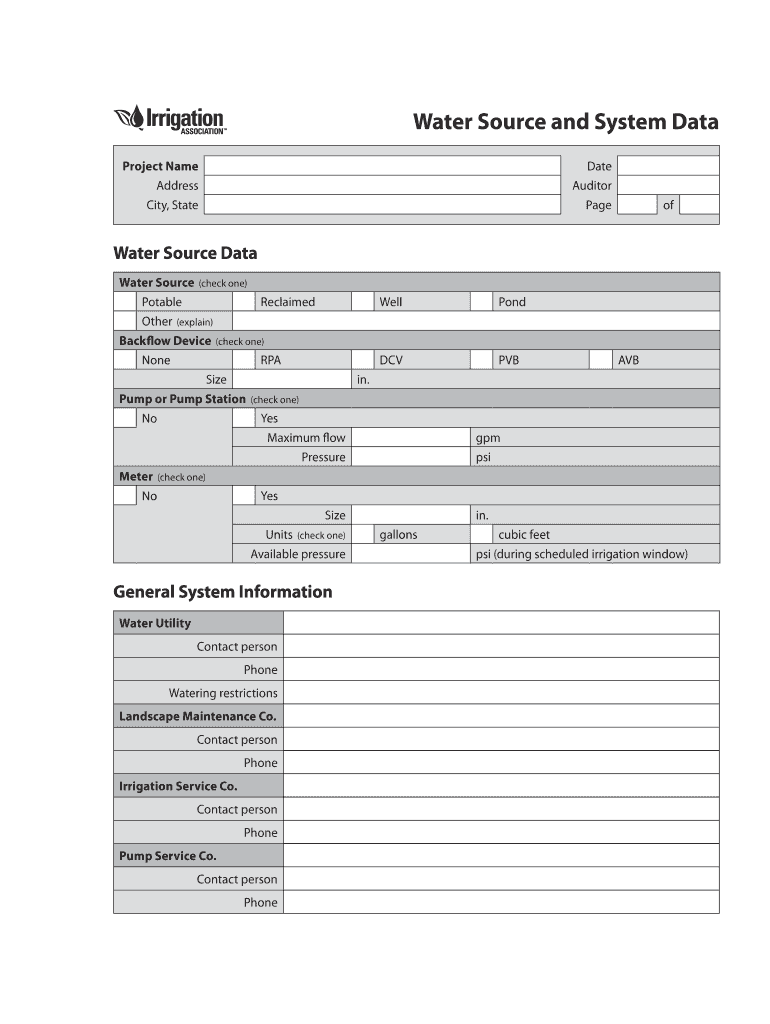
- Provide the project name, address, city, and state in the designated fields to identify your irrigation audit.
- Enter the date of the audit along with the auditor's name to document the form's completion.
- In the 'Water Source Data' section, check one option for the source: Potable, Reclaimed, Well, or Other, and if necessary, provide an explanation.
- Indicate the presence of a backflow device, pump or pump station, and meter by checking the respective boxes and providing sizes and flow rates as required.
- Fill in the 'General System Information' section with details about the water utility, contact persons, and any relevant watering restrictions.
- Complete the 'Controller Data' section by selecting whether there is central control, smart controllers, weather stations, and provide specific model numbers or settings.
- Proceed to fill out the 'Site Conditions Review', providing necessary data about plant material, soil type, observations, and maintenance frequency pertinent to the irrigation system.
- For sprinklers and drip/micro systems, specify types, flow rates, and recognize any issues or observations in the respective review sections.
- Lastly, refer to any calculations required for flow rates, precipitation rates, or distribution uniformity, and make sure to clarify data input from prior steps.
- After completing all sections, you can save any changes, download the filled forms, print them, or share with relevant parties as needed.
Start your irrigation process by filling out the necessary documents online now.
Experience a faster way to fill out and sign forms on the web. Access the most extensive library of templates available.
Related content
Dec 3, 2021 — Appendix B: Level 1 Water Loss Audit Validation Report...
by S Wyatt · 2006 — This compact disk contains worksheets and blank report forms as...
PLEASE DO NOT RETURN YOUR FORM TO THE ABOVE ADDRESS. 1. REPORT DATE (DD-MM-YYYY). 2...
Get answers to your most pressing questions about US Legal Forms API.
How do you perform a water audit?
Steps in a Water Audit Step 1: The Water Use Inventory. It is important that facility executives develop an understanding of exactly how and where their facility uses water. ... Step 2: Metering. ... Step 3: Review Maintenance Practices. ... Step 4: The Water Efficiency Plan.
What information can an irrigation audit provide?
An irrigation auditor observes each zone in a sprinkler system and the landscape surrounding sprinkler heads to identify sources of inefficient water use: broken, damaged, or leaking heads; improperly positioned sprinklers watering streets and sidewalks; sprinkler heads too low or off vertical; sprinkler heads ...
What is a landscape irrigation auditor?
Certified Landscape Irrigation Auditors develop system testing strategies, check pressure and flow rates, and conduct water application distribution tests. They collect data to determine irrigation uniformity and efficiency. They take soil samples and determine soil types and root zone depths.
How do you evaluate an irrigation system?
To assess your irrigation system you need to determine the rate that water is being applied, and how uniformly that water is being distributed. To check these you need to know the MAR, the DU, and the pressures and flows within your system.
What method is most frequently used to audit sprinkler system rate and time?
The use of catch containers or cans has long been the standard method to determine the two primary irrigation system performance measures: precipitation rate and distribution uniformity. Catch cans are used to collect water in an area of interest (that is, individual irrigation zones) over a set time.
How to do an irrigation audit?
1:52 5:39 How To Perform A Landscape Irrigation Audit - The Basics YouTube Start of suggested clip End of suggested clip Stop your timer. And record the time. Next record the amount of water collected in each catchment.MoreStop your timer. And record the time. Next record the amount of water collected in each catchment. Reading from the bottom line of the meniscus. After all catchment levels have been recorded.
Use professional pre-built templates to fill in and sign documents online faster. Get access to thousands of forms.
If you believe that this page should be taken down, please follow our DMCA take down process here.