Loading
Get Particle Theory Worksheet 2020-2026
How it works
-

Open form follow the instructions
-

Easily sign the form with your finger
-

Send filled & signed form or save
How to fill out the Particle Theory Worksheet online
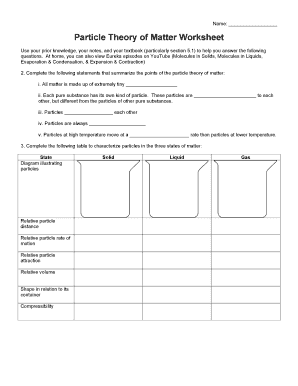
The Particle Theory Worksheet is designed to help users engage with the foundational concepts of particle theory. This guide provides step-by-step instructions for effectively completing the worksheet online while ensuring a comprehensive understanding of each component.
Follow the steps to complete the Particle Theory Worksheet online.
- Press the ‘Get Form’ button to acquire the worksheet and open it in the editing interface.
- Begin with the first section that summarizes the points of the particle theory of matter. Fill in the blanks using your prior knowledge, notes, or relevant textbook sections. Ensure you think critically about the definitions of matter and how particles relate to each other.
- Move to the table characterizing the three states of matter. You will need to draw diagrams illustrating particles and provide details for each state regarding relative particle distance, rate of motion, attraction, volume, shape, and compressibility. Use your understanding of particle theory to inform these characteristics.
- In the final section, you will explain various phenomena using concepts from particle theory. Carefully read each prompt and formulate responses that accurately describe how particle behavior clarifies the given situations. Refer to learned principles to support your explanations.
- After completing all sections, review the entire worksheet for accuracy and completeness. Make any necessary adjustments.
- Finally, save the changes made to the document. You may also choose to download, print, or share the completed worksheet as needed.
Make sure to complete your Particle Theory Worksheet online for a thorough understanding of matter and its properties.
All matter is composed of tiny indivisible particles too small to see. These particles do not share the properties of the material they make up. There is nothing in the space between the particles that make up matter. The particles which make up matter are in constant motion in all physical states.