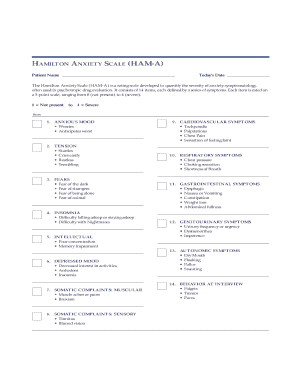
HAMA form.lay 7/14/06 3:11 PM Page 1 HAMILTON ANXIETY SCALE (HAM-A) Patient Name Today s Date The Hamilton Anxiety Scale (HAM-A) is a rating scale developed to quantify the severity of anxiety symptomatology,.

How it works
  • Open form

    Open form follow the instructions

  • Easily sign form

    Easily sign the form with your finger

  • Share form

    Send filled & signed form or save

How to fill out the Hamilton A Assessment online

The Hamilton Anxiety Scale (HAM-A) is a valuable tool used to assess and quantify the severity of anxiety symptoms. This guide will help you complete the Hamilton A Assessment online accurately and efficiently.

Follow the steps to fill out the Hamilton A Assessment online.

  1. Press the ‘Get Form’ button to access the Hamilton A Assessment and open it in your preferred digital editor.
  2. Begin by entering the patient name at the designated field. This information is necessary for identifying the assessment.
  3. In the next field, input today's date, which will serve as a reference for the timing of the assessment.
  4. Proceed to each of the 14 items listed in the assessment. For each item, circle the score that corresponds to the severity of symptoms experienced, ranging from 0 (not present) to 4 (severe).
  5. For anxious mood, evaluate and rate based on worries and anticipation of the worst outcomes.
  6. Assess tension by considering if the individual startles easily, cries often, feels restless, or experiences trembling.
  7. Rate fears by evaluating common fears such as fear of the dark, strangers, being alone, or certain animals.
  8. For insomnia, determine the difficulties faced in falling asleep, staying asleep, or experiencing nightmares.
  9. Evaluate intellectual factors by considering poor concentration and memory impairment.
  10. Assess depressed mood based on decreased interest in activities, anhedonia, and insomnia.
  11. Rate somatic complaints under muscular issues, including aches, pains, and bruxism.
  12. Complete the sensory somatic complaints section by noting any tinnitus or blurred vision.
  13. Evaluate cardiovascular symptoms such as tachycardia, palpitations, chest pain, and sensations of faintness.
  14. Assess respiratory symptoms by considering chest pressure, choking sensations, and shortness of breath.
  15. In the gastrointestinal symptoms section, rate any difficulties with swallowing, nausea, vomiting, constipation, or weight loss.
  16. Evaluate genitourinary symptoms such as urinary frequency, urgency, dysmenorrhea, or impotence.
  17. For autonomic symptoms, consider any dry mouth, flushing, pallor, or sweating.
  18. Finally, in the behavior at interview section, assess any observable behaviors like fidgeting, tremors, or pacing.
  19. Once all sections are completed and accurately filled out, you can save your changes, download, print, or share the completed Hamilton A Assessment.

Complete the Hamilton A Assessment online for effective anxiety symptom evaluation.

Get form

Experience a faster way to fill out and sign forms on the web. Access the most extensive library of templates available.

Related content

Hamilton Anxiety Rating Scale (HAM-A)

Commentary. The HAM-A was one of the first rating scales developed to measure the severity...

Learn more
Hamilton Anxiety Rating Scale (HAM-A)

Commentary. The HAM-A was one of the first rating scales developed to measure the severity...

Learn more
human-practices | SHSBNU_China - iGEM 2024

Nov 12, 2024 — - Hamilton Anxiety Rating Scale (HAMA): A scale used to assess the...

Learn more
Questions & Answers

Get answers to your most pressing questions about US Legal Forms API.

Contact support

How is Hamilton anxiety scored?

Hamilton Anxiety is scored by evaluating how a patient answers each question on the assessment. Each response is assigned a numerical value based on severity, contributing to an overall score. Understanding the scoring process enhances the utility of the Hamilton A Assessment in guiding treatment decisions.

The Hamilton rating scale for depression is distinct from the anxiety scale, focusing on symptoms related to depression rather than anxiety. To score it, you would follow similar scoring methods by assigning values based on responses to a series of questions. Utilizing both assessments can provide a comprehensive view of a patient’s mental health.

The Hamilton score for anxiety reflects the severity of anxiety symptoms, with scores ranging from 0 to 56 on the Hamilton Anxiety Rating Scale. Higher scores indicate greater anxiety levels, beneficial for both practitioners and patients. Using the Hamilton A Assessment can help track progress with treatment over time.

To calculate the anxiety score using the Hamilton A Assessment, you total the points assigned to each response from the patient's answers. Each question has a predetermined scoring scale, which usually ranges from 0 to 4. This simple calculation provides a clear understanding of the patient’s anxiety levels.

Yes, the Hamilton Anxiety Rating Scale is a copyrighted tool, which means its use may have restrictions. However, educational and clinical settings often have guidelines for its appropriate application. If you need to utilize the Hamilton A Assessment, make sure to check the specific usage rights or obtain the necessary permissions.

A normal anxiety test score on the Hamilton Anxiety Rating Scale typically falls between 0 and 7, indicating minimal anxiety. Mild anxiety is generally scored between 8 and 14, while higher scores suggest more severe anxiety. Understanding these ranges is critical for crafting an effective treatment plan using the Hamilton A Assessment.

To administer the Hamilton Anxiety Rating Scale, a licensed clinician asks the patient a set of questions related to anxiety symptoms experienced over the last week. Each question has specific responses that correspond to a scoring system. Proper administration ensures accurate assessment, making the Hamilton A Assessment a valuable tool in mental health evaluations.

The anxiety rating scale, specifically the Hamilton A Assessment, helps measure the severity of anxiety symptoms in individuals. It consists of a series of questions that assess both psychological and physical aspects of anxiety. By using this scale, clinicians can effectively evaluate a patient's mental health and make informed treatment decisions.

Scoring the GAD-7 involves adding the scores from seven specific questions, where each question rates anxiety symptoms on a scale from 0 to 3. The total score ranges from 0 to 21, with higher scores reflecting more severe anxiety. For optimal mental health care, consider using resources like UsLegalForms to find the right forms and professional guidance.

To administer the Hamilton Anxiety Rating Scale effectively, a trained clinician first engages the participant, asking about their experiences and symptoms related to anxiety. Each item is scored based on both patient responses and clinician observations, with a procedure that usually takes about 15 to 20 minutes. This thorough approach ensures an accurate assessment, leading to better treatment decisions.

Get This Form Now!

Use professional pre-built templates to fill in and sign documents online faster. Get access to thousands of forms.

If you believe that this page should be taken down, please follow our DMCA take down process here.

Get Hamilton A Assessment