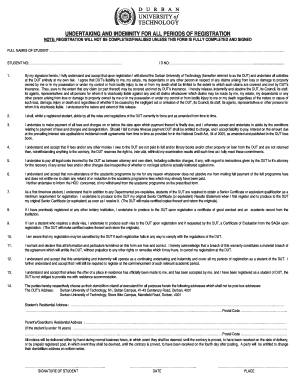
Open form follow the instructions
Easily sign the form with your finger
Send filled & signed form or save
How to fill out the Undertaking and Indemnity online
Filling out the Undertaking and Indemnity form online is an important task for students at Durban University of Technology. This guide provides clear and supportive instructions to help you complete each section of the form accurately and effectively.
Follow the steps to complete the Undertaking and Indemnity form
- Click ‘Get Form’ button to obtain the form and open it in the editor.
- Begin by entering your full names in the designated field. Ensure that your names match the official documents.
- Input your student number in the appropriate box. This number is crucial for your registration record.
- Provide your identification number (ID No.) in the specified area. Accuracy is essential for confirmation of your identity.
- Read the undertaking carefully. By signing, you accept responsibility for attending university activities at your own risk, and you acknowledge that the DUT's liability is limited.
- Next, confirm your understanding and agreement to abide by all DUT rules and regulations.
- Fill out the payment obligations by agreeing to pay all fees by their due dates and accept any applicable interest charges.
- Acknowledge that non-payment may result in the withholding of examination results until obligations are met.
- Provide all required documentation, such as your Senior Certificate, when registering and after receiving it.
- If applicable, submit any required visas and certificates upon registration.
- Review your information for accuracy. Ensure that you understand the implications of the undertaking and indemnity before signing.
- Finally, sign the document and enter the date and place where it is being signed. Verification by a commissioner of oaths may be necessary.
- Save your changes, and you may then choose to download, print, or share the completed form as needed.
Complete your documents online to ensure a smooth registration process.
Experience a faster way to fill out and sign forms on the web. Access the most extensive library of templates available.
Related content
... undertaking of indemnity. It will be the responsibility of the claimant in a foreign...
§ 248.4 Undertaking of indemnity. (a) If the check is found to be outstanding and unpaid...
Jan 5, 2017 — Such indemnity shall include, but is not limited to, financial...
Get answers to your most pressing questions about US Legal Forms API.
How to file an indemnity claim?
Filing an indemnity claim involves preparing a detailed description of the losses incurred and submitting it to the responsible party or their insurer. You will generally need to gather supporting documentation, such as receipts and incident reports, to validate your claim. US Legal Forms offers handy templates that can guide you through this process, making it easier to file your claim correctly.
What is indemnification in simple terms?
Indemnification, in simple terms, means compensating someone for loss or damage they have suffered. It is a protective measure that ensures an affected party is made whole when things go wrong. Grasping the concept of indemnification is essential for anyone involved in contracts or agreements, as it can impact financial outcomes.
How to file an indemnity?
Filing an indemnity typically involves submitting a formal claim that outlines the circumstances leading to the loss and the basis for indemnification. You will need to provide relevant documentation that supports your claim. If you're unsure how to start, consider using US Legal Forms to access templates and resources designed to simplify this process.
What is an indemnity undertaking?
An indemnity undertaking is a legal promise where one party agrees to protect another party from loss or damage resulting from specific actions or events. It outlines the responsibilities associated with indemnifying someone should a specified risk occur. Understanding this concept is vital, especially when engaging in contracts that involve significant risks.
What is the deed of undertaking and indemnity?
The deed of undertaking and indemnity is a formal legal document that combines both the commitment to perform specific actions and the promise to indemnify the other party against losses. This deed establishes a strong foundation for trust and accountability in business relationships. Utilizing resources from US Legal Forms can help you navigate the complexities of drafting such a deed effectively.
What is indemnity and undertaking?
Indemnity and undertaking often go hand in hand, with indemnity providing financial protection and undertaking representing a commitment to fulfill specific obligations. Together, they create a robust framework in legal agreements, ensuring that parties uphold their responsibilities while addressing potential liabilities. This combination is particularly useful in various financial and legal contexts.
What is an indemnity in simple terms?
Indemnity, in simple terms, refers to a promise made by one party to compensate another for specific losses or damages. It acts as a safeguard, ensuring that if something goes wrong, the affected party receives financial protection. Understanding indemnity is essential for individuals and businesses alike to minimize risks during agreements.
What is the purpose of an indemnity agreement?
An indemnity agreement serves to protect one party from potential losses or damages incurred by another party. By outlining each party's responsibilities, it clarifies the scope of liability and ensures that all parties have a clear understanding of their obligations. This agreement is crucial in business transactions where risks are involved. With tools from US Legal Forms, you can easily draft a tailored indemnity agreement.
How long is a check good for in Ontario?
A cheque in Ontario is generally considered good for six months. After this timeframe, it is often classified as stale and may not be accepted for cashing or depositing. If you have a cheque nearing its expiration, actively seeking a resolution with the issuer can save you from potential losses. In such situations, looking into legal structures like undertaking and indemnity may offer assistance.
How long is a cheque valid for in Ontario?
In Ontario, a cheque is valid for six months from the date written on it. After this time, it may be deemed stale, and banks often will not honor it. If you encounter issues related to cheque validity, considering agreements focused on undertaking and indemnity can provide clear guidance and protection.
Use professional pre-built templates to fill in and sign documents online faster. Get access to thousands of forms.
If you believe that this page should be taken down, please follow our DMCA take down process here.