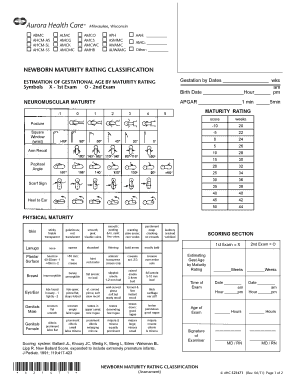
Milwaukee, Wisconsin ABMC AHCMAS AHCMSL AHCMSS ALMC AMCG AMCK AMCMC AMCO AMCS AMCWC AMHB APH ASMMC AWAMC AUWAMG AAH: AMG: Other: NEWBORN MATURITY RATING CLASSIFICATION ESTIMATION OF GESTATIONAL AGE.

How it works
  • Open form

    Open form follow the instructions

  • Easily sign form

    Easily sign the form with your finger

  • Share form

    Send filled & signed form or save

How to fill out the Newborn Maturity Rating And Classification online

This guide provides clear, step-by-step instructions for users on how to fill out the Newborn Maturity Rating And Classification form online. The aim is to help you accurately assess and classify newborn maturity based on various parameters.

Follow the steps to complete the form effectively.

  1. Click the ‘Get Form’ button to access the Newborn Maturity Rating And Classification form and open it for editing.
  2. Begin by entering the details of the newborn, including the gestational age measured in weeks, and the birth date along with the time it occurred.
  3. Complete the neuromuscular maturity section by filling in the APGAR scores for 1 minute and 5 minutes, selecting the appropriate values based on the infant's condition.
  4. Evaluate the maturity rating by assessing various components such as posture, arm recoil, and heel to ear among others. Use the provided scoring scale to record scores accurately.
  5. Fill out the physical maturity section, detailing observations related to skin condition, lanugo, and other physical characteristics.
  6. Complete the scoring section by recording the details of the first and second examinations, ensuring to include the signatures of the examiners.
  7. Finally, review all data entered in the form for accuracy. Save changes, and if needed, download, print, or share the completed form.

Start filling out the Newborn Maturity Rating And Classification form online today.

Get form

Experience a faster way to fill out and sign forms on the web. Access the most extensive library of templates available.

Related content

Measurement of Fetal and Infant Maturity - Preterm...

by RE Behrman · 2007 · Cited by 8 — This field requires a better classification of...

Learn more
Gestational Age Assessment

Scores are given for 6 physical and 6 nerve and muscle development (neuromuscular) signs...

Learn more
HHS-Developed Risk Adjustment Model Algorithm...

Infants without diagnoses will be assigned to the lowest severity category and the Age 1...

Learn more
Questions & Answers

Get answers to your most pressing questions about US Legal Forms API.

Contact support

What is the rating of a newborn?

The rating of a newborn assesses their health and developmental state right after birth. This evaluation often covers various factors, including growth metrics and reflexes. The Newborn Maturity Rating And Classification acts as a valuable tool in helping parents comprehend and track their newborn's progress. Knowing the rating allows for proactive health decisions and care tailored to a baby's unique needs.

A newborn maturity rating evaluates a baby's developmental readiness and overall health in their first days of life. This rating takes into account gestational age, physical condition, and specific health assessments. It serves as a crucial component of the Newborn Maturity Rating And Classification, providing essential information to caregivers. Understanding this rating helps parents feel more informed and confident in their baby's care.

The score for a newborn baby typically reflects their health assessments post-birth. This may involve numerical ratings across various health metrics. The Newborn Maturity Rating And Classification offers a comprehensive score that helps healthcare providers and parents understand a newborn's condition better. A clear score can guide necessary actions and supports a baby's healthy transition into life outside the womb.

The baby ranking scale often relates to various assessments designed to evaluate a newborn's health and development. Specifically, this could include measurements of reflexes, responses to stimuli, and physiological metrics. The Newborn Maturity Rating And Classification utilizes these scales to provide parents with a clear picture of their baby's health. This information is vital for ensuring timely care and addressing developmental concerns.

A normal rate for a newborn can refer to several health indicators, including heart rate, breathing rate, and weight gain. Generally, a newborn's heart rate should be between 120 and 160 beats per minute, while their breathing rate should be around 30 to 60 breaths per minute. Monitoring these rates is part of the Newborn Maturity Rating And Classification, which offers crucial insight into a baby's overall well-being and development.

Age classification for newborns often refers to those who are up to 28 days old. Newborns fall into two primary categories: premature, if born before 37 weeks of gestation, and full-term, if born between 37 and 42 weeks. The Newborn Maturity Rating And Classification helps parents understand where their child fits within these classifications and what that means for their care.

The newborn health rating is a system used to assess a baby's condition soon after birth. This rating considers various health indicators, such as breathing, heart rate, and reflexes. By utilizing the Newborn Maturity Rating And Classification, healthcare providers can deliver essential guidance to new parents regarding their baby's health status. It creates a clearer understanding of what to expect in the early days.

Newborns are typically classified based on their gestational age, weight, and overall health. Medical professionals use these factors to determine the most appropriate category for each newborn. This classification aids in deciding the necessary care and interventions, ensuring every baby receives the right support. Understanding the Newborn Maturity Rating And Classification can help parents and caregivers grasp their baby’s needs.

The physical maturity assessment of a newborn includes evaluating characteristics like skin color, muscle tone, and reflex responses. These aspects provide insight into the infant's maturity level and overall health. Utilizing the Newborn Maturity Rating And Classification ensures that assessments are thorough and reliable, facilitating better healthcare decisions.

Assessing maturity in a newborn involves observing multiple factors, such as their physical development and behavioral responses. Health professionals often rely on established criteria to gauge overall maturity. The Newborn Maturity Rating And Classification framework aids in this assessment, offering a clear structure for determining developmental progress.

Get This Form Now!

Use professional pre-built templates to fill in and sign documents online faster. Get access to thousands of forms.

If you believe that this page should be taken down, please follow our DMCA take down process here.

Get Newborn Maturity Rating And Classification