Open form follow the instructions
Easily sign the form with your finger
Send filled & signed form or save
How to fill out the Framingham Risk Score online
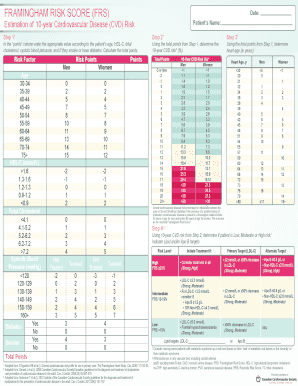
The Framingham Risk Score is an important tool for estimating a person’s 10-year risk of cardiovascular disease. This guide provides step-by-step instructions to help you accurately complete the form online, ensuring a clear understanding of each component.
Follow the steps to accurately complete the Framingham Risk Score.
- Click ‘Get Form’ button to obtain the form and open it for editing.
- In the first section, provide the patient's details, including their name and the date.
- For the estimation of 10-year cardiovascular disease risk, locate the points column. Based on the patient's age, HDL-C levels, total cholesterol, systolic blood pressure, smoking status, and diabetes status, enter the appropriate values to calculate total points.
- Using the total points calculated, refer to the heart age chart to determine the patient's heart age.
- Consult the 10-year cardiovascular disease risk table to ascertain the risk percentage corresponding to the total points for both men and women.
- Evaluate the risk level (low, moderate, or high) based on the 10-year cardiovascular disease risk percentage and indicate the relevant lipid and Apo B targets.
- Once all sections are completed, review the information for accuracy. You can then save changes, download, print, or share the form as needed.
Complete your Framingham Risk Score online today to gain valuable insights into cardiovascular health.
Experience a faster way to fill out and sign forms on the web. Access the most extensive library of templates available.
Related content
by NJ Bosomworth · 2011 · Cited by 166 — The Framingham risk score (FRS) has evolved...
The app estimates a patient's 10-year ASCVD risk at initial visits, forecasts intervention...
The Framingham risk calculator is intended for men and women who have not already had a...
Get answers to your most pressing questions about US Legal Forms API.
How to calculate your risk score?
To calculate your risk score, collect necessary health information, such as age, cholesterol levels, and blood pressure readings. Input these figures into the Framingham Risk Score calculator available through various health resources. Accurate self-evaluation is crucial, and tools from US Legal Forms can simplify this process for you.
How do you measure your risk?
Measuring your risk involves evaluating your personal health data against established benchmarks like the Framingham Risk Score. Regular check-ups and assessments are vital, as they help you track changes over time. Taking proactive steps with platforms like US Legal Forms can enhance your ability to monitor your health effectively.
What is the formula for calculating risk index?
The formula for calculating a risk index often combines various health metrics, similar to the Framingham Risk Score. It may consider multiple health parameters, such as cholesterol levels and blood pressure, to create an overall index. Understanding how this index works can empower you to make healthier lifestyle choices.
Is the Framingham risk score still used?
The Framingham Risk Score remains a widely accepted tool in modern medicine. Many healthcare providers still use it to evaluate patients' cardiovascular risks and guide treatment decisions. By staying informed about your Framingham Risk Score, you can actively engage in your health management.
How do you calculate the Framingham risk score?
Calculating the Framingham Risk Score requires inputting personal health information into the established formula. Factors like age, resting blood pressure, cholesterol levels, and smoking habits play significant roles in this calculation. Utilizing a reliable platform like US Legal Forms can assist you in accurately determining your risk score and understanding its implications.
How do you calculate a risk score?
Calculating a risk score involves compiling data from various health indicators, such as cholesterol levels, blood pressure, and lifestyle choices. The Framingham Risk Score uses these factors to provide a percentage risk of having a heart attack within a specific timeframe. An accurate calculation can serve as a crucial tool in managing your health effectively.
What is the formula to calculate risk?
To calculate risk, the formula often considers factors like age, gender, cholesterol levels, blood pressure, smoking status, and diabetes. These inputs help determine an individual's overall risk for cardiovascular events. By using the Framingham Risk Score formula, you can gain valuable insight into your health risks and make informed choices.
What is the normal range for the Framingham risk score?
The normal range for the Framingham Risk Score typically falls between 0 to 30 percent risk over ten years. A score of less than 10 indicates low risk, while a score over 20 suggests high risk. Understanding where you fall within this range can guide your health decisions, and tools like US Legal Forms can help streamline your health assessments.
What is a normal cardiac risk score?
A normal cardiac risk score is typically considered to be below 10% in the Framingham Risk Score framework. This signifies that an individual has a low risk of experiencing heart disease within the next ten years. Regular monitoring and lifestyle adjustments can help maintain a normal score.
What is the Framingham score UK?
The Framingham score UK is a specific adaptation of the Framingham Risk Score tailored for the UK population. This version accounts for different health statistics and risk factors relevant to the UK demographic. Using the Framingham score UK allows you to gauge your cardiovascular health effectively.
Use professional pre-built templates to fill in and sign documents online faster. Get access to thousands of forms.
If you believe that this page should be taken down, please follow our DMCA take down process here.