How it works
  • Open form

    Open form follow the instructions

  • Easily sign form

    Easily sign the form with your finger

  • Share form

    Send filled & signed form or save

How to fill out the Chapter 3 Section 1 Guided Reading The Indo Europeans Answer Key online

This guide provides a comprehensive overview of how to accurately complete the Chapter 3 Section 1 Guided Reading The Indo Europeans Answer Key online. By following these instructions, users will be able to navigate the form effectively and ensure all required details are captured accurately.

Follow the steps to complete your guided reading answer key.

  1. Click the ‘Get Form’ button to access the guided reading answer key and open it for editing.
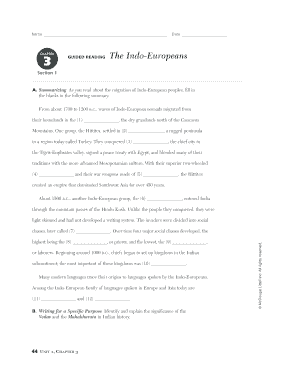
  2. Begin with section A, which requires summarizing the migration of Indo-European peoples. Fill in the blanks by reading the surrounding text carefully and using your knowledge to complete the sentences.
  3. For each blank, consider the historical context and use the information provided to ensure accuracy in your responses. Pay attention to keywords such as specific locations and cultural details.
  4. Move on to section B, where you will identify and explain the significance of the Vedas and the Mahabharata in Indian history. Provide thoughtful insights based on your understanding and research.
  5. Once all sections are completed, review your responses for completeness and clarity. Ensure that all fields are filled according to the instructions.
  6. Save your changes to the document. You may also choose to download, print, or share the completed guided reading answer key as needed.

Complete your guided reading answer key online to enhance your understanding of Indo-European history.

Get form

Experience a faster way to fill out and sign forms on the web. Access the most extensive library of templates available.

Related content

Origin Of Indo European Languages

The Indo-European languages comprise a diverse group of languages spoken primarily across...

Learn more
UF Quest 1 – Identities General...

2019 — Historical And Linguistic Overview. The Most Prominent European Language Groups:...

Learn more
User Guide

Page 3. Contents. About this documentation. . . . . . . . iii. Chapter 1. Meet your...

Learn more
Questions & Answers

Get answers to your most pressing questions about US Legal Forms API.

Contact support

What are the Indo European migrations?

The Indo-European migrations are hypothesized migrations of Proto-Indo-European language (PIE) speakers, and subsequent migrations of people speaking derived Indo-European languages, which took place approx. 4000 to 1000 BCE, potentially explaining how these languages came to be spoken across a large area of Eurasia, ...

The term Indo-European was introduced in 1816 by Franz Bopp of Germany and referred to a family of languages in Europe and Asia (including Northern India, Iran, Afghanistan, Pakistan, and desh) that were found to have a remarkable structural relationship.

The Indo-European family is significant to the field of historical linguistics as it possesses the second-longest recorded history of any known family, after the Afroasiatic family in the form of the pre-Arab Egyptian language and the Semitic languages.

The term Indo-European was introduced in 1816 by Franz Bopp of Germany and referred to a family of languages in Europe and Asia (including Northern India, Iran, Afghanistan, Pakistan, and desh) that were found to have a remarkable structural relationship.

They are (linguistic) descendants of the people of the Yamnaya culture (c. 3600-2300 BCE) in Ukraine and southern Russia, and settled in the area from Western Europe to India in various migrations in the third, second, and early first millenniums BCE.

The ancestors of Italians are mostly Indo-European speakers (Italic peoples such as Latins, Falisci, Picentes, Umbrians, Samnites, Oscans, Sicels and Adriatic Veneti, as well as Celts, Iapygians and Greeks) and pre-Indo-European speakers (Etruscans, Ligures, Rhaetians and Camunni in mainland Italy, Sicani in Sicily and ...

(Japanese, Greek, and Sanskrit have been transliterated — written in the Roman alphabet.) You probably noticed some similarities among all of the languages except Japanese. In fact, all except Japanese belong to the Indo-European family.

They lived in tribes that spoke forms of a language that we call Indo-European. were the ancestors of many of the modern languages of Europe, Southwest Asia, and South Asia. English, Spanish, Persian, and Hindi all trace their origins back to different forms of the original Indo-European language.

The geographical location where it was spoken, the Proto-Indo-European homeland, has been the object of many competing hypotheses; the academic consensus supports the Kurgan hypothesis, which posits the homeland to be the Pontic–Caspian steppe in what is now Ukraine and southern Russia, associated with the Yamnaya ...

Published in the journal Nature today, a new study by an international team led by scientists at Harvard Medical School and the Australian Center for Ancient DNA has shown that at least some of the Indo-European languages spoken in Europe were likely introduced by a massive migration from the Russian steppe.

Get This Form Now!

Use professional pre-built templates to fill in and sign documents online faster. Get access to thousands of forms.

If you believe that this page should be taken down, please follow our DMCA take down process here.

Get Chapter 3 Section 1 Guided Reading The Indo Europeans Answer Key