How it works
  • Open form

    Open form follow the instructions

  • Easily sign form

    Easily sign the form with your finger

  • Share form

    Send filled & signed form or save

How to fill out the Structured Cabling Checklist online

This guide provides clear and detailed instructions on how to complete the Structured Cabling Checklist online. By following these steps, users can ensure that every required section is accurately filled out, facilitating compliance with quality standards and operational procedures.

Follow the steps to effectively complete the checklist.

  1. Press ‘Get Form’ button to access the checklist and open it in the editor.
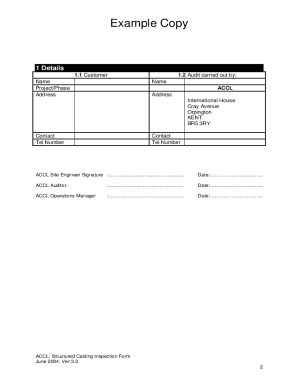
  2. Begin by filling out the 'Details' section. Provide the customer's name, project phase, address, contact information, and the names of the individuals carrying out the audit.
  3. Move to the 'Channel Model' section. Indicate the type of copper and fiber used, selecting from provided options such as UTP, STP, or different fiber types.
  4. In the 'Cabinets Frames' section, specify the type of cabinet used and answer yes or no to questions about earthing and bonding.
  5. Proceed to the 'Cabling' section where you will verify installations by checking their compliance with specified criteria, such as securing cables and proper separation of power/data.
  6. Fill out the 'Copper Voice Terminations' and 'Copper Data Terminations' sections, ensuring all relevant questions are answered, and appropriate notes are provided when necessary.
  7. Continue to the 'Fibre Terminations' section, confirming details about the fiber optic connections and their compliance.
  8. Complete the 'Labelling' section by confirming that all labels are visible and correctly formatted.
  9. Answer the questions in the 'Copper Testing' and 'Optical Fibre Testing' sections, specifying equipment used and test results.
  10. Lastly, in the 'Additional Information' section, provide any necessary notes regarding sections that were marked as no or N/A.
  11. Once all sections are complete, save your changes, and choose to download, print, or share the form as needed.

Complete your Structured Cabling Checklist online today to ensure thorough documentation and compliance.

Get form

Experience a faster way to fill out and sign forms on the web. Access the most extensive library of templates available.

Related content

Cabling standard

Jul 21, 2008 — This standard provides guidance and requirements for data, voice, and...

Learn more
OTS Structured Cabling Installation Checklist.docx

Structured Cabling System Installation Checklist. Project Details Checklist Date. Client...

Learn more
Shure DIS Cabling Best Practices

Only use the solid conductor type for structured cables that terminate to a patch panel...

Learn more
Questions & Answers

Get answers to your most pressing questions about US Legal Forms API.

Contact support

What are the 6 components of structured cabling?

The six components of structured cabling are Entrance Facilities, Equipment Room, Backbone Cabling, Telecommunications Room, Horizontal Cabling and Work Area. In decades past, cabling for voice and data communications systems was far less complex than it is today.

A properly designed and installed structure cabling system provides a cabling infrastructure that delivers predictable performance as well as has the flexibility to accommodate moves, additions, and changes; maximizes system availability; provides redundancy; and future proofs the usability of the cabling system.

What is the international standard for structured cabling? ISO/IEC 11801 is the international standard for structured cabling – This International standard structured cabling is suitable for a wide range of applications (analog & ISDN telephony, various data communication standards etc.

There are three main types of structured cabling – twisted pair, coaxial, and optical fiber. They all have specific standards which you should be aware of when installing or upgrading your network. 1) Twisted pair cables are the most used type of cable for data transmission, but they have low transmission speeds.

Structured cabling tests ensure that there are no damages or faults within your cabling infrastructure. Furthermore, It verifies that all equipment is connected to the correct ports, patch cables are correctly labelled, everything is grounded properly and meets all safety, performance, and regulatory standards.

In telecommunications, structured cabling is building or campus cabling infrastructure that consists of a number of standardized smaller elements (hence structured) called subsystems. Structured cabling components include twisted pair and optical cabling, patch panels and patch cables.

Structured cabling system consists of six essential components. They are horizontal cabling, backbone cabling, work area, telecommunications closet, equipment room & entrance facility.

The Six Main Components of a Structured Cabling System. >The main components of forming a structured cabling system include entrance facilities, backbone and horizontal cabling, telecommunications and equipment rooms, and workstations.

Get This Form Now!

Use professional pre-built templates to fill in and sign documents online faster. Get access to thousands of forms.

If you believe that this page should be taken down, please follow our DMCA take down process here.

Get Structured Cabling Checklist