Open form follow the instructions
Easily sign the form with your finger
Send filled & signed form or save
How to fill out the Label A Ukulele online
Filling out the Label A Ukulele form is a straightforward process that allows users to accurately identify and label the parts of a ukulele. This guide will provide clear, step-by-step instructions to ensure you complete the form correctly.
Follow the steps to complete the Label A Ukulele form.
- Click ‘Get Form’ button to obtain the form and open it in the editor.
- Begin by entering your name in the designated field labeled ‘NAME’ at the top of the form.
- In the next field labeled ‘Class,’ specify your class or relevant identifier.
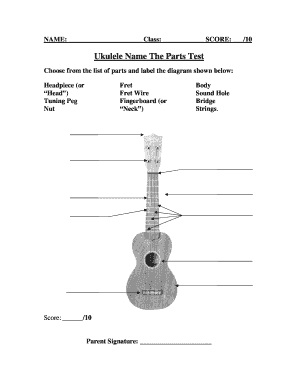
- Review the diagram of the ukulele provided in the form. You will see various parts labeled with numbers.
- Next to each diagram part, write the correct labels from the provided list: Headpiece, Tuning Peg, Nut, Fret, Fret Wire, Fingerboard, Body, Sound Hole, Bridge, and Strings.
- After labeling the parts, calculate your score based on correctness and enter it in the SCORE section.
- Lastly, ensure that you have a space for a parent or guardian's signature and include their name in the designated ‘Parent Signature’ field.
- Review all your entries for accuracy. You can then save changes, download, print, or share the completed form as needed.
Start completing your Label A Ukulele form online today!
Experience a faster way to fill out and sign forms on the web. Access the most extensive library of templates available.
Related content
But that's no reason to deny the label of "state instrument" to the 'ukulele. ... The...
Personalized label inside the ukulele Gear ... Give us a text you want to have on a label...
Aug 27, 2025 — It is a four-stringed guitar-type instrument, about 2/3 the size of a...
Get answers to your most pressing questions about US Legal Forms API.
How to know what ukulele to get?
Choosing the right ukulele depends on your playing style and skill level. If you are a beginner, consider starting with a soprano or concert ukulele, as they offer a fun introduction. Those with more experience may prefer a tenor or baritone for their richer sound. When deciding on what to label a ukulele, think about your musical goals and how each type can help you achieve them.
How to identify a ukulele?
Identifying a ukulele involves looking at its distinct features such as size, shape, and sound. Check for its four strings and smaller body compared to guitars or other string instruments. Additionally, consider the sound produced when strummed, which often has a bright and cheerful tone. Learning how to accurately label a ukulele can not only help you recognize yours but also assist in selecting one that matches your style.
How to label strings on a ukulele?
Labeling strings on a ukulele helps you master chord shapes and finger placements. Use small stickers or colorful markers to identify each string—G, C, E, and A—starting from the top. Ensure the labels are clear but unobtrusive, so they do not hinder your playing. This practice enhances your learning experience and makes it easier to share your skills with others when you label a ukulele.
What are the 4 types of ukuleles?
The four primary types of ukuleles are soprano, concert, tenor, and baritone. The soprano is the smallest, often producing a bright, cheerful sound. The concert is slightly larger, providing more volume and a richer tone. The tenor offers an even deeper sound, while the baritone is the largest and can be tuned like the top four strings of a guitar, giving you diverse musical options as you label a ukulele.
How to recognize a good ukulele?
A good ukulele typically has a solid body, well-finished frets, and proper tuning pegs. When examining a ukulele, check the craftsmanship, look for any imperfections, and play a few chords to assess the sound quality. Additionally, consider the materials used; higher-quality woods contribute to a richer tone. By knowing how to label a ukulele, you can find one that meets your standards for both performance and aesthetics.
How do I tell what type of ukulele I have?
Identifying the type of ukulele involves examining its size and shape. Common types include soprano, concert, tenor, and baritone. Each type has specific dimensions and tonal qualities, so measure your ukulele and compare it with standard sizes. Knowing how to label a ukulele type can enhance your playing experience and inform your choice of music.
How to put on ukulele stickers?
Applying ukulele stickers is a simple process that allows you to personalize your instrument. First, ensure the ukulele surface is clean and dry. Next, carefully peel off the sticker and place it on the desired spot, smoothing it down to avoid air bubbles. This is a great way to label a ukulele, making it uniquely yours while also protecting the finish.
How to tell the difference between a guitar and a ukulele?
To identify whether you have a guitar or a ukulele, focus on the size and number of strings. A ukulele is smaller, usually with four nylon strings, while a guitar typically has six strings made of steel. Additionally, check the body shape; ukuleles have a more rounded body compared to guitars. Understanding these differences can help you label a ukulele accurately and appreciate its unique features.
How to convert guitar into ukulele?
Converting guitar music into ukulele requires altering chord progressions and melodies to suit the ukulele's tuning and playing style. You can either simplify the music or adapt it by using chord charts specific to the ukulele. This practice not only helps you learn but also solidifies your ability to label a ukulele creatively.
How to transcribe guitar to ukulele?
Transcribing guitar music to ukulele involves taking the original song and adjusting it for the ukulele's four-string format. Focus on matching the chords first and then adapt the melody as needed. Keep a reference of the original piece handy as you work to ensure you effectively label a ukulele's unique sound.
Use professional pre-built templates to fill in and sign documents online faster. Get access to thousands of forms.
If you believe that this page should be taken down, please follow our DMCA take down process here.