Open form follow the instructions
Easily sign the form with your finger
Send filled & signed form or save
How to fill out the sensory assessment checklist online
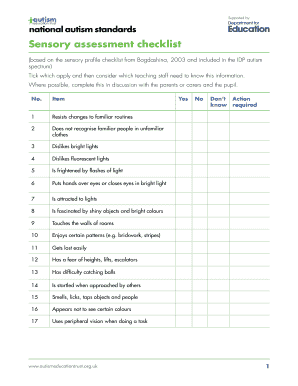
The sensory assessment checklist is a valuable tool designed to identify sensory processing difficulties in individuals, particularly those on the autism spectrum. This guide provides step-by-step instructions to help users complete the checklist online effectively and efficiently.
Follow the steps to complete the sensory assessment checklist online.
- Press the ‘Get Form’ button to access the sensory assessment checklist and open it in your chosen online platform.
- Begin reviewing each item on the checklist carefully. The items will ask about various sensory sensitivities or preferences. For each statement, determine whether it applies to the individual by marking 'Yes,' 'No,' or 'Don't know.'
- Consider discussing the items with the individual’s parents or caregivers to ensure accuracy. Their input can provide essential context and clarity.
- After completing the checklist, review your responses to ensure all relevant items are marked appropriately. Make any necessary adjustments based on further discussions.
- Once the checklist is complete, users can save changes directly to their device. You may also have the option to download or print the completed form for your records.
- Finally, share the checklist with relevant teaching staff or support personnel who need to be informed about the sensory needs of the individual.
Complete the sensory assessment checklist online for a better understanding of sensory processing needs.
Experience a faster way to fill out and sign forms on the web. Access the most extensive library of templates available.
Related content
This checklist includes activities for movement, touch/temperature, auditory, vision...
May 9, 2024 — Common tools include the Sensory Profile, Sensory. Processing Measure, and...
Your four-part Gander Instruction Manual is designed to help you better understand and...
Get answers to your most pressing questions about US Legal Forms API.
What are the four sensory processing patterns?
The four sensory processing patterns are sensory seekers, sensory avoiders, sensory registrators, and sensory modulators. Each pattern indicates a unique way people relate to sensory experiences, influencing behavior and interaction. By utilizing a Sensory Assessment Checklist, caregivers can gain valuable insights into these patterns, leading to more effective support and interventions.
What are the signs of low sensory registration?
Signs of low sensory registration may include a lack of awareness of surroundings, difficulty focusing in noisy environments, and missing out on social cues. Individuals may appear disinterested or disconnected due to their challenges in processing sensory information. A Sensory Assessment Checklist can assist in identifying these signs, allowing for effective strategies to enhance sensory awareness.
What are the 4 sensory patterns?
The four sensory patterns include seeking, avoiding, registering, and sensory modulation. Each pattern represents a different way individuals interact with sensory input from their environments. A Sensory Assessment Checklist can help identify which patterns are dominant in an individual, leading to better understanding and support from caregivers and professionals.
What are the 5 stages of sensory processing?
The five stages of sensory processing are detection, discrimination, organization, integration, and modulation. These stages outline the process by which the brain interprets sensory information and prepares appropriate responses. Understanding these stages with tools like a Sensory Assessment Checklist helps in developing tailored interventions that can enhance function.
What are the different sensory processing disorders?
Sensory processing disorders encompass a range of difficulties in responding appropriately to sensory stimuli. Common types include sensory modulation disorder, sensory discrimination disorder, and sensory-based motor disorder. By identifying these challenges with a Sensory Assessment Checklist, caregivers can better advocate for effective treatment plans and support.
What are the 4 types of sensory processing?
The four types of sensory processing include sensory registration, sensory modulation, sensory discrimination, and sensory integration. Each type affects how individuals respond to sensory inputs in their environment. Understanding these types through a Sensory Assessment Checklist can reveal critical information that aids in developing personalized strategies.
What is included in a sensory assessment?
A sensory assessment usually encompasses a variety of components such as questionnaires, observational checklists, and sometimes standardized tests. These elements collectively paint a clearer picture of an individual's sensory processing abilities and challenges. Using a Sensory Assessment Checklist, professionals can gain insights that inform effective interventions and support strategies.
What is a sensory checklist for?
A sensory checklist is a useful tool that helps individuals evaluate their sensory processing abilities. It identifies specific sensory preferences and challenges, guiding parents, teachers, and therapists in understanding a person's sensory needs. Utilizing a Sensory Assessment Checklist enhances awareness and supports tailored strategies that improve daily experiences.
Who can do a sensory profile assessment?
Only qualified professionals, such as occupational therapists or psychologists, should conduct a sensory profile assessment. They rely on the Sensory Assessment Checklist to obtain and analyze critical information related to sensory processing. Our platform can help you find the right professionals to lead this important assessment, ensuring accurate results and tailored support.
Who completes a sensory assessment?
A sensory assessment is usually completed by the professional conducting the evaluation, with input from caregivers and educators. They may also guide parents in filling out the Sensory Assessment Checklist, which provides essential insights into the child’s sensory preferences and challenges. Effective communication ensures a holistic understanding of the individual’s sensory responses.
Use professional pre-built templates to fill in and sign documents online faster. Get access to thousands of forms.
If you believe that this page should be taken down, please follow our DMCA take down process here.