Loading
Form preview
  • US Legal Forms
  • Other Templates
  • More Forms
  • More Multi-State Forms
  • Certificate Of Appropriateness 2020

Get Certificate Of Appropriateness 2020-2026

How it works

  1. Open form

    Open form follow the instructions

  2. Easily sign form

    Easily sign the form with your finger

  3. Share form

    Send filled & signed form or save

How to fill out the Certificate of Appropriateness online

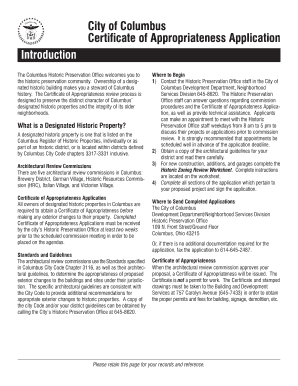
This guide provides clear, step-by-step instructions on how to fill out the Certificate of Appropriateness application online. Completing this form is essential for owners of designated historic properties in Columbus who wish to make exterior changes.

Follow the steps to complete your application accurately.

  1. Press the ‘Get Form’ button to access the Certificate of Appropriateness application and open it for editing.
  2. Fill in the applicant information section. Type or print legibly the property address, applicant name, and contact details. If the applicant is not the owner, ensure they are authorized to propose changes.
  3. Provide the property owner's information, including their mailing address and contact information. This section should also be filled out legibly.
  4. Select the project classification that applies to your proposed changes by checking the relevant boxes. Include 'Conceptual Review,' 'New Construction,' 'Exterior Building Alteration,' 'Landscaping,' 'Signage or Graphics,' 'Variance or Zoning Change,' or 'Demolition.'
  5. Describe your project in detail in the work description section. Outline all proposed changes, materials to be used, and provide any necessary details to help the review committee understand your intentions.
  6. Compile any required materials to accompany your application, such as color photos, drawings, material samples, or a site plan. Ensure these materials follow the specifications listed.
  7. Sign and date the application, certifying that the information provided is accurate and that you have authorization from the property owner.
  8. Once completed, save your changes, download a copy for your records, and print or share the form as needed. Ensure you submit the form to the Historic Preservation Office before the application deadlines.

Get started on your Certificate of Appropriateness application today to ensure timely submission.

Get form

Experience a faster way to fill out and sign forms on the web. Access the most extensive library of templates available.
Get form

Related content

Certificate of Appropriateness - LPC
A Certificate of Appropriateness is needed when work affects protected architectural...
Learn more
Certificates of Appropriateness and Quasi-Judicial...
May 28, 2025 — What projects need a Certificate of Appropriateness? In general, a major...
Learn more
Certificates of Confidentiality
This guidance1 describes FDA implementation of the revised provisions applicable to the...
Learn more

Related links form

CollegeAmerica Distribution Request Form - American Funds RecordkeeperDirect Deconversion Request - American Funds PHADA - Public Housing Authorities Directors Association - Phada Phada App Form

Questions & Answers

Get answers to your most pressing questions about US Legal Forms API.

Contact support

A certificate of compliance is typically issued by local government authorities or specific regulatory bodies. This document confirms that a project or business adheres to zoning laws and building codes. When applying for a Certificate Of Appropriateness, this certificate may help showcase your dedication to following legal requirements. At USLegalForms, we can assist you in obtaining the necessary documents and streamlining this process.

In construction, COA stands for Certificate Of Appropriateness. This certificate is essential for property owners seeking to alter or establish buildings that are part of historic districts. It signifies that your proposed changes align with local architectural guidelines, ensuring that the integrity of the area remains preserved. Engaging with the correct processes not only protects your investment but also endorses community values.

A certificate of conformity certifies that a product meets certain regulatory standards, while a certificate of analysis provides detailed information about the composition of a product. In real estate, understanding these documents can be crucial, especially when applying for a Certificate Of Appropriateness. Ensuring that your property aligns with the necessary regulations can help you assess what modifications are acceptable.

A certificate of inclusion refers to the document that acknowledges a property or structure meets specific eligibility criteria under regulations. This includes design standards and historical significance. In the context of a Certificate Of Appropriateness, having a certificate of inclusion can streamline your application for making modifications to a historic property. By ensuring compliance with guidelines, you can enhance your chances of receiving approval.

In architecture, COA denotes Certificate Of Appropriateness, a critical document that validates design changes in historically significant structures. It ensures that modifications align with preservation standards and community guidelines. Familiarizing yourself with the Certificate Of Appropriateness process is imperative, and you can find useful resources through US Legal Forms to assist you.

COA generally stands for Certificate Of Appropriateness, particularly in fields involving property modifications and assessments. This certificate is required in various contexts, especially in historic preservation efforts, ensuring that any changes respect the original character of the property. Understanding the implications of a Certificate Of Appropriateness is vital for homeowners and builders alike.

In engineering, COA can refer to Certificate Of Appropriateness when discussing compliance with building codes and regulations. This certificate confirms that proposed construction adheres to established standards and is suitable for its intended purpose. Ensuring you have a Certificate Of Appropriateness before starting any project is crucial to avoid legal repercussions and maintain quality.

Creating a certificate of analysis involves documenting the results of testing conducted on a product or material. While it differs from a Certificate Of Appropriateness, the outline of the certificate remains similar, containing specific details and results. You can leverage US Legal Forms to find templates that simplify this process and ensure accuracy in your documentation.

In contracting, COA stands for Certificate Of Appropriateness. This document is essential when you are undertaking work on a property that falls under certain regulations, particularly those in historic districts. The Certificate Of Appropriateness helps ensure that any changes you make are in harmony with the existing architectural style. If you require assistance in obtaining this document, consider using US Legal Forms for the necessary templates and guidance.

Certificate-based authentication requires you to install and configure digital certificates on your devices. This process ensures that communication occurs only between trusted parties. Various platforms, including US Legal Forms, can assist you in this setup, especially in the context of maintaining compliance with certificate of appropriateness standards.

Get This Form Now!

Use professional pre-built templates to fill in and sign documents online faster. Get access to thousands of forms.
Get form
If you believe that this page should be taken down, please follow our DMCA take down processhere.
Get Certificate Of Appropriateness
Get form
  • Adoption
  • Bankruptcy
  • Contractors
  • Divorce
  • Home Sales
  • Employment
  • Identity Theft
  • Incorporation
  • Landlord Tenant
  • Living Trust
  • Name Change
  • Personal Planning
  • Small Business
  • Wills & Estates
  • Packages A-Z
  • Affidavits
  • Bankruptcy
  • Bill of Sale
  • Corporate - LLC
  • Divorce
  • Employment
  • Identity Theft
  • Internet Technology
  • Landlord Tenant
  • Living Wills
  • Name Change
  • Power of Attorney
  • Real Estate
  • Small Estates
  • Wills
  • All Forms
  • Forms A-Z
  • Other Templates
  • Legal Hub
  • About Us
  • Help Portal
  • Legal Resources
  • Blog
  • Affiliates
  • Contact Us
  • Delete My Account
  • Site Map
  • Industries
  • Forms in Spanish
  • Localized Forms
  • State-specific Forms
  • Forms Kit
  • Real Estate Handbook
  • All Guides
  • Notarize
  • Incorporation services
  • For Consumers
  • For Small Business
  • For Attorneys
  • USLegal
  • FormsPass
  • pdfFiller
  • signNow
  • altaFlow
  • DocHub
  • Instapage
Form Packages
  • Adoption
  • Bankruptcy
  • Contractors
  • Divorce
  • Home Sales
  • Employment
  • Identity Theft
  • Incorporation
  • Landlord Tenant
  • Living Trust
  • Name Change
  • Personal Planning
  • Small Business
  • Wills & Estates
  • Packages A-Z
Form Categories
  • Affidavits
  • Bankruptcy
  • Bill of Sale
  • Corporate - LLC
  • Divorce
  • Employment
  • Identity Theft
  • Internet Technology
  • Landlord Tenant
  • Living Wills
  • Name Change
  • Power of Attorney
  • Real Estate
  • Small Estates
  • Wills
  • All Forms
  • Forms A-Z
  • Other Templates
Customer Service
  • Legal Hub
  • About Us
  • Help Portal
  • Legal Resources
  • Blog
  • Affiliates
  • Contact Us
  • Delete My Account
  • Site Map
  • Industries
  • Forms in Spanish
  • Localized Forms
  • State-specific Forms
  • Forms Kit
Legal Guides
  • Real Estate Handbook
  • All Guides
Prepared for you
  • Notarize
  • Incorporation services
Our Customers
  • For Consumers
  • For Small Business
  • For Attorneys
Our Sites
  • USLegal
  • FormsPass
  • pdfFiller
  • signNow
  • altaFlow
  • DocHub
  • Instapage
Social Media
Call us now toll free:
+1 833 426 79 33
As seen in:
© Copyright 1999-2026 airSlate Legal Forms, Inc. 17 Station Street, Ste. 203, Brookline, MA 02445
  • Your Privacy Choices
  • Terms of Service
  • Privacy Notice
  • Content Takedown Policy
  • Bug Bounty Program