Loading
Form preview
  • US Legal Forms
  • Form Library
  • More Forms
  • More Multi-State Forms
  • Unlawful Detainer 2020

Get Unlawful Detainer 2020-2026

How it works

  1. Open form

    Open form follow the instructions

  2. Easily sign form

    Easily sign the form with your finger

  3. Share form

    Send filled & signed form or save

How to fill out the Unlawful Detainer online

Filling out the Unlawful Detainer form online can be a straightforward process with the right guidance. This comprehensive guide will help you navigate each section of the form, ensuring that you provide the necessary information accurately and efficiently.

Follow the steps to complete the Unlawful Detainer form online.

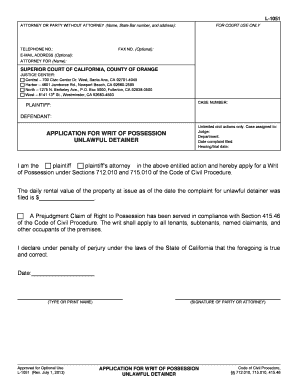
  1. Click ‘Get Form’ button to access the form and open it in the online editor.
  2. Enter your information in the 'Attorney or Party Without Attorney' section. Include your name, State Bar number (if applicable), and address. This is crucial for identifying you within the court system.
  3. Fill in your contact details, including telephone number, fax number (if you wish to provide it), and email address (optional). If you are an attorney, indicate your client’s name in the 'Attorney for' section.
  4. Specify the court information by selecting the appropriate Superior Court of California location. Enter the case number assigned to your unlawful detainer case.
  5. Identify the parties involved in the case by filling in their titles; include 'Plaintiff' and 'Defendant' names.
  6. Indicate the application type by checking the box for 'Application for Writ of Possession' and ensure it aligns with your civil action.
  7. Provide details about the case, such as the judge's name, department, and the date the complaint was filed. This information helps the court processes.
  8. State the hearing or trial date, if known, to inform the court’s scheduling.
  9. Declare your position by indicating if you are the plaintiff or the plaintiff's attorney. This assertion is important for the court to recognize your authority in this application.
  10. Complete the section detailing the daily rental value of the property at the time the complaint was filed. This figure is necessary for calculation purposes.
  11. Confirm compliance with the Prejudgment Claim of Right to Possession statement. This indicates that you have notified all relevant parties as required by law.
  12. Finalize your application by typing or printing your name, signing the document, and dating it to authenticate your request.
  13. After reviewing for accuracy, save your changes. You may download, print, or share the form as needed.

Start filling out your Unlawful Detainer form online today!

Get form

Experience a faster way to fill out and sign forms on the web. Access the most extensive library of templates available.
Get form

Related content

Eviction cases in California
This is called an unlawful detainer case, and it's how a landlord legally evicts a tenant...
Learn more
unlawful detainer | Wex | US Law | LII / Legal...
An unlawful detainer, also known as an eviction lawsuit, is a summary proceeding to...
Learn more
Unlawful Detainer Action - Mayan Languages...
A lawsuit brought by a landlord against a tenant to evict the tenant from rental property...
Learn more

Related links form

Polar Graphing Project Clinical Testing Requisition Form And Instructions - Marshfield Labs - Marshfieldlabs Institutional Application For Financial Aid - My Galen Fop Legal Defense Plan - North Dakota State Lodge Fraternal Order Of ... - Ndfop

Questions & Answers

Get answers to your most pressing questions about US Legal Forms API.

Contact support

In California, the burden of proof in an unlawful detainer case rests primarily on the landlord, who must demonstrate that the tenant has violated the terms of the lease agreement or failed to leave after a lawful notice. The landlord needs to provide evidence, such as documented notices and proof of the tenant's actions. It is vital to present a strong case to the court to succeed in obtaining an unlawful detainer judgment. To navigate this process effectively, consider leveraging the resources offered by US Legal Forms for your unlawful detainer needs.

An unlawful detainer occurs when a tenant remains in a rental property after their lease has ended or after they have been given proper notice to vacate. For example, if a landlord has served a tenant a notice to leave due to non-payment of rent, and the tenant refuses to move out, this situation constitutes an unlawful detainer. Understanding how this process works can help landlords protect their rights. Using a platform like US Legal Forms can simplify the filing process for unlawful detainer actions.

Ejectment cases in the Philippines can primarily be classified into two types: unlawful detainer and forcible entry. Unlawful detainer applies to situations where the occupant refuses to leave after their right to stay has ended, while forcible entry involves unlawful possession of property. Knowing these distinctions is important for property owners who need to take action. Our US Legal Forms platform offers guidance on handling these cases efficiently.

In California, the unlawful detainer process begins when a landlord files a complaint against tenants who refuse to vacate the property. The tenant is then served with a summons, providing them a set period to respond. If the tenant does not respond or vacate, a court judgment may be issued to execute the eviction. Understanding this process helps landlords ensure they follow the correct legal steps in reclaiming their property.

Article 434 of the Civil Code of the Philippines outlines the rights related to the unlawful detainer of property. It emphasizes the importance of legal procedures in asserting property rights, ensuring that evictions are conducted lawfully. Understanding this article equips property owners with the knowledge needed to navigate disputes effectively. For more detailed insights, our US Legal Forms platform provides resources tailored to your needs.

An unlawful detainer refers to a legal action taken by a property owner against individuals unlawfully occupying their property. This legal process is designed to remove occupants who continue to stay despite the expiration of their lease or permission. In the Philippines, unlawful detainer can help property owners reclaim their space efficiently. Familiarizing yourself with this process can enhance your approach to property management.

Property owners in the Philippines have the right to enjoy, sell, or lease their property as they see fit. This includes the right to seek an unlawful detainer against individuals unlawfully occupying their property. Moreover, owners can take legal action if their rights are violated or if there is any form of trespassing. Understanding these rights is essential for effective property management.

To evict illegal occupants in the Philippines, you must file an unlawful detainer suit in the appropriate court. This legal process allows property owners to regain possession of their property. It's crucial to gather evidence, such as rental agreements and communication records, to support your case effectively. Utilizing our US Legal Forms platform can simplify this process by providing you with the necessary templates and guidance.

An unlawful detainer must be served in California either by a sheriff or a process server. The documents must be delivered directly to the tenant, typically in a way that ensures they receive the information. After serving, the server will provide proof of service to the court. Following these steps correctly is vital for the validity of your case.

To answer an unlawful detainer in California, you need to file a written response with the court within five days of receiving the complaint. Your answer should address each point made by the landlord, providing your side of the story. Properly drafting your answer is crucial, as it sets the stage for your defense during the trial.

Get This Form Now!

Use professional pre-built templates to fill in and sign documents online faster. Get access to thousands of forms.
Get form
If you believe that this page should be taken down, please follow our DMCA take down processhere.
Get Unlawful Detainer
Get form
  • Adoption
  • Bankruptcy
  • Contractors
  • Divorce
  • Home Sales
  • Employment
  • Identity Theft
  • Incorporation
  • Landlord Tenant
  • Living Trust
  • Name Change
  • Personal Planning
  • Small Business
  • Wills & Estates
  • Packages A-Z
  • Affidavits
  • Bankruptcy
  • Bill of Sale
  • Corporate - LLC
  • Divorce
  • Employment
  • Identity Theft
  • Internet Technology
  • Landlord Tenant
  • Living Wills
  • Name Change
  • Power of Attorney
  • Real Estate
  • Small Estates
  • Wills
  • All Forms
  • Forms A-Z
  • Form Library
  • Legal Hub
  • About Us
  • Help Portal
  • Legal Resources
  • Blog
  • Affiliates
  • Contact Us
  • Delete My Account
  • Site Map
  • Industries
  • Forms in Spanish
  • Localized Forms
  • State-specific Forms
  • Forms Kit
  • Real Estate Handbook
  • All Guides
  • Notarize
  • Incorporation services
  • For Consumers
  • For Small Business
  • For Attorneys
  • USLegal
  • FormsPass
  • pdfFiller
  • signNow
  • altaFlow
  • DocHub
  • Instapage
Form Packages
  • Adoption
  • Bankruptcy
  • Contractors
  • Divorce
  • Home Sales
  • Employment
  • Identity Theft
  • Incorporation
  • Landlord Tenant
  • Living Trust
  • Name Change
  • Personal Planning
  • Small Business
  • Wills & Estates
  • Packages A-Z
Form Categories
  • Affidavits
  • Bankruptcy
  • Bill of Sale
  • Corporate - LLC
  • Divorce
  • Employment
  • Identity Theft
  • Internet Technology
  • Landlord Tenant
  • Living Wills
  • Name Change
  • Power of Attorney
  • Real Estate
  • Small Estates
  • Wills
  • All Forms
  • Forms A-Z
  • Form Library
Customer Service
  • Legal Hub
  • About Us
  • Help Portal
  • Legal Resources
  • Blog
  • Affiliates
  • Contact Us
  • Delete My Account
  • Site Map
  • Industries
  • Forms in Spanish
  • Localized Forms
  • State-specific Forms
  • Forms Kit
Legal Guides
  • Real Estate Handbook
  • All Guides
Prepared for you
  • Notarize
  • Incorporation services
Our Customers
  • For Consumers
  • For Small Business
  • For Attorneys
Our Sites
  • USLegal
  • FormsPass
  • pdfFiller
  • signNow
  • altaFlow
  • DocHub
  • Instapage
Social Media
Call us now toll free:
+1 833 426 79 33
As seen in:
© Copyright 1999-2026 airSlate Legal Forms, Inc. 17 Station Street, Suite 303, Brookline, MA 02445
  • Your Privacy Choices
  • Terms of Service
  • Privacy Notice
  • Content Takedown Policy
  • Bug Bounty Program