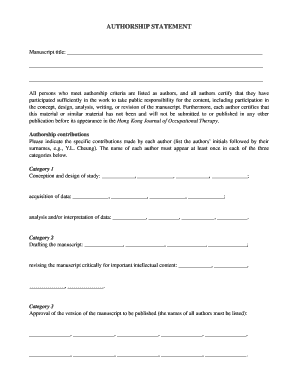
AUTHORSHIP STATEMENT Manuscript title: All persons who meet authorship criteria are listed as authors, and all authors certify that they have participated sufficiently in the work to take public responsibility.

How it works
  • Open form

    Open form follow the instructions

  • Easily sign form

    Easily sign the form with your finger

  • Share form

    Send filled & signed form or save

How to fill out the Author Statement Elsevier online

Completing the Author Statement Elsevier is an essential step in the manuscript submission process. This guide provides clear instructions to help you accurately fill out the necessary fields and ensure compliance with authorship criteria.

Follow the steps to effectively complete your Author Statement.

  1. Press the ‘Get Form’ button to access the Author Statement form in an editable format.
  2. In the manuscript title field, clearly enter the full title of the manuscript you are submitting. Ensure accuracy as this title will represent your work.

Complete your Author Statement online today to streamline your manuscript submission process.

Get form

Experience a faster way to fill out and sign forms on the web. Access the most extensive library of templates available.

Related content

Requirements for manuscript submission: what every...

by N Karabulut · 2015 · Cited by 4 — Each author must agree and confirm that the...

Learn more
Statement on Authorship Guidelines* January 2020

To be an author, one must contribute substantially, write drafts, provide final approval...

Learn more
authorship - NamuWiki

Sep 18, 2025 — Substantial contributions to research ideas, experimental design , data...

Learn more
Questions & Answers

Get answers to your most pressing questions about US Legal Forms API.

Contact support

What does author statement mean?

An author statement refers to a written acknowledgment detailing each author's contributions to a specific research article. This statement provides clarity on who is responsible for various aspects of the research process. Effectively, it serves as a foundation for ethical authorship and transparency in scholarly communication. By understanding what an author statement means, you can navigate the complexities of the Author Statement Elsevier.

An author statement is a formal declaration regarding the roles and contributions of authors in a research project. It emphasizes transparency, accountability, and responsible authorship. The purpose of this statement is to ensure proper attribution and recognition in the academic community. Understanding the nuances of an author statement is crucial for navigating the submission process, particularly with the Author Statement Elsevier.

Crediting the author means recognizing the contributions and efforts of individuals involved in a research project. This recognition promotes ethical academic practices and helps maintain the integrity of scholarly publishing. It ensures that authors receive acknowledgment for their work and enhances the authenticity of the research. In essence, proper credit is a vital aspect of the Author Statement Elsevier.

A CRediT statement provides a standardized framework to specify each author's contributions to a research paper. CRediT stands for Contributor Roles Taxonomy, which outlines various roles authors may play. By using a CRediT statement, you ensure transparency and help readers understand the contribution dynamics. Incorporating a CRediT statement within the Author Statement Elsevier can significantly enhance clarity.

An author contribution statement describes the specific roles each author played in a research project. It defines contributions in areas such as conception, design, execution, and writing. This statement enhances clarity regarding authorship and helps in appropriately assigning credit. Effectively using an author contribution statement is important, especially within the framework of the Author Statement Elsevier.

The author statement in Elsevier is a brief declaration that outlines each author's individual contributions to the research. This statement ensures that all authors receive appropriate credit for their work. It's an essential component of the submission process, promoting accountability and transparency. Knowing how to structure this statement can be crucial for publishing your work effectively under the Author Statement Elsevier.

In an author statement, you should clarify your contributions to the research. This includes detailing specific tasks like the study design, data collection, analysis, and writing. Transparency helps establish accountability and ensures proper attribution in the publishing process. By articulating these roles, you enhance the credibility of your work in the context of the Author Statement Elsevier.

For a systematic review, the author contribution statement should specify each author’s role in the various phases of the review process. This includes identifying relevant studies, data extraction, and synthesis of findings. Clearly laying out each contributor's involvement enhances the quality of your submission and is essential for compliance with Elsevier's guidelines.

In a journal submission, the author statement outlines each author’s contributions and disclosures relevant to the manuscript. This section helps the journal maintain clear ethical standards and ensures proper attribution of work. Providing a thorough author statement not only satisfies submission requirements but also enhances the manuscript’s credibility in the eyes of the reviewers and readers.

The author contribution statement describes the specific tasks performed by each author during the research and writing process. It serves to clarify who was involved in what aspects of the study, from conceptualization to execution. This information is important for the transparency and integrity of your work, especially when submitting it to Elsevier.

Get This Form Now!

Use professional pre-built templates to fill in and sign documents online faster. Get access to thousands of forms.

If you believe that this page should be taken down, please follow our DMCA take down process here.

Get Author Statement Elsevier