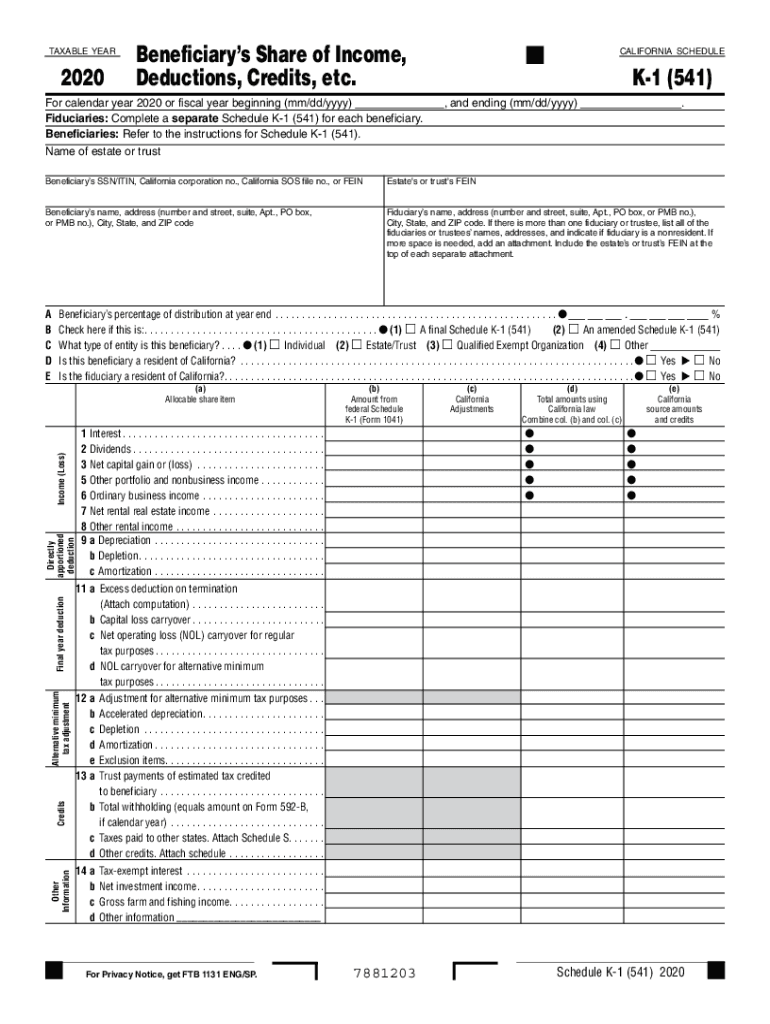
A B C D E - Beneficiary s percentage of distribution at year end. Check here if this is. A final Schedule K-1 541 2 An amended Schedule K-1 541 What type of entity is this beneficiary. Individual 2 Estate/Trust 3 Qualified Exempt Organization 4 Other Is this beneficiary a resident of California. Yes No Is the fiduciary a resident of California. Yes a Allocable share item b Amount from federal Schedule K-1 Form 1041 c California Adjustments d Total amounts using Combine col. Beneficiaries Refer to the instructions for Schedule K-1 541. Name of estate or trust CALIFORNIA SCHEDULE K-1 541 and ending mm/dd/yyyy. TAXABLE YEAR Beneficiary s Share of Income Deductions Credits etc. For calendar year 2018 or fiscal year beginning mm/dd/yyyy Fiduciaries Complete a separate Schedule K-1 541 for each beneficiary. If more space is needed add an attachment. Include the estate s or trust s FEIN at the top of each separate attachment. A B C D E - Beneficiary s percentage of distribution at year end. C....

Open form follow the instructions

Easily sign the form with your finger

Send filled & signed form or save
How to fill out the CA FTB 541 - Schedule K-1 online
Filling out the CA FTB 541 - Schedule K-1 can seem daunting, but with the right guidance, it becomes a straightforward process. This guide will walk you through each section of the form, ensuring you have all the necessary information to complete your filing accurately.
Follow the steps to successfully complete the CA FTB 541 - Schedule K-1.
- Click the ‘Get Form’ button to access the CA FTB 541 - Schedule K-1 online and open it in your preferred document editor.
- Fill in the taxable year at the top of the form, indicating either calendar year or the corresponding fiscal year beginning and ending dates.
- Enter the name of the estate or trust and the beneficiary's Social Security number (SSN) or Individual Taxpayer Identification Number (ITIN), along with the estate's or trust's federal Employer Identification Number (FEIN).
- Complete the beneficiary's personal details, including their name, address, city, state, and ZIP code.
- Provide the fiduciary's name and address, along with indicating if the fiduciary is a nonresident of California. If additional space is needed for fiduciaries, attach a separate sheet with the relevant information.
- Indicate the beneficiary's percentage of distribution at year-end by entering the appropriate percentage in the provided field.
- Select the appropriate checkbox if this is an amended or final Schedule K-1.
- Choose the type of entity for the beneficiary by selecting from the given options; individual, estate/trust, qualified exempt organization, or other.
- Answer whether the beneficiary and fiduciary are residents of California by selecting 'Yes' or 'No'.
- Proceed to fill out the income, deductions, and credits section, entering amounts for items such as interest, dividends, capital gains, and business income as appropriate.
- Calculate California adjustments using the provided spaces, ensuring total amounts comply with California law.
- After completing all fields and sections, review the form for accuracy, then save any changes made.
- Once satisfied, you can download, print, or share the completed form as necessary.
Start filling out your CA FTB 541 - Schedule K-1 online today to ensure accurate and timely filing.
Experience a faster way to fill out and sign forms on the web. Access the most extensive library of templates available.
Related content
For more information, go to ftb.ca.gov and search for conformity. ... The estate or trust...
Extends to January 1, 2018, the termination of the prohibition against CA ..... supplies...
May 1, 2018 - User Manual: Locks May 1, 2018 Mayflower Sales - Current Price Lists....
Get answers to your most pressing questions about US Legal Forms API.
How does K 1 loss affect my taxes?
K-1 Losses If your K-1 shows a net loss, you report it on the appropriate tax schedule, for example Schedule E for a partnership. Then you write in the loss on your Form 1040 and deduct it from any other taxable income. As long as you end up in the black overall, you can deduct all your losses.
Are distributions to partners Taxable?
Instead, profits and losses from the partnership are passed through to the partners, who pay the taxes at the individual level. Since partners pay taxes on their share of partnership income, they aren't taxed when they receive a withdrawal or distribution -- as long as the distribution doesn't exceed their basis.
Who is required to file a Louisiana tax return?
Louisiana law requires every resident and non-resident with Louisiana income to file individual income taxes. The residents pay taxes on all income earned, as long as they lived in Louisiana at least 6 months of the year or have Louisiana as their permanent residence.
What is form it 540?
Form IT-540 Resident Income Tax Return. Louisiana residents file their state income taxes using a form IT-540. This document can be obtained from the website of the Louisiana Department of Revenue. ... Louisiana Resident Income Tax Return It-540 Step 4: Indicate all exemptions being claimed.
What is a 541 form?
Form 541. Fiduciary Income Tax Return. Schedule J (541) Trust Allocation of an Accumulation Distribution.
What is a 541 tax form?
More In Forms and Instructions Taxpayers and tax return preparers use this form to disclose items or positions that are not otherwise adequately disclosed on a tax return to avoid certain penalties. Form 8308, Report of a Sale or Exchange of Certain Partnership Interests.
Do trusts pay state taxes?
Similar to individuals, trusts normally pay federal and state income taxes. ... Therefore, federal taxes take a big bite out of the investment returns of trusts before even considering state income taxes. Trusts are only taxed on ordinary income that is not distributed to a beneficiary.
Is a grantor trust a simple trust?
A simple trust must distribute all its income currently. Generally, it cannot accumulate income, distribute out of corpus, or pay money for charitable purposes. ... A grantor trust is a trust over which the grantor has retained certain interests or control. The grantor trust rules in IRC 671-678 are anti-abuse rules.
What is taxable income for a trust?
In general, the trust must pay income tax on any income its assets generate. But if the terms of the trust require it to pay out its income to a beneficiary, then the trust itself is entitled to get a deduction for any distributable net income. Any remaining income not distributed then gets taxed to the trust directly.
Does California recognize grantor trusts?
The revocable living trust used by Californians in their estate plans cannot benefit, as all trust income is taxed to the California resident who created the trust. ... With irrevocable non-grantor trusts, the residence of the trustee and the beneficiaries matters when seeking to avoid California trust income tax.
Use professional pre-built templates to fill in and sign documents online faster. Get access to thousands of forms.
If you believe that this page should be taken down, please follow our DMCA take down process here.