Department of the Treasury Internal Revenue Service Contents Future Developments. 1 Publication 915 What s New. 20 How To Get Tax Help. 28 Index. 32 For the latest information about developments related to Pub. 915 such as legislation enacted after it was published go to IRS.gov/Pub915. 1 Cat* No* 15320P Reminders. 1 Social Security and Equivalent Railroad Retirement Benefits Introduction. 2 For use in preparing 2018 Returns Are Any of Your Benefits Taxable. 3 How To Report Your Benefits. 6 How Much Is Taxable. 6 Lump-Sum Election. 10 Deductions Related to Your Benefits. 15 Worksheets. 15 Appendix. What s New No miscellaneous itemized deductions allowed* You can no longer claim any miscellaneous itemized deductions. Miscellaneous itemized deductions are those deductions that would have been subject to the 2 of adjusted gross income limitation* See the Instructions for Schedule A Form 1040 for more information on these changes. 2018 Form 1040 redesigned* The 2018 Form 1040 has been rede....
Loading

Open form follow the instructions

Easily sign the form with your finger

Send filled & signed form or save
How to fill out the IRS Publication 915 online
This guide provides clear and comprehensive instructions for completing IRS Publication 915 online, a critical resource for reporting the tax implications of social security and equivalent railroad retirement benefits. Whether you are filing your taxes for the first time or looking for specific information, this guide is designed to help you navigate each section efficiently.
Follow the steps to fill out IRS Publication 915 online.
- Click ‘Get Form’ button to obtain the form and open it in the editor.
- Review the introduction section to understand the purpose of IRS Publication 915 and its relevance to your tax situation.
- In the first section, ensure you enter your personal information as required, including your name and social security number, as they are essential for proper identification.
- Proceed to the area that asks about your benefits. Here, clearly indicate whether any of your social security or railroad retirement benefits are taxable.
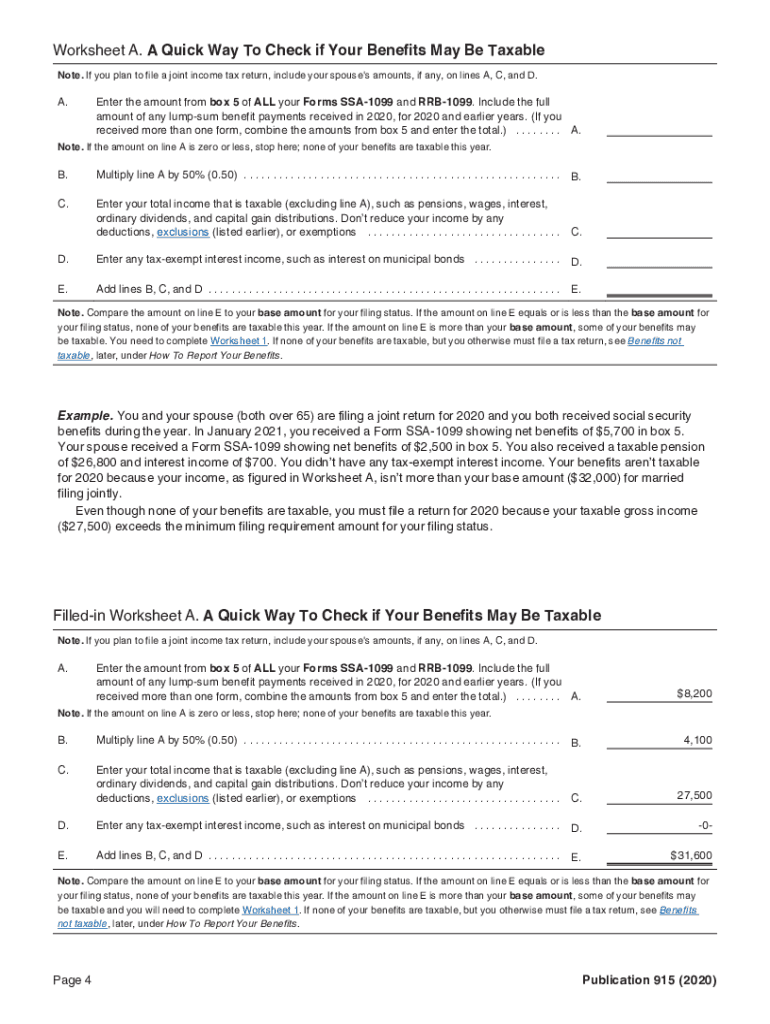
- Use the provided worksheets to assist in calculating your taxable benefits. This includes comparing your total income to the base amount relevant to your filing status.
- If applicable, fill out the sections regarding lump-sum elections or repayments, providing detailed information based on past benefits and repayments.
- Review all inputted data to ensure accuracy, as incorrect information can delay processing.
- Once completed, you can save your changes. Choose the options to download, print, or share your filled-out form as needed.
Start preparing your documents online to ensure a smooth filing process!
Experience a faster way to fill out and sign forms on the web. Access the most extensive library of templates available.
Related content
Jan 10, 2019 - Form SSA-1099, Social Security Benefit Statement 2018 ... Publication 915...
IRS Publication 915 (linked below) contains worksheets helpful in determining the amount...
Department of the Treasury Internal Revenue Service Publication 907 Cat. ... For changes...
Get answers to your most pressing questions about US Legal Forms API.
Are Social Security benefits taxed after age 66?
At 65 to 67, depending on the year of your birth, you are at full retirement age and can get full Social Security retirement benefits tax-free. However, if you're still working, part of your benefits might be subject to taxation. The IRS adds the figures for your earnings and half your Social Security benefits.
Is Social Security taxable in 2018?
The SSA also notes no one is required to pay taxes on more than 85 percent of their Social Security benefits. ... The maximum annual taxable Social Security earnings for a taxpayer have increased 7 percent to $128,400 for the tax year 2018.
What amount of Social Security is taxable?
Calculating Your Social Security Income Tax If your combined income was more than $34,000, you will pay taxes on up to 85% of your Social Security benefits. For married couples filing jointly, you will pay taxes on up to 50% of your Social Security income if you have a combined income of $32,000 to $44,000.
Do you need to file taxes if you are retired?
If your only source of retirement income is Social Security, you may not have to pay taxes or file an income tax return. If you receive only Social Security or railroad retirement tier 1 benefits or have limited other income, use the IRS interview to determine whether you must file a federal income tax return.
Is Social Security taxed after age 70?
If you wait until after your full retirement age to claim Social Security retirement benefits, your benefit amounts will be permanently higher. ... After age 70, there is no longer any increase, so you should claim your benefits then even if they will be partly subject to income tax.
At what age do you no longer have to pay taxes?
When Seniors Must File For the tax year 2018, you will need to file a tax return if you are not married, at least 65 years of age, and your gross income is $13,600 or higher. Regardless, if you live on your Social Security benefits, you don't include this in your gross income.
Do you have to file taxes after age 70?
Requirements to File You may or may not be free from paying income tax after age 70, depending on your circumstances. ... No matter what age you are, you may not have to file or pay income taxes, especially if you don't earn a dollar of income during the tax year.
Is it worth itemizing in 2019?
Itemizing means deducting each and every deductible expense you incurred during the tax year. For this to be worthwhile, your itemizable deductions must be greater than the standard deduction to which you are entitled. For the vast majority of taxpayers, itemizing will not be worth it for the 2018 and 2019 tax years.
What is the standard tax deduction for 2019?
The standard deduction amounts will increase to $12,200 for individuals, $18,350 for heads of household, and $24,400 for married couples filing jointly and surviving spouses. For 2019, the additional standard deduction amount for the aged or the blind is $1,300.
What is the standard deduction for 2019?
The standard deduction amounts will increase to $12,200 for individuals, $18,350 for heads of household, and $24,400 for married couples filing jointly and surviving spouses. For 2019, the additional standard deduction amount for the aged or the blind is $1,300.
Use professional pre-built templates to fill in and sign documents online faster. Get access to thousands of forms.
If you believe that this page should be taken down, please follow our DMCA take down process here.