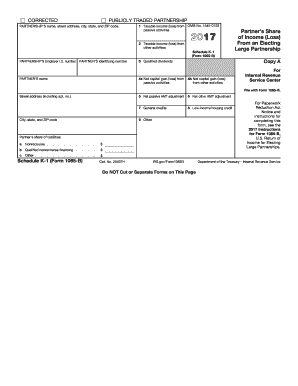
) from other activities 2017 Schedule K-1 (Form 1065-B) PARTNERSHIP S Employer I.D. number PARTNER S identifying number Partner s Share of Income (Loss) From an Electing Large Partnership Copy A 3 Qualified dividends PARTNER S name 4a Net capital gain (loss) from passive activities 4b Net capital gain (loss) from other activities Street address (including apt. no.) 5 Net passive AMT adjustment 6 Net other AMT adjustment 7 General credits 8 Low-income housing credit For Inter.
Open form follow the instructions
Easily sign the form with your finger
Send filled & signed form or save
How to fill out the IRS Schedule K-1 (1065-B) online
Filling out the IRS Schedule K-1 (1065-B) is an essential task for individuals involved in partnerships. This guide provides clear, step-by-step instructions to help you efficiently complete the form online, ensuring you meet your tax reporting obligations.
Follow the steps to successfully complete the IRS Schedule K-1 (1065-B).
- Click ‘Get Form’ button to access the form and open it in the editor.
- Begin by entering the name, street address, city, state, and ZIP code of the partnership at the top of the form. This information is crucial for identification purposes.
- Provide the partnership’s Employer Identification Number (EIN) and the partner's identifying number. Accurate entries are critical for the IRS records.
- In section 1, report the taxable income (loss) from passive activities. Ensure that the amounts entered reflect the correct financial figures as reported by the partnership.
- Section 2 is for reporting taxable income (loss) from other activities, so enter the relevant amounts as necessary.
- List any qualified dividends received in section 3. This includes earning from investments held by the partnership.
- In sections 4a and 4b, report net capital gains (losses) from passive and other activities respectively, ensuring to differentiate between the two.
- Fill out sections 5 and 6 to indicate any net passive and other Alternative Minimum Tax adjustments, if applicable.
- Enter any general credits in section 7 and the low-income housing credit in section 8, ensuring that you have supporting documentation for these credits.
- Section 9 is for any other relevant tax information. Make sure to add details that may affect the partner's tax return.
- Lastly, report the partner's share of liabilities in sections a, b, and c, providing clear figures for nonrecourse, qualified nonrecourse financing, and any other liabilities.
- Once all sections have been completed, review all entries for accuracy, then save changes, download, print, or share the form as needed.
Complete your IRS Schedule K-1 (1065-B) online today to ensure accurate tax reporting.
Experience a faster way to fill out and sign forms on the web. Access the most extensive library of templates available.
Related content
Jan 21, 2025 — Enter the property distributed subject to recognition of precontribution...
Schedule K-1 (Form 1065) 2016. Page 2. This list identifies the codes used on ... B Gross...
b Did any individual or estate own, directly or indirectly, an interest of 50% or more in...
Get answers to your most pressing questions about US Legal Forms API.
How is K1 partnership income taxed?
1 partnership income, reported on the IRS Schedule 1 (1065B), is generally taxed as ordinary income at the individual member's tax rate. This income does not undergo double taxation, as it passes through the partnership directly to the members. Tax obligations can vary based on individual circumstances and state laws. It is advisable to consult with a tax professional to navigate this process effectively.
Why would an LLC file a 1065?
An LLC files IRS Schedule K-1 (1065-B) to report the income, deductions, and credits of its members to the IRS. This filing allows the LLC to benefit from pass-through taxation, where profits are taxed at the individual level rather than the corporate level. Filing this form is essential for accurate financial reporting. It ensures compliance and helps prevent future tax issues.
Does a loss on a K1 reduce taxable income?
Yes, a loss reported on an IRS Schedule K-1 (1065-B) can potentially reduce your taxable income. However, the specifics of how the loss can offset your taxes depend on various factors, such as your other income sources. It’s crucial to understand the limits and implications of claiming this loss. Consulting an expert can provide personalized guidance.
How do I report K1 income on a tax return?
To report your K-1 income, begin by determining the total amount you need to include from your IRS Schedule K-1 (1065-B). This amount will typically go on your Form 1040, along with any additional schedules that apply. Report the income correctly to avoid any issues with the IRS. Proper preparation of your tax return can prevent potential audits.
What do I do with a Schedule K-1 Form 1065?
When you receive an IRS Schedule K-1 (1065-B), it outlines your share of income, deductions, and credits from a partnership. First, review the information carefully to ensure accuracy. Then, you will need to include this information on your individual tax return. It plays a vital role in calculating your tax obligations.
Does a K-1 show the percentage of ownership?
Yes, the IRS Schedule K-1 (1065-B) includes information about each partner's percentage of ownership in the partnership. This detail is crucial for tax reporting and determining each partner's share of the income or loss. Clarity on ownership percentages helps partners understand their financial stakes in the business. Reviewing your K-1 closely can enhance your awareness of your partnership's financial position.
Can I fill out my own 1065 form?
Yes, you can fill out your own IRS Schedule 1065 form, but it requires careful attention to detail and understanding of tax regulations. Many partnerships find it beneficial to use tax software or consult with professionals to ensure accuracy. Utilizing resources such as the uslegalforms platform can simplify this process by providing templates and guides for completing the form. Being diligent in this task can save you time and potential tax issues.
Who fills out schedule K-1 form 1065?
The partnership itself is responsible for filling out the Schedule K-1 (1065-B) form. Specifically, the partnerships must provide this form to all partners, detailing their share of income, deductions, and credits. It's essential for partnerships to keep accurate records and ensure that each partner receives their K-1 timely for tax purposes. This process aids in maintaining transparency among partners.
What is a K-1 partnership?
1 partnership is a structure in which two or more individuals share ownership in a business. Each partner receives an IRS Schedule K1 (1065B) that outlines their individual share of the partnership's income, losses, and other tax attributes. This important document facilitates accurate tax reporting for each partner. Understanding this structure is crucial for anyone considering entering a partnership.
What is an example of a K-1 partnership?
An example of a K-1 partnership involves two or more individuals who start a consulting firm together. This partnership would file an IRS Schedule K-1 (1065-B) to document each partner's share of profits and losses. The form helps clarify the financial relationship among partners while ensuring proper tax reporting. Partnerships like this can range from small businesses to larger firms.
Use professional pre-built templates to fill in and sign documents online faster. Get access to thousands of forms.
If you believe that this page should be taken down, please follow our DMCA take down process here.