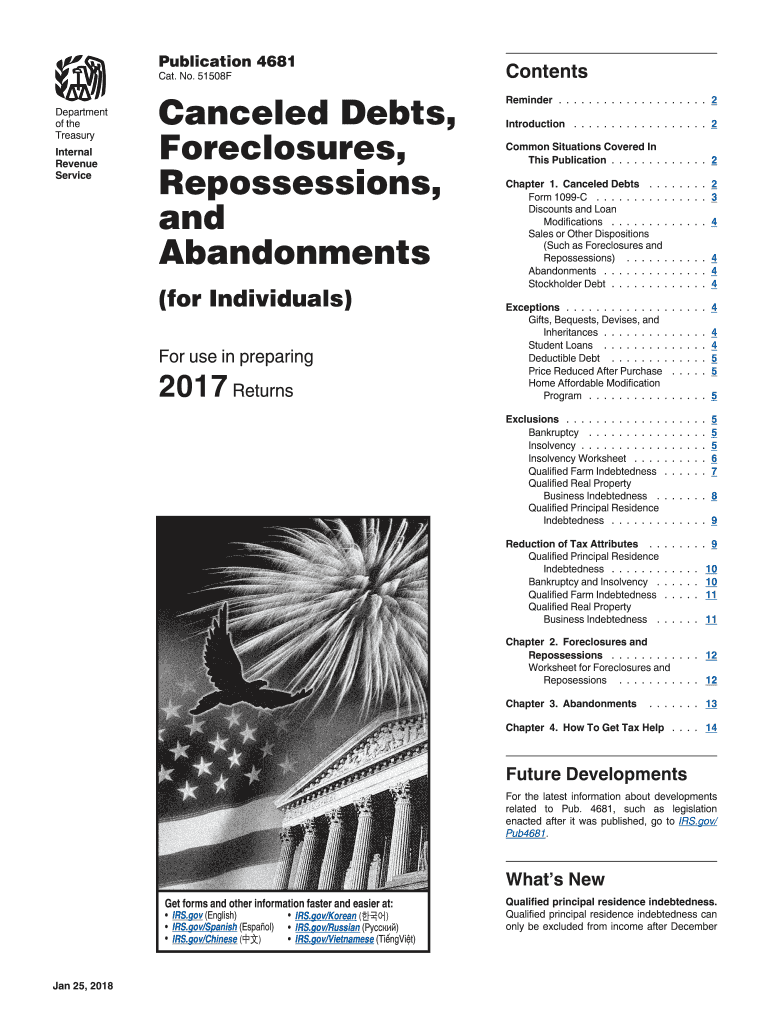
Forgive that debt for less than its full amount, you are treated for income tax purposes as having income and may have to pay tax on this income. Note. This publication generally refers to debt that is canceled, forgiven, or discharged for less than the full amount of the debt as canceled debt. Sometimes a debt, or part of a debt, that you do not have to pay is not considered canceled debt. These exceptions are discussed later under Exceptions. Sometimes a canceled debt may be excluded fro.
Loading

Open form follow the instructions

Easily sign the form with your finger

Send filled & signed form or save
How to fill out the IRS Publication 4681 online
This guide provides a clear and supportive overview of how to fill out the IRS Publication 4681, which deals with the tax treatment of canceled debts, foreclosures, repossessions, and abandonments. Following this step-by-step approach will help users navigate the form effectively, ensuring compliance with IRS requirements.
Follow the steps to complete IRS Publication 4681 online:
- Click ‘Get Form’ button to obtain the form and open it in the document editor, allowing you to start filling out the necessary fields.
- Begin by entering your personal information in the designated fields, including your name, address, and Social Security number.
- Review the 'Common Situations Covered' section to identify which scenarios apply to you, whether it be canceled debts, foreclosures, repossessions, or abandonments.
- Fill in Section 1 regarding canceled debts. This includes detailing the amounts canceled and understanding how these may affect your taxable income.
- Proceed to Section 2, where you will report information related to foreclosures or repossessions of property. Specify the property, the outstanding loan amounts, and the fair market values.
- In Section 3, outline any abandoned property, ensuring you have clear documentation of your intentions and actions regarding the abandonment.
- Review the 'Exclusions' for any applicable tax attributes that you may qualify for, such as bankruptcy or insolvency, which could affect how the canceled debt is treated.
- Once all relevant sections are completed, save your changes and review the form for accuracy to ensure that all applicable information has been entered correctly.
- Finally, download the completed document or print it to share with relevant parties, or keep a copy for your records.
Complete your IRS Publication 4681 online today to ensure your tax matters are handled accurately.
Experience a faster way to fill out and sign forms on the web. Access the most extensive library of templates available.
Related content
Jan 23, 2025 — Publication 4681 explains the federal tax treatment of: Canceled debts...
IRS Publication 4681 explains how to read Forms 1099-A and C. A taxpayer who erroneously...
Jan 30, 2018 — See. Pub. 4681, Canceled Debts, Foreclosures, Reposses- sions, and...
Get answers to your most pressing questions about US Legal Forms API.
Can cancelled debt be removed from a credit report?
Cancelled debt may remain on your credit report for up to seven years, depending on the nature of the debt and its cancellation status. However, if you believe the information is incorrect, you can dispute it with the credit bureau. Reviewing IRS Publication 4681 can help you understand any relevant implications of cancelled debt on your credit report.
How do I prove insolvency to the IRS?
To prove insolvency to the IRS, you need to demonstrate that your total liabilities exceed your total assets at the time the debt was canceled. You can do this by compiling a detailed list of your assets and liabilities. IRS Publication 4681 offers insight into how insolvency can impact tax obligations, assisting you in presenting your case effectively.
What is IRS Publication 4681?
IRS Publication 4681 provides comprehensive information regarding cancellation of debt and its tax implications. This publication outlines when a creditor must issue a 1099-C and the tax treatment for borrowers. It serves as a valuable resource for individuals navigating complex tax situations tied to debt cancellation.
What are the exceptions to 1099-C cancellation of debt?
There are specific exceptions to 1099-C cancellation of debt, which includes situations like bankruptcy, insolvency, and certain qualified principal residence indebtedness. It is essential to consult IRS Publication 4681 for detailed criteria and rules related to these exceptions. Understanding these exceptions can help you in managing your financial future better.
Can you dispute a 1099-C?
Yes, you can dispute a 1099-C if you believe the information is inaccurate. It's essential to provide adequate documentation to support your claim. Reviewing IRS Publication 4681 can help you understand your rights in this scenario and guide you on how to proceed with your dispute.
Where can I get IRS Publication 4681?
You can download IRS Publication 4681 directly from the official IRS website. By searching for 'IRS Publication 4681' in their search bar, you'll find the PDF format readily available. It is crucial to refer to the latest publication for accurate and updated information regarding debt cancellation.
How do you calculate insolvency?
Calculating insolvency involves evaluating your total assets and total liabilities. You simply subtract your total liabilities from your total assets, and if the result is negative, you are insolvent. Guidance from IRS Publication 4681 can help you follow this method precisely, ensuring that you account for all relevant financial factors.
How do I prove insolvency on a 1099c?
To prove insolvency on a 1099-C, you should complete the insolvency worksheet as recommended in IRS Publication 4681. This worksheet will help you demonstrate that your liabilities exceed your assets at the time the debt was canceled. Keeping thorough records will support your case and allow the IRS to understand your financial situation better.
How is insolvency calculated for cancellation of debt?
Insolvency for the cancellation of debt is calculated by subtracting your total liabilities from your total assets. If your total liabilities exceed your total assets, you are considered insolvent. IRS Publication 4681 offers a worksheet you can use to help clarify this calculation, ensuring that you submit accurate information during tax assessments.
How do I show insolvency on my tax return?
To show insolvency on your tax return, you need to complete the insolvency worksheet as outlined in IRS Publication 4681. You will provide details about your total assets and total liabilities to demonstrate that your debts exceed your assets. By accurately presenting this information, you can clarify your insolvency status during the tax filing process.
Use professional pre-built templates to fill in and sign documents online faster. Get access to thousands of forms.
If you believe that this page should be taken down, please follow our DMCA take down process here.
This form is available in several versions. Select the version you need from the drop-down list below.