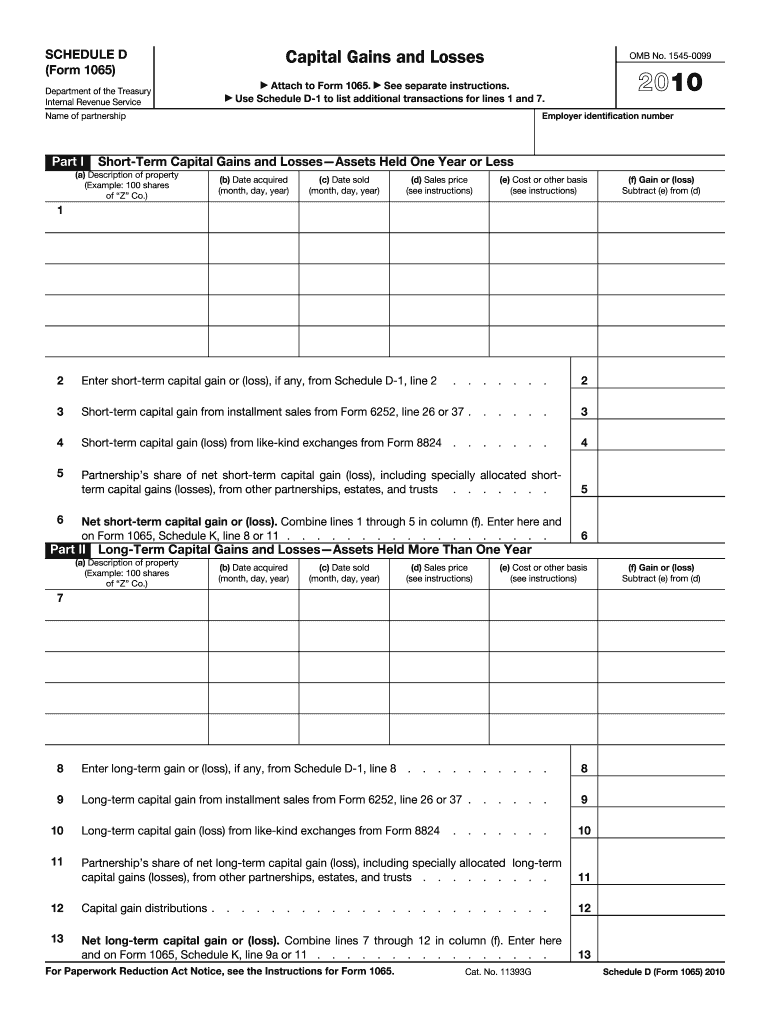
To Form 1065. See separate instructions. Use Schedule D-1 to list additional transactions for lines 1 and 7. Short-Term Capital Gains and Losses Assets Held One Year or Less (a) Description of property (Example: 100 shares of Z Co.) (b) Date acquired (month, day, year) (c) Date sold (month, day, year) (d) Sales price (see instructions) (e) Cost or other basis (see instructions) (f) Gain or (loss) Subtract (e) from (d) 1 2 Enter short-term capital gain or (loss), if any, fr.
Loading

Open form follow the instructions

Easily sign the form with your finger

Send filled & signed form or save
How to fill out the IRS 1065 - Schedule D online
This guide provides clear and supportive instructions for filling out the IRS 1065 - Schedule D online. By following these steps, users can efficiently report their partnership's capital gains and losses.
Follow the steps to complete your Schedule D online.
- Click ‘Get Form’ button to access the form and open it in your editor.
- In Part I, you will report short-term capital gains and losses for assets held for one year or less. Begin by providing a description of each property in column (a).
- Next, enter the date you acquired each asset in column (b) and the date sold in column (c). This information is crucial for determining the holding period.
- Now, record the sales price of each asset in column (d) and the cost or other basis in column (e). Ensure accuracy, as these figures will be used to calculate your gain or loss.
- Calculate the gain or loss by subtracting the amount in column (e) from that in column (d). Enter the result in column (f). Be diligent when making these calculations.
- Complete lines 1 through 5 on the form by entering the applicable short-term capital gains or losses from Schedule D-1. Add these results and write the net amount on line 6.
- Move to Part II for long-term capital gains and losses, repeating the process from Part I. Document details in the same way across columns (a) through (f).
- On line 13 of Part II, combine the total amounts from lines 7 to 12. This net long-term capital gain or loss will be reported in Schedule K.
- Review all entries carefully for accuracy before saving your progress. Once completed, you can save changes, download, print, or share the Schedule D form.
Start filling out your IRS 1065 - Schedule D online to ensure accurate reporting of your partnership's capital gains and losses.
Experience a faster way to fill out and sign forms on the web. Access the most extensive library of templates available.
Related content
Part I. Short-Term Capital Gains and Losses—Generally Assets Held One Year or Less (see...
Use Schedule D (Form 1065) to report sales or exchanges of capital assets, capital gain...
9 a Net long-term capital gain (loss) (attach Schedule D (Form 1065)) . . . . . . ....
Get answers to your most pressing questions about US Legal Forms API.
How to report partnership distributions in the IRS?
To report partnership distributions, you must include the necessary information on your IRS 1065 and associated forms, including Schedule D. Distributions might affect the members' basis in the partnership and need accurate documentation. Using platforms like US Legal Forms can help ensure you report them correctly and comply with IRS requirements.
What is a Schedule D worksheet?
A Schedule D worksheet serves as a preparatory tool for taxpayers dealing with capital gains and losses. It breaks down each transaction for reporting on Schedule D, making the preparation process simpler and more organized. Utilizing a worksheet ultimately leads to a more accurate IRS 1065 - Schedule D submission.
What is Schedule D form 1065?
Schedule D form 1065 specifically addresses the reporting of capital gains and losses for partnerships. This form is essential for partnerships to comply with IRS requirements while it tracks gains and losses from asset transactions. Mastering the IRS 1065 - Schedule D helps ensure accurate reporting and smooth tax filing.
Can I fill out my own 1065 form?
Yes, you can fill out your own 1065 form, including the IRS 1065 - Schedule D, provided you understand the requirements and details involved. Doing it yourself may save fees, but ensure you have a thorough understanding of partnership tax law. If you find it overwhelming, consider using resources like US Legal Forms for assistance.
Is Schedule D considered income?
No, Schedule D itself is not considered income; it is a reporting tool for capital gains and losses. The gains that you report on Schedule D may contribute to your overall taxable income, but the form's purpose is to document these transactions accurately. Understanding this distinction is vital when filing your IRS 1065 - Schedule D.
Do I have to list every transaction on Schedule D?
Yes, you should list every transaction on Schedule D to provide a clear picture of your capital gains and losses. This ensures compliance with IRS regulations and helps you avoid future audits. Missing transactions can lead to inaccuracies on your IRS 1065 - Schedule D, which could affect your overall tax situation.
What is the Schedule D worksheet?
The Schedule D worksheet is a helpful tool that guides taxpayers through the process of calculating their capital gains and losses. It allows you to neatly organize each transaction, making it easier to complete the IRS 1065 - Schedule D accurately. This worksheet simplifies your tax preparation, ensuring you cover all necessary details.
What does Schedule D mean?
Schedule D is a form used to report capital gains and losses from the sale of assets. When dealing with partnerships, such as those filing Form 1065, it helps identify how much profit or loss the partnership has realized during the tax year. Understanding IRS 1065 - Schedule D is crucial to ensure accurate tax reporting and compliance.
Can I file my partnership tax return online?
Yes, you can file your partnership tax return online, including IRS form 1065. Many online tax preparation services offer simple and efficient ways to complete your filing. By using these platforms, you can file your IRS 1065 - Schedule D smoothly and with guidance, ensuring that you meet all requirements. Be sure to gather all necessary documents before you start.
What IRS forms cannot be filed electronically?
Certain IRS forms are not available for electronic filing, and this typically includes various specialized forms. Forms like 8888 for direct deposit allocations and 1040X for amended returns, may require paper filing. It’s essential to check the IRS website or consult your tax professional to ensure compliance. Understanding these restrictions can help you avoid delays in your filing.
Use professional pre-built templates to fill in and sign documents online faster. Get access to thousands of forms.
If you believe that this page should be taken down, please follow our DMCA take down process here.
This form is available in several versions. Select the version you need from the drop-down list below.