Or B. No person entitled to a copy of this Account pursuant to Virginia Code Section 64. 2-1303 made a written Date. Fiduciary s Signature FORM CC-1680 MASTER PAGE ONE OF TWO 10/12 Certificate of Mailing I the undersigned do hereby certify that I have mailed a copy of the foregoing ACCOUNT FOR DECEDENT S ESTATE to the following individuals on this the. Fiduciary s Signature FORM CC-1680 MASTER PAGE ONE OF TWO 10/12 Certificate of Mailing I the undersigned do hereby certify that I have mailed a copy of the foregoing ACCOUNT FOR DECEDENT S ESTATE to the following individuals on this the. day of. 20. Executor/Administrator Name of Recipient Address City State ZIP Add pages as necessary. Print Highlight Fields Clear All Data ACCOUNT FOR DECEDENT S ESTATE Court File No*. COMMONWEALTH OF VIRGINIA VA. CODE 64. 2-1206 64. 2-1308 Circuit Court of. Estate of. Deceased Type of Fiduciary Executor Date of decedent s death. Administrator of intestate Curator Name of fiduciary. Day telephone. Mailing....
Loading

Open form follow the instructions

Easily sign the form with your finger

Send filled & signed form or save
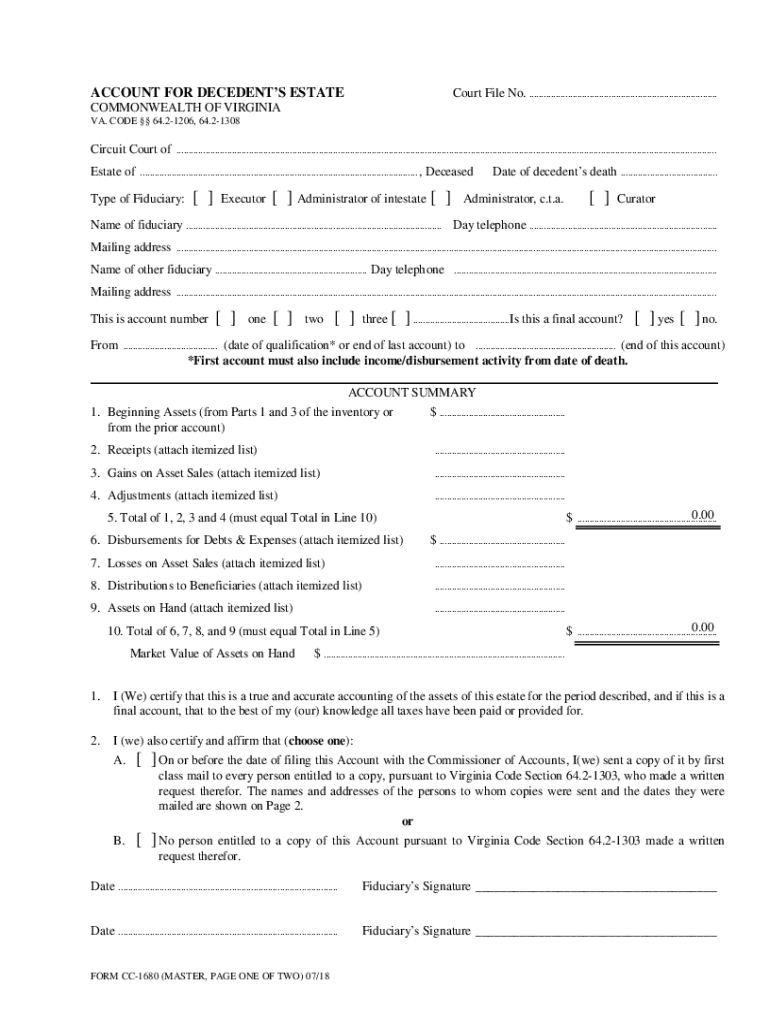
How to fill out the VA CC-1680 online
The VA CC-1680, or Account for Decedent's Estate, is an essential document used to report the financial activities of a decedent's estate. This guide provides comprehensive and user-friendly instructions for completing the form online, ensuring accurate submission tailored to your needs.
Follow the steps to complete the VA CC-1680 online effectively.
- Press the ‘Get Form’ button to obtain the VA CC-1680 form and open it in your chosen online editing tool.
- Begin by accurately filling in the court file number at the top of the form. This number is crucial for tracking your submission.
- Complete the details of the decedent’s estate, including their name, the type of fiduciary, and the date of the decedent's death.
- Indicate whether the fiduciary is the executor, administrator of intestate, or another role by checking the appropriate box.
- Provide the name and contact information for the fiduciary, along with their mailing address.
- In the account number section, specify the account number being referenced, and select whether this is the first, second, or third account review.
- Indicate if this account is final by checking 'yes' or 'no,' and clearly state the date of qualification or the end of the last account to establish the reporting time frame.
- Detail the financial components, beginning with the total of beginning assets and receipts, ensuring each value corresponds to the attached itemized lists.
- Complete the 'Account Summary' section by accurately calculating totals for disbursements, gains, losses, and distributions to beneficiaries.
- Certify the accuracy of information entered by signing and dating where indicated, and ensure that copies of the account have been mailed to the appropriate individuals as required.
- Once all sections are completed, save your changes, and select the option to download, print, or share the form as needed.
Complete your VA CC-1680 online today to ensure timely and accurate submissions.
Experience a faster way to fill out and sign forms on the web. Access the most extensive library of templates available.
Related content
The Supreme Court of Virginia. ... [Form CC-1680] Instructions and Sample Form ·...
Deeds -- Virginia -- Middlesex County. gg cc PUBLIC "-//Library of Virginia//TEXT...
... senior director for Europe and Russia, and David Holmes, counselor for political...
Get answers to your most pressing questions about US Legal Forms API.
Can the executor of the estate take everything?
The executor of an estate, after being appointed by the court, only has control over assets called probate assets. There usually exists non-probate assets over which the executor has no control. ... Therefore, the executor does not have the right to exercise control over real estate, although it often happens.
How do I become executor of an estate without a will?
Determine Your Priority for Appointment. ... Receive Written Waivers From Other Candidates. ... Contact Court in the County Where Deceased Resided. ... File the Petition for Administration. ... Attend the Probate Hearing. ... Secure a Probate Bond.
Who can be executor of estate?
An executor is the person responsible for managing the administration of your estate after you die. If you don't choose an executor, the court will choose one for you. The first decision is whether to choose a person or an institution to act as executor. A bank, trust company, or other institution can serve.
What are the qualifications to be an executor?
An executor has a fiduciary duty to the estate. This means that an executor must put aside his or her own self-interest and act solely in the best interest of the estate. The first step to succeeding as an executor is qualifying. This should be done as soon after the decedent's death as possible.
Can administrator of estate sell property?
Real property is often the main asset of an estate. The home may be sold during the probate process but only by someone with legal authority to manage the estate assets. The Personal Representative (executor) must be formally appointed by the Probate Court to have authority over estate assets.
Can an administrator of an estate be removed?
An administrator usually oversees the estate of a person who died without a will. If there is a valid will but no executor because the only executor named in the will was removed or resigned, the court may appoint an administrator with powers of an executor instead. ... An administrator C.T.A.
What does an estate administrator do?
Administrator and Estate An administrator is an individual appointed to dispose of the assets of the estate, manage any creditors, and pay fees out of the estate for any required attorneys, appraisers or accountants.
Who can be administrator of an estate?
Administrator of an estate. The administrator of an estate is a legal term referring to a person appointed by a court to administer the estate of a deceased person who left no will.
How do you become an administrator of an estate?
Contact the surrogate or probate court of the county where the deceased lived or owned real estate. ... Briefly review the values of the deceased's assets if you're not sure what the deceased owned. ... Go to the probate court. ... Complete the petition. ... Sign and date the petition. ... File the petition and pay the filing fee.
How long do you have to probate a will in Virginia?
However, Virginia courts recommend that the executor file for probate within 30 days of the testator's death. Once the executor files the will, the circuit court clerk will issue a probate order. At that point, the statute of limitations begins to run.
Use professional pre-built templates to fill in and sign documents online faster. Get access to thousands of forms.
If you believe that this page should be taken down, please follow our DMCA take down process here.