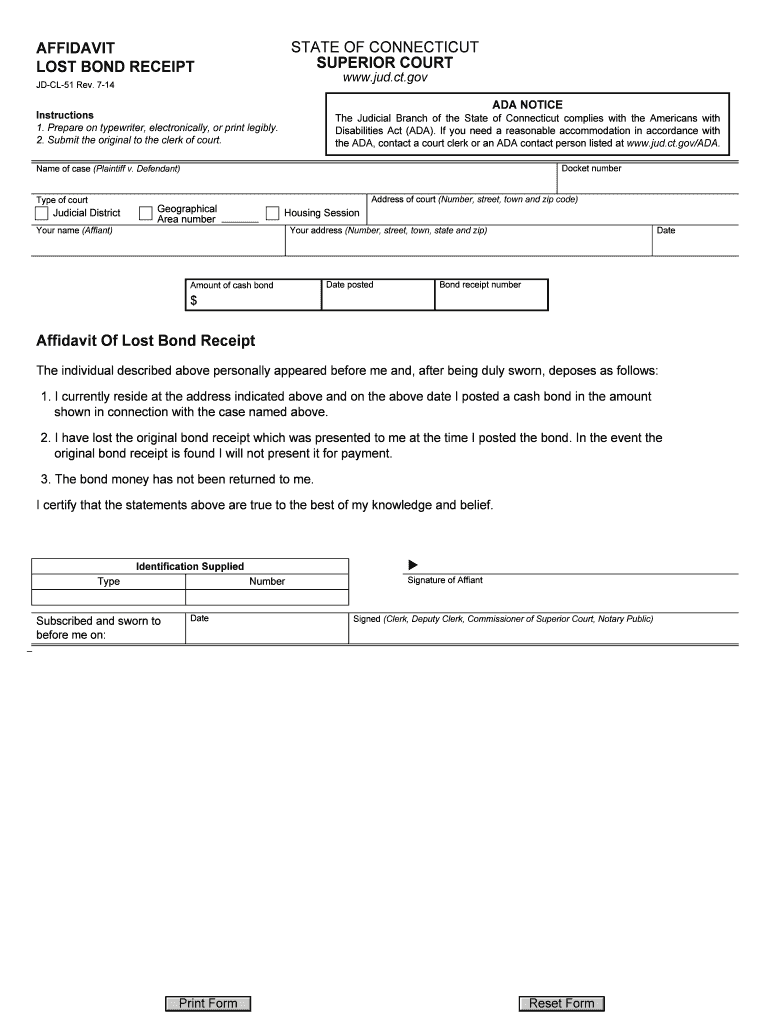
T the original to the clerk of court. The Judicial Branch of the State of Connecticut complies with the Americans with Disabilities Act (ADA). If you need a reasonable accommodation in accordance with the ADA, contact a court clerk or an ADA contact person listed at www.jud.ct.gov/ADA. Docket number Name of case (Plaintiff v. Defendant) Type of court Judicial District Your name (Affiant) Address of court (Number, street, town and zip code) Geographical Area number Housing Session Date You.
Loading

Open form follow the instructions

Easily sign the form with your finger

Send filled & signed form or save
How to fill out the CT JD-CL-51 online
The CT JD-CL-51 form, also known as the affidavit of lost bond receipt, is a crucial document for individuals needing to report the loss of a bond receipt. This guide will provide you with step-by-step instructions to help you complete the form accurately and efficiently online.
Follow the steps to complete the CT JD-CL-51 form online
- Press the ‘Get Form’ button to access the CT JD-CL-51 form and open it in your online editor.
- Begin by entering the docket number as assigned to your case. This information helps identify your legal matter within the court system.
- In the 'Name of case' field, specify the names of the parties involved, formatted as Plaintiff v. Defendant.
- Select the type of court from the provided options; this is important for ensuring your affidavit is filed correctly.
- Fill in the judicial district corresponding to your case. This is usually based on the court where your case is being handled.
- Enter your name in the 'Your name (Affiant)' field. This identifies you as the individual affirming the loss of the bond receipt.
- Input the court address, including the number, street, town, and zip code, ensuring accuracy for proper filing.
- Add the geographical area number if applicable. This may vary based on the court's jurisdiction.
- Indicate if your case falls under a housing session, marking it as necessary.
- Document the date related to your case, ensuring it aligns with the posting of your cash bond.
- Fill in your address, including the number, street, town, state, and zip code, for correspondence purposes.
- Specify the amount of the cash bond you posted, prominently shown in dollar format.
- Record the date the bond was posted, providing clarity on the timeline of your case.
- Enter the bond receipt number issued at the time of posting. This is essential to verify your transaction.
- Review the affidavit statement, confirming that the statements of residence and loss of bond receipt are accurate.
- Provide your signature as the Affiant, certifying that the information shared is true to the best of your knowledge.
- Select the type of identification supplied and include the relevant identification number and the date it was subscribed and sworn.
- Once all fields are completed and verified, you can either save your changes, download, print, or share the completed form as necessary.
Complete your CT JD-CL-51 form online today for a smooth filing experience.
Experience a faster way to fill out and sign forms on the web. Access the most extensive library of templates available.
Related content
JD-CL-51 Rev. 8-23. Subscribed and sworn to before me on: Affidavit of Lost Bond Receipt...
BACKGROUND AND PURPOSE: The CT table strap may impair shoulder lowering during cervical...
by S Campbell · 2017 · Cited by 1430 — Purpose. This AUA Guidelines focuses primarily...
Get answers to your most pressing questions about US Legal Forms API.
How long do you have to sue someone in CT?
The timeframe to sue someone in Connecticut varies depending on the nature of your claim. Generally, for personal injury and property damage claims, you have up to two years from the date of the incident to initiate legal action. Always review specific laws related to your case type, and consider completing the CT JD-CL-51 form for small claims as part of your preparation. It's wise to act promptly to enhance your chances of a successful outcome.
How long do you have to file small claims in CT?
In Connecticut, you generally have a specific timeframe to file small claims, which is usually within six years from the date of the incident that caused your loss. However, certain types of claims may have different deadlines, so it's essential to understand your particular situation. The CT JD-CL-51 form can be a useful tool in this process by guiding you through the necessary requirements. Make sure to gather all pertinent information and submit your claim within the deadline.
How to file a civil lawsuit in CT?
Filing a civil lawsuit in Connecticut involves several key steps to ensure that you have a valid claim. Begin by gathering necessary documents and evidence to support your case. Then, complete the required forms, including the CT JD-CL-51, which is vital for small claims cases. After filing the forms with the appropriate court, you must serve the defendant with a copy of the complaint.
Can you bail yourself out of jail in CT?
In Connecticut, individuals can bail themselves out, provided they meet certain criteria set by the court. A bail amount is determined based on the charges and the individual's criminal history. Completing the CT JD-CL-51 form can provide clarity on your rights and options. If you need detailed assistance, US Legal Forms can simplify this process for you.
How to vacate a warrant in CT?
To vacate a warrant in Connecticut, you typically must file a motion with the court. The CT JD-CL-51 form can help you articulate your request before the judge. It is advisable to provide any relevant information that justifies your reasons. For guidance through this process, consider utilizing US Legal Forms to ensure you're following the correct procedures.
What are the new bail laws in CT?
Recent updates to bail laws in Connecticut have focused on reducing pretrial detention and ensuring fair access to bail. The CT JD-CL-51 form plays a crucial role in these processes, providing a streamlined way for individuals to understand their rights. It's important to know these changes help promote equality within the legal system. For personalized support, US Legal Forms can assist you in navigating these updates effectively.
How do I get court documents in CT?
You may also call the Centralized Services Unit at 860-263-2750. All requests for files must include the name of the case and docket number. Docket numbers may be available on-line at .jud.ct.gov by utilizing the case look-up function. Files should be available within one or two business days.
Do warrants expire in CT?
While some court proceedings may have statutes of limitations, most warrants in Connecticut remain active indefinitely. In other words, a warrant does not expire and can remain active for many years. The court can only cancel them upon a suspect's surrender or after their arrest or the individual dies.
What is a motion for capias in CT?
section 45a-242.) On motion of a party or on the court's own motion, the court may issue a capias to authorize a proper officer to arrest and bring before the court an individual who has failed to comply with a subpoena.
What is a civil summons in CT?
You are being sued. This is a summons in a lawsuit. The complaint attached states the claims the plaintiff is making against you. 2. To receive further notices, you or your attorney must file an Appearance (form JD-CL-12) with the clerk at the address above.
Use professional pre-built templates to fill in and sign documents online faster. Get access to thousands of forms.
If you believe that this page should be taken down, please follow our DMCA take down process here.