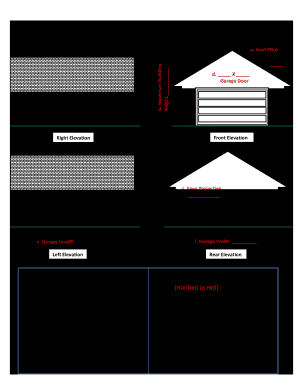
________ Ground Level e. Garage Length __________ f. Garage Width __________ Left Elevation Rear Elevation 1. Please indicate on all elevations the location of: • Windows • Doors 2. Please complete items (marked in red): a. Roof Pitch b. Maximum Building Height c. Eave Projection d. Overhead Garage Door Size e. Garage Length f. Garage Width Standard Detached Garage Details Additional Notes Windows cannot be placed in a wall that is less than 4’0” to the property line. If the.
Open form follow the instructions
Easily sign the form with your finger
Send filled & signed form or save
How to fill out the Canada Standard Detached Garage Details online
Filling out the Canada Standard Detached Garage Details form is an essential step for obtaining the necessary permit for your detached garage project. This guide will provide detailed instructions to help you complete the online form effectively.
Follow the steps to successfully complete your garage details submission.
- Click ‘Get Form’ button to access the Canada Standard Detached Garage Details form and open it in your preferred editor.
- Begin by indicating the roof pitch in section a. Make sure to mark the angle of the roof accurately for proper structural assessment.
- Complete section b by entering the maximum building height of the garage. This information is crucial for compliance with local zoning laws.
- In section c, provide the eave projection measurement. This should reflect how far the roof extends from the side of the building.
- Fill out section d with the appropriate garage door dimensions, ensuring it meets the requirements for your specified roof and door opening size.
- Specify the garage length in section e and the garage width in section f. Accurate measurements will help in the evaluation process.
- On all elevation drawings, mark the locations of windows and doors, as indicated in the instructions. This information is critical for safety and accessibility compliance.
- Review any additional notes provided in the form, such as window placement restrictions and foundation requirements, ensuring that all regulations are met.
- After completing the form, you have the option to save changes, download the completed document, print it for physical submission, or share it as needed.
Start filling out your Canada Standard Detached Garage Details form online today to ensure a smooth permit application process.
Experience a faster way to fill out and sign forms on the web. Access the most extensive library of templates available.
Related content
Access to detached garage. Access to a detached garage shall be provided or maintained in...
Aug 8, 2025 — The following minimum parking space dimensions are standards for use in...
Jan 1, 2020 — (1) Garages. In each attached garage and in each detached garage with...
Get answers to your most pressing questions about US Legal Forms API.
Does a detached garage need a foundation?
In most cases, a detached garage requires some form of foundation to maintain stability and durability. The type of foundation needed can vary based on local building codes and conditions. A solid foundation ensures the structure can withstand various environmental factors. For comprehensive guidance, check the Canada Standard Detached Garage Details, which offer vital information on construction requirements.
Does a dwelling policy cover a detached garage?
Whether a dwelling policy covers a detached garage often depends on the specific terms of the insurance policy. Many policies include detached structures, but coverage can vary. Homeowners should review their insurance documents or consult with their provider to understand the extent of coverage. Consulting the Canada Standard Detached Garage Details can offer additional information pertinent to these policies.
Is a detached garage considered residential?
A detached garage itself is not typically classified as residential space. Instead, it is categorized as an accessory structure that supports the main residential building. However, if it meets specific criteria or is modified for living purposes, it might be regarded differently. For more insights, refer to the Canada Standard Detached Garage Details.
What is a garage classified as?
A garage is generally classified as an accessory structure used primarily for sheltering vehicles. In legal terms, its classification can affect property taxes and insurance policies. It is crucial to understand how the Canada Standard Detached Garage Details define garages in your area, as this can impact your home’s value and coverage.
What makes a garage considered attached?
An attached garage is directly connected to the main building, sharing a wall or being physically joined. This configuration allows for easier access from the residence to the garage. In terms of Canada Standard Detached Garage Details, an attached garage offers different advantages, such as convenience and potential energy savings for heating or cooling.
Is a detached garage considered part of a residence?
In most cases, a detached garage is not seen as an integral part of the residence. It functions separately from the main living structure and is often built for specific purposes related to vehicle protection and storage. Nevertheless, local laws may treat it differently, so it is wise to check local zoning and building codes for clarity on this aspect. The Canada Standard Detached Garage Details could guide you on these distinctions.
Is a detached garage considered a residence?
A detached garage is typically not classified as a residence. It serves primarily as a space for parking vehicles and storage. However, if someone converts it into a living area, it could be deemed a residence under certain regulations. Understanding the legal distinctions, as outlined in the Canada Standard Detached Garage Details, is essential for homeowners.
What is a good size for a detached garage?
A good size for a detached garage largely depends on your specific needs; however, 24x24 feet is often considered ideal for most homeowners. This size comfortably fits two cars while providing some extra room for storage. Following the Canada Standard Detached Garage Details can guide you in selecting a size that suits your lifestyle. Strategically planning the layout can enhance both utility and accessibility.
What is the standard 2 car detached garage size?
A standard size for a two-car detached garage is typically around 24x24 to 24x30 feet. This space allows for comfortable parking and some added storage or workspace. Aligning with the Canada Standard Detached Garage Details ensures that you have adequate storage for tools and equipment. Always take into account the accessibility and layout to maximize your garage's efficiency.
What is the average square footage of a detached garage?
On average, a detached garage ranges from 400 to 600 square feet. This size accommodates one or two cars while still leaving space for storage or a workshop. The Canada Standard Detached Garage Details provide guidelines for optimal design, ensuring you utilize your space effectively. Consider your personal needs as well as the potential uses of your garage when planning.
Use professional pre-built templates to fill in and sign documents online faster. Get access to thousands of forms.
If you believe that this page should be taken down, please follow our DMCA take down process here.