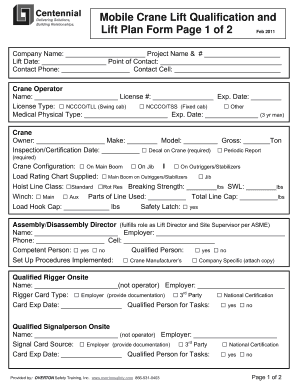
_____________________________ Contact Phone: __________________ Contact Cell: ____________________________ Crane Operator Name: ______________________ License #: ________________ Exp. Date: ________ License Type: □ NCCCO/TLL (Swing cab) □ NCCCO/TSS (Fixed cab) □ Other Medical Physical Type: ______________________ Exp. Date: ______________ (3 yr max) Crane Owner: __________________ Make: ________ Model: _________ Gross: _______Ton Inspection/Certification Date: __________ □ Decal on Crane.
Loading
Open form follow the instructions
Easily sign the form with your finger
Send filled & signed form or save
How to fill out the Centennial Mobile Crane Lift Qualification and Lift Plan online
Filling out the Centennial Mobile Crane Lift Qualification and Lift Plan online is a crucial process for ensuring safety and compliance in crane operations. This guide will provide you with clear, step-by-step instructions to help you effectively complete the form.
Follow the steps to successfully fill out the form.
- Click ‘Get Form’ button to obtain the form and open it in the editor.
- Begin by entering your company's name and the project name along with the project number. Ensure all fields are filled out accurately to avoid any delays.
- Fill in the lift date, point of contact, and contact phone numbers. Provide both the primary contact number and a cell phone number for quick communication.
- For the crane operator section, input the operator's name, license number, and expiration date. Choose the appropriate license type from the options provided.
- Document the medical physical type of the crane operator along with its expiration date, ensuring it does not exceed three years.
- Record the crane's name, owner, make, model, and gross tonnage. Ensure all provided details are accurate.
- Enter the inspection and certification date of the crane, and check the required boxes regarding decals and periodic report submissions.
- Specify the crane configuration, particularly the setup with the main boom, jib, or outriggers, and ensure a load rating chart is supplied for the chosen configuration.
- Complete the hoist line class, breaking strength, and safe working load. Make sure to detail the winch used and the total line capacity.
- Designate the assembly/disassembly director and provide their name, employer information, and contact details.
- Identify the qualified rigger and qualified signalperson onsite by documenting their names, employers, certification types, and expiration dates.
- In the site conditions section, report any overhead or underground hazards, and evaluate ground conditions relevant to the crane operation.
- Fill out the lift and rigging plan by providing load descriptions, known load weight, projected measurements, and any additional stress or configurations required.
- Draw a lift or rigging sketch to illustrate the setup, including the crane's position, load shape, and distances to hazards.
- Review all entries for accuracy and completeness, and ensure required documentation is attached.
- Once completed, save your changes and consider downloading, printing, or sharing the form for your records.
Complete the Centennial Mobile Crane Lift Qualification and Lift Plan online today for a safer lifting experience.
Experience a faster way to fill out and sign forms on the web. Access the most extensive library of templates available.
Related content
This part applies to any crane, derrick, or hoist having a maximum rated capacity of one...
This fifth edition of the 'Handbook of Rigging' is a comprehensive reference for rigging...
Sep 3, 1990 — The American Mobile Satellite Corp. (AMSC), which is licensed to use the...
Get answers to your most pressing questions about US Legal Forms API.
What is included in a lifting plan?
A lifting plan should cover the weight and dimensions of the load, types of equipment used, and the lifting procedure. Additionally, it should outline safety measures and potential hazards. By incorporating all these details, you create a thorough Centennial Mobile Crane Lift Qualification and Lift Plan that promotes safe lifting practices.
How do I fill out a lift plan?
To fill out a lift plan, start by gathering essential information like the load's weight, equipment specifications, and site conditions. Then, detail the lifting process, including safety checks and communication methods. This information strengthens your Centennial Mobile Crane Lift Qualification and Lift Plan, enhancing operational efficiency.
What is the 3-3-3 rule for lifting?
The 3-3-3 rule indicates that the lifting operation should not exceed three obstacles, three operators, or three rigging points. This guideline simplifies the complexities of crane operations. Adhering to the 3-3-3 rule is crucial for an effective Centennial Mobile Crane Lift Qualification and Lift Plan.
What should be included in a crane lift plan?
A crane lift plan should include load details, crane specifications, site analysis, and risk assessments. Additionally, include emergency procedures and communication protocols to prepare everyone involved. These components are vital for a successful Centennial Mobile Crane Lift Qualification and Lift Plan that prioritizes safety.
How do you fill out a lifting permit?
Filling out a lifting permit requires accurate information about the lift, including the load type, weight, and lifting method. Ensure you consult local regulations as they may dictate specific requirements. An effective lifting permit complements your Centennial Mobile Crane Lift Qualification and Lift Plan, reinforcing safety standards.
How to complete a lift plan?
Completing a lift plan requires you to outline all necessary details such as load specifications, equipment choices, and safety measures. After inputting all information, ensure every party involved reviews and approves the plan. This collaborative approach drives the development of an effective Centennial Mobile Crane Lift Qualification and Lift Plan.
How to make a crane lifting plan?
To make a crane lifting plan, gather essential information such as the load, lifting equipment, and environmental conditions first. Then, outline procedures for rigging, communicating, and executing the lift. This systematic approach ensures a thorough Centennial Mobile Crane Lift Qualification and Lift Plan, thereby enhancing safety and clarity.
What should be considered for a lift plan?
When creating a lift plan, consider aspects like the load's weight and shape, the lifting equipment's capabilities, and any nearby structures or obstacles. Weather conditions and the experience of your crew also play significant roles. Inclusion of these considerations is fundamental for a successful Centennial Mobile Crane Lift Qualification and Lift Plan.
What are the criteria for a lift plan?
Key criteria for a lift plan involve load weight assessment, crane capacity, site conditions, and safety protocols. It's also critical to incorporate a thorough risk assessment to identify potential hazards. These criteria shape a robust Centennial Mobile Crane Lift Qualification and Lift Plan, safeguarding all involved parties during the lift.
What should be in a crane lift plan?
A crane lift plan must include key details such as the load weight, type of crane, lift radius, and rigging specifications. Additionally, consider including a site diagram, safety measures, and a communication plan. Integrating these elements ensures a comprehensive Centennial Mobile Crane Lift Qualification and Lift Plan that prioritizes safety and efficiency.
Use professional pre-built templates to fill in and sign documents online faster. Get access to thousands of forms.
If you believe that this page should be taken down, please follow our DMCA take down process here.