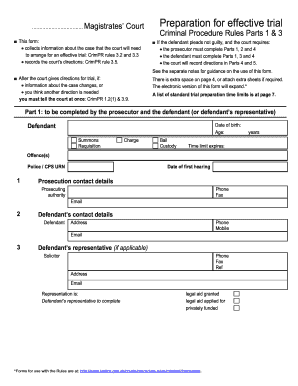
3 records the court’s directions: CrimPR rule 3.5. Preparation for effective trial Criminal Procedure Rules Parts 1 & 3 ■ If the defendant pleads not guilty, and the court requires: the prosecutor must complete Parts 1, 2 and 4 the defendant must complete Parts 1, 3 and 4 the court will record directions in Parts 4 and 5. See the separate notes for guidance on the use of this form. ■ After the court gives directions for trial, if: information about the case changes, .
Loading
Open form follow the instructions
Easily sign the form with your finger
Send filled & signed form or save
How to fill out the UK Criminal Procedure Rules Parts 1 & 3 online
This guide provides clear and detailed instructions for completing the UK Criminal Procedure Rules Parts 1 and 3 online. By following these steps, users can ensure they provide all necessary information for the court to prepare for an effective trial.
Follow the steps to fill out the form accurately and efficiently.
- Use the 'Get Form' button to access the online form and open it for completion.
- Begin by entering the required information in Part 1, focusing on the defendant's personal details, including date of birth, age, and contact information. Make sure to specify whether the defendant is in custody or on bail.
- Complete the charge and indicate the applicable offences. Ensure that all details are accurate to prevent any delays.
- If applicable, fill out prosecution contact details thoroughly, including the name of the prosecuting authority and any relevant contact information.
- If the defendant has a representative, provide their contact details in the relevant section, specifying if they are legally aided or privately funded.
- Continue to Part 3, where the defendant or their representative must confirm understanding of the plea options and whether a guilty plea applies under the circumstances.
- Respond to the case management information, ticking the statements that are correct regarding the conduct and identification of the defendant, and specify any disputed facts for clarity.
- In the applications for directions section, indicate if any variations to the standard trial preparation time limits are requested. Provide details wherever 'Yes' is selected.
- Finalize the form by reviewing all sections, ensuring all information is filled out accurately and comprehensively. Verify that any additional notes or information needed have been attached.
- Once completed, users can save changes, download a copy, or share the form with the relevant parties as necessary.
Complete your documents online with confidence and ensure all necessary information is provided for a smooth process.
Experience a faster way to fill out and sign forms on the web. Access the most extensive library of templates available.
Related content
1 Extension of powers to stop and search. 2 Warrants to enter and search. 3 Arrestable...
by JD Lawson · 1911 · Cited by 9 — Keedy, Criminal Procedure in England, 1 J. Am...
Jul 26, 2025 — The court consists of 2-3 police judges or one District Ju, and there is...
Get answers to your most pressing questions about US Legal Forms API.
What are the 7 elements of the criminal justice system in the UK?
The seven elements of the criminal justice system in the UK include law enforcement, the legal profession, the judiciary, corrections, probation, victims' services, and community resources. Each element plays a vital role in maintaining justice and order, working in tandem within the framework of the UK Criminal Procedure Rules Parts 1 & 3. Understanding these elements aids in recognizing the comprehensive approach to justice in the UK.
What is the CRPC in the UK?
The Criminal Procedure Rules Committee (CRPC) in the UK is responsible for creating and amending the criminal procedure rules. These rules guide how criminal cases are processed in courts, promoting efficiency and fairness. By adhering to the UK Criminal Procedure Rules Parts 1 & 3, legal practitioners can ensure they comply with established protocols, which is vital for successful case management.
What are the rules of evidence in the UK?
The rules of evidence in the UK govern what information can be presented in court. The UK Criminal Procedure Rules Parts 1 & 3 outline these rules, focusing on relevance, admissibility, and fairness in legal proceedings. Understanding these rules helps parties navigate the complexities of legal disputes effectively, ensuring justice is served.
Do prosecutors have to share all evidence?
No, prosecutors do not have to share every piece of evidence. The UK's Criminal Procedure Rules Parts 1 & 3 emphasize the need for disclosure of evidence that may impact a defendant's right to a fair trial. Essential evidence that connects to the defense’s case must be shared to maintain judicial integrity and fairness.
What is the Federal Rule of Criminal Procedure 3?
Federal Rule of Criminal Procedure 3 outlines the procedures for initiating federal criminal prosecutions in the United States. This rule requires that an indictment or information be filed to commence the prosecution, thereby ensuring adherence to due process. While this pertains to U.S. law, it reflects principles similar to the UK Criminal Procedure Rules Parts 1 & 3 regarding the importance of procedural clarity.
What happens if the prosecution fails to disclose evidence?
If the prosecution fails to disclose evidence as mandated by the UK Criminal Procedure Rules Parts 1 & 3, it can lead to serious consequences. The defense may argue for the case to be dismissed or for a mistrial, depending on the significance of the undisclosed information. Courts often take such failures seriously, as they directly impact the fairness of the trial.
Does the prosecutor have to disclose all evidence in the UK?
Under the UK Criminal Procedure Rules Parts 1 & 3, prosecutors are required to disclose evidence that may undermine their case or assist the defense. This requirement ensures a fair trial by providing defendants with the information necessary to challenge the prosecution's case. While some exceptions exist, such as sensitive information, the overarching principle favors transparency in the legal process.
What is the criminal code in England?
The criminal code in England comprises a collection of statutes that define criminal offenses and their respective penalties. It serves as a framework for the enforcement of criminal law, guiding judges, lawyers, and law enforcement officers. Familiarity with the UK Criminal Procedure Rules Parts 1 & 3 is essential for anyone navigating the complexities of the criminal code.
What is the criminal Evidence Act in the UK?
The Criminal Evidence Act governs the admissibility of evidence in criminal trials in the UK. It sets forth guidelines on what constitutes acceptable evidence and how it should be presented in court. Being aware of this Act is crucial when dealing with issues outlined in the UK Criminal Procedure Rules Parts 1 & 3, ensuring fair trials based on reliable and valid evidence.
What is the Criminal Law Act in the UK?
The Criminal Law Act provides a comprehensive framework for criminal law in the UK, specifying offenses and their corresponding penalties. This Act is crucial in defining the legal boundaries for acceptable behavior and the justice system's role in enforcing them. Understanding the Act is essential, especially in the context of the UK Criminal Procedure Rules Parts 1 & 3, as it guides legal proceedings enforcing criminal justice.
Use professional pre-built templates to fill in and sign documents online faster. Get access to thousands of forms.
If you believe that this page should be taken down, please follow our DMCA take down process here.