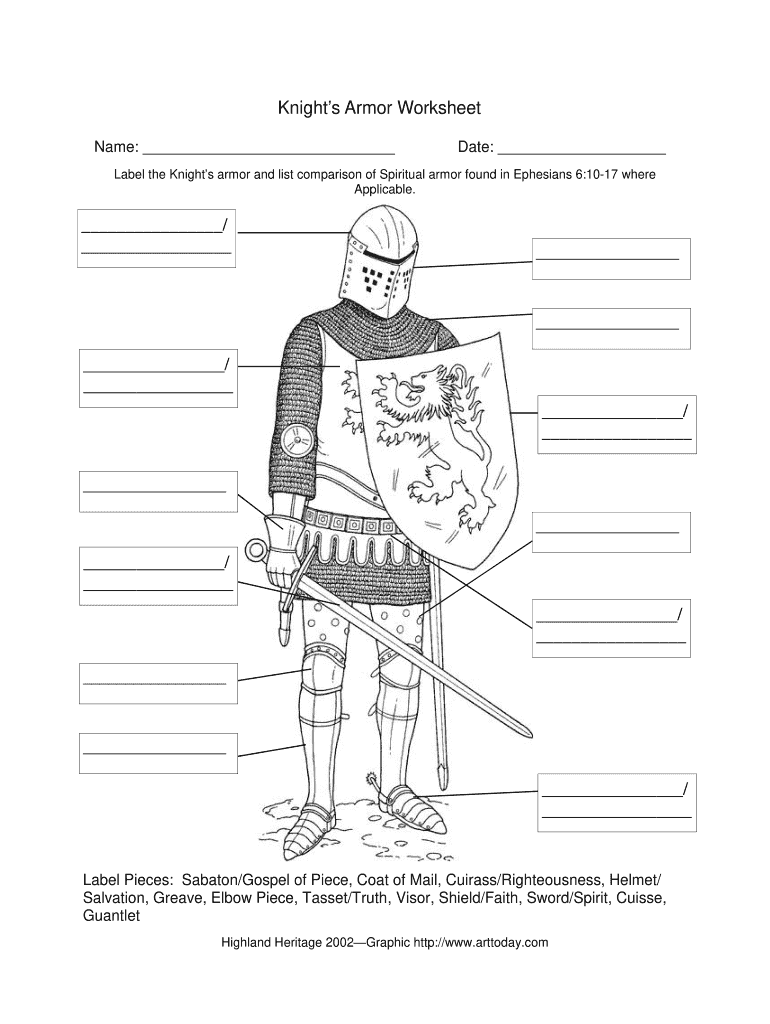
Able. ________________/ _________________ _________________ _________________ ________________/ _________________ ________________/ _________________ _________________ _________________ ________________/ _________________ ________________/ _________________ _________________ _________________ ________________/ _________________ Label Pieces: Sabaton/Gospel of Piece, Coat of Mail, Cuirass/Righteousness, Helmet/ Salvation, Greave, Elbow Piece, Tasset/Truth, Visor, Shield/Faith, Sword/Spiri.
Loading

Open form follow the instructions

Easily sign the form with your finger

Send filled & signed form or save
How to fill out the AU Highland Heritage Knight's Armor Worksheet online
This guide provides clear instructions on how to successfully complete the AU Highland Heritage Knight's Armor Worksheet online. By following these steps, users will ensure that all necessary information is accurately recorded.
Follow the steps to complete the Knight's Armor Worksheet efficiently.
- Click ‘Get Form’ button to obtain the form and open it in the editor.
- Begin by entering your name in the designated field at the top of the form. Make sure to write your full legal name for clarity.
- Next, fill in the date on which you are completing this worksheet. This helps in tracking when the information was provided.
- Label the knight's armor sections where applicable by referring to the specified categories provided. You will compare them with the spiritual armor outlined in Ephesians 6:10-17.
- For each armor piece, enter the appropriate terminology that corresponds with its spiritual counterpart. For example, you would label the 'Sabaton' with the 'Gospel of Peace' to signify its spiritual meaning.
- Continue filling out the remaining fields by following the same pattern of labeling armor pieces like the coat of mail and cuirass as required. Ensure the connection to the spiritual armor is clear.
- Once all sections are filled out, review your entries for accuracy and completeness.
- Finally, save your changes and choose to download, print, or share the completed form as needed.
Start filling out the AU Highland Heritage Knight's Armor Worksheet online today for a seamless experience.
Experience a faster way to fill out and sign forms on the web. Access the most extensive library of templates available.
Related content
by P Wrigley · 2001 · Cited by 6 — knight wore his armor, and tell how the armor he...
Armor (protective wear) (4)[-] · Ballots (4)[-] · Canisters (4)[-] · Clocks (4)[-] ·...
Armor Command. Detai! is what sets this strategy game apart from the rest. This is no...
Get answers to your most pressing questions about US Legal Forms API.
What is a cloth that a knight wears called?
The long, sleeveless outer garment that Western Europeans commonly wore during the Middle Ages was called a surcoat. Pictures of medieval knights often show them with loose surcoats over their armor. Men wore surcoats from around the 12th century, while women began to wear them about a hundred years later.
What do you wear under metal armor?
Also, when you are wearing arming wear underneath steel armor, it will be your arming wear and not your clothing that will come into contact with the protective oil coating on your armor. Arming wear can include gambesons as well as padded pieces that cover the head, legs, and arms, as well as other places on the body.
What is under knight armor?
An arming doublet (also called aketon) worn under armour, particularly plate armour of fifteenth- and sixteenth-century Europe, contains arming points for attaching plates. Fifteenth century examples may include mail goussets sewn into the elbows and armpits to protect the wearer in locations not covered by plate.
Was knight armor actually used?
English medieval knights wore metal armour of iron or steel to protect themselves from archers and the long swords of opponents. From the 9th century CE, chain mail suits gave protection and freedom of movement until solid plate armour became more common in the 14th century CE.
How strong was knights armor?
Knights in late medieval Europe had the best armor in the world (it completely covered the body in metal plates).
Was medieval knight armor effective?
While this armour was effective against cuts or strikes, their weak points could be exploited by thrusting weapons, such as estocs, poleaxes, and halberds. The effect of arrows and bolts is still a point of contention with regard to plate armour.
How effective was knight armor?
Plate armour gave the wearer very good protection against sword cuts, as well against spear thrusts, and provided decent defense against blunt weapons. The evolution of plate armour also triggered developments in the design of offensive weapons.
How do you unlock the knight armor in Hogwarts legacy?
0:08 0:31 How to get the Knight Armor in Hogwarts Legacy! - YouTube YouTube Start of suggested clip End of suggested clip And start killing all the spiders. There you can check your progress by going to Challengers. AndMoreAnd start killing all the spiders. There you can check your progress by going to Challengers. And then clicking on combat.
What do knights wear under their armor?
A knight wore a coat of mail called a hauberk made of metal rings linked tightly together to protect his body. Underneath this he wore a padded shirt called an aketon. This gave more protection and made wearing the coat of mail less uncomfortable.
How much did a suit of armor weigh?
plate armor for same amount of coverage?) Normal full suits of plate metal weighed 33-62 pounds, if made from well tempered high quality steel. Now this differed greatly from jousting plate which was a lot heavier, had pieces that were interchangeable for various scenarios, and were made with thicker steel.
Use professional pre-built templates to fill in and sign documents online faster. Get access to thousands of forms.
If you believe that this page should be taken down, please follow our DMCA take down process here.