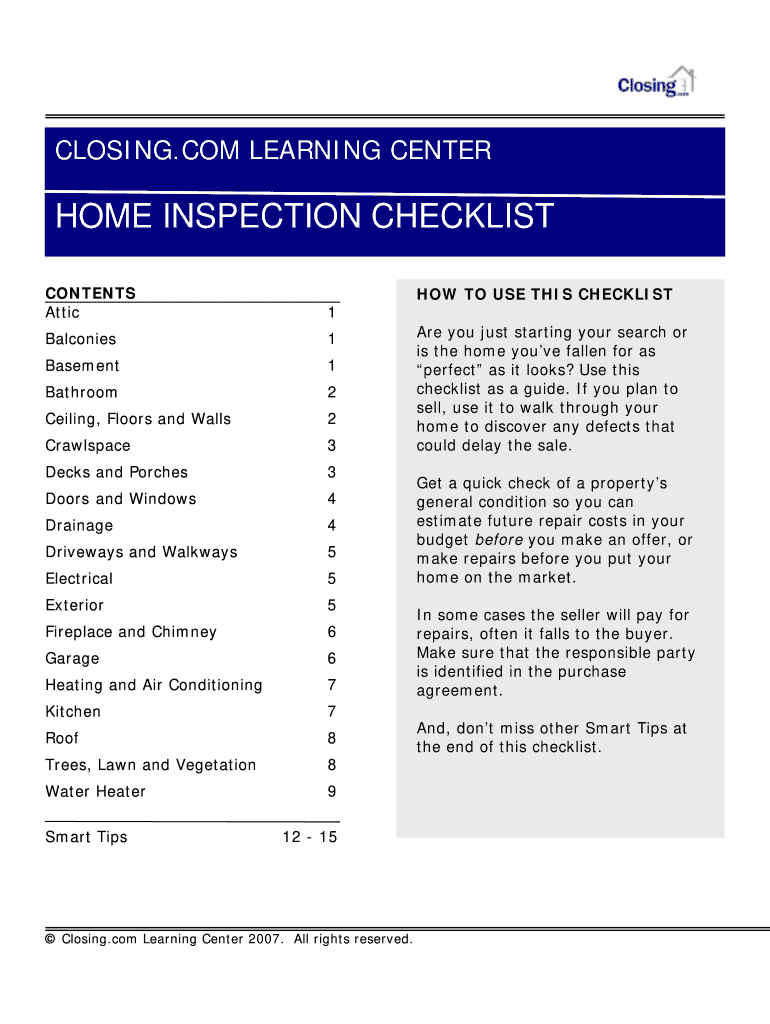
CLOSING.COM LEARNING CENTER HOME INSPECTION CHECKLIST CONTENTS Attic Balconies Basement Bathroom Ceiling, Floors and Walls Crawlspace Decks and Porches Doors and Windows Drainage Driveways and Walkways.

Open form follow the instructions

Easily sign the form with your finger

Send filled & signed form or save
How to fill out the Printable Home Inspection Checklist online
The Printable Home Inspection Checklist is an essential tool to assess the condition of a property before making a purchase or during the selling process. This guide walks you through filling out the checklist online, ensuring that you can effectively evaluate each crucial area of the home.
Follow the steps to accurately complete your home inspection checklist.
- Click ‘Get Form’ button to obtain the form and open it in the editor.
- Begin with the 'Attic' section. Evaluate accessibility, signs of leaks, ventilation, and insulation by selecting 'YES' or 'NO' for each question.
- Proceed to the 'Balconies' section. Assess drainage, support condition, and any signs of moisture. Provide your observations in the notes section if necessary.
- Continue to 'Basement'. Inspect for damp odors, water leaks, and structural integrity. Utilize the notes for any significant findings.
- Move on to the 'Bathroom' section. Review conditions like the flooring near the toilet, ventilation, and fixture functionality by answering the provided prompts.
- Fill out the 'Ceiling, Floors, and Walls' section by checking for water spots, cracks, or other signs of wear. Record any anomalies in the notes area.
- Examine the 'Crawl Space'. Ensure accessibility, check for moisture, cracks, and any signs of pest damage, documenting your observations.
- Assess 'Decks and Porches' for stability. Investigate the condition of posts and railings, noting any concerns.
- Evaluate 'Doors and Windows'. Check for functionality, mold, and any damages. Record specific details in the notes.
- Review the 'Drainage' section. Look for standing water and check the slope of the yard and driveway, documenting your findings.
- Address 'Driveway and Walkways'. Note any cracks or uneven surfaces and include your observations.
- Inspect the 'Electrical' section. Ensure the main panel is accessible, and all necessary outlets are present, using the notes for any concerns.
- Check the 'Exterior' for signs of damage related to various materials, and note your findings.
- Examine the 'Fireplace and Chimney' to ensure they are in good condition, recording any necessary notes.
- Review the 'Garage' functionality and its structural integrity, using the notes section for any comments.
- Evaluate 'Heating and Air Conditioning' systems for functionality, and document the make and model.
- Inspect the 'Kitchen' for signs of leaks and ensure appliances are securely installed. Make notes accordingly.
- Finally, assess the 'Roof', verifying the condition of shingles and overall structure. Document any issues.
- After completing all sections, review your inputs for accuracy. Save your changes, and you can download, print, or share the completed form as needed.
Start filling out your home inspection checklist online today for a thorough property evaluation.
Experience a faster way to fill out and sign forms on the web. Access the most extensive library of templates available.
Related content
Please read these instructions prior to commencing your inspection. This checklist is...
Mar 20, 2020 — We have the ultimate moving checklist to help you prepare for this...
Robot Inspection Checklist – Robot Size Inspection . ... standard distributors (for...
Get answers to your most pressing questions about US Legal Forms API.
What fixes are mandatory after a home inspection?
There is no such thing as a mandatory fix after a home inspection at least not legally. Inspections can turn up all kinds of issues, from mold and chemical contamination to roof damage and plumbing issues.
How do I make my own home inspection?
Assemble a Few Basic Tools. Problem-finding tools. ... Visually Examine Walls and Ceilings. Start by looking for discoloration on the walls and ceilings. ... Assess the Plumbing. ... Examine the Windows and Furnace. ... Check Electrical Outlets and Switches. ... Inspect the Exterior. ... Required Tools for this Project.
What are red flags in a home inspection?
If ants, termites, cockroaches, mice or other pests have taken moved in before the new buyers, it's a home inspection red flag. In some cases, pests wander through a home and a thorough cleaning or a few traps can end a pest problem.
What should I pay attention to during a home inspection?
Oil tank. ... HVAC system. ... Roof. ... Structural integrity of the chimney. ... Water drainage and disbursement. ... Electricity system. ... Foundation. ... Quality of the flooring.
How do I prepare for a home inspection checklist?
Provide open access to areas that need to be checked. ... Clear the perimeter. ... Check the roof. ... Keep a clean house. ... Replace any bulbs that are out. ... Make sure your toilets are functioning properly. ... Put in a fresh furnace return filter.
What are major issues in a home inspection?
Structural Issues. Structural issues can generally be seen in the attic or crawlspace. ... Roof. ... Plumbing. ... Electrical. ... Heating and Colling System / HVAC. ... Water Damage. ... Termites. ... Final Thoughts on Major Home Inspection Issues.
What are the most common home inspection problems?
Problem #1: Rundown roofing. Asphalt shingle roofs last 15 to 20 years. ... Problem #2: Drainage issues. ... Problem #3: Faulty foundation. ... Problem #4: Plumbing problems. ... Problem #5: Pest infestations. ... Problem #6: Hidden mold. ... Problem #7: Failing heating systems. ... Problem#8: Electrical wiring.
What can fail a home inspection?
Problem #1: Rundown roofing. ... Problem #2: Drainage issues. ... Problem #3: Faulty foundation. ... Problem #4: Plumbing problems. ... Problem #5: Pest infestations. ... Problem #6: Hidden mold. ... Problem #7: Failing heating systems. ... Problem#8: Electrical wiring.
What is the checklist for a home inspection?
Exterior: Examine the exterior. Don't leave any stone unturned, whether it's on the roof or in the yard. Interior: Walk through the house and be critical of everything you see. Plumbing/HVAC: Don't forget to take a look at the property's plumbing and HVAC unit, as both are big-ticket items worthy of a closer inspection.
What should I be worried about a home inspection?
Foundation issues. Foundation issues can be a big deal and are typically very expensive, says Mike Lyon, Quicken Loans vice president of operations. Mold. ... Water damage. ... Roof problems. ... Furnace issues. ... Vermin. ... Age of the electrical system. ... Vermin.
Use professional pre-built templates to fill in and sign documents online faster. Get access to thousands of forms.
If you believe that this page should be taken down, please follow our DMCA take down process here.