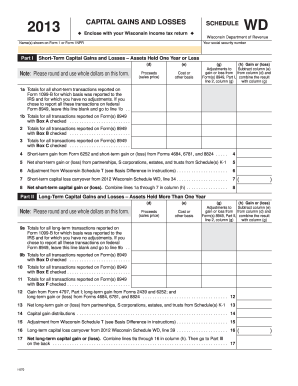
Or (loss) from Forms 4684, 6781, and 8824 . . . . . . . . . . . . . . . . . . . . . . . . . . . . . . . . . . . 12 1 3 Net long-term gain or (loss) from partnerships, S corporations, estates, and trusts from Schedule(s) K 1 13 1 4 Capital gain distributions . . . . . . . . . . . . . . . . . . . . . . . . . . . . . . . . . . . . . . . . . . . . . . . . . . . . . . . . . . . . . 14 1 5 Adjustment from Wisconsin Schedule T (see Basis Difference in instructions) . . . . . .

How it works
  • Open form

    Open form follow the instructions

  • Easily sign form

    Easily sign the form with your finger

  • Share form

    Send filled & signed form or save

How to fill out the WI DoR Schedule WD online

Filling out the Wisconsin Department of Revenue Schedule WD online can seem daunting, but this guide aims to simplify the process for you. Follow the clear and structured steps below to accurately complete the form for reporting capital gains and losses.

Follow the steps to successfully complete your Schedule WD.

  1. Click ‘Get Form’ button to access the WI DoR Schedule WD and open it in your chosen editor.
  2. Begin with Part I, where you will report your short-term capital gains and losses. Fill in your name(s) and social security number as shown on Form 1 or 1NPR.
  3. In column (d), input the proceeds from sales of assets held for one year or less. In column (e), input the cost or other basis of these assets.
  4. For any adjustments to your gain or loss, refer to Form 8949, Part I, and input those figures in column (g). Calculate the total gain or loss in column (h) by subtracting column (e) from column (d) and adding column (g).
  5. Repeat the process for lines 1a through 7 in Part I. Make sure all amounts are rounded to whole dollars and record totals accordingly.
  6. Move to Part II to report long-term capital gains and losses. Follow the same procedure as in Part I, filling in the necessary information in columns (d), (e), (g), and (h).
  7. In Part III, summarize your findings from Parts I and II. Combine the results and fill in lines 18 through 28 based on the instructions provided.
  8. If applicable, move to Part IV to compute the Wisconsin adjustment to income. Follow the step-by-step guidance as outlined in the instructions.
  9. Finally, ensure all entries are accurate. Once completed, you can save the document, download, print, or share for your records.

Start filling out your WI DoR Schedule WD online today to ensure your capital gains and losses are accurately reported.

Get form

Experience a faster way to fill out and sign forms on the web. Access the most extensive library of templates available.

Related content

2024 I-070 Wisconsin Schedule WD, Capital Gains...

Short-term capital loss carryover from 2023 Wisconsin Schedule WD, line 34 ....

Learn more
2019 I-111 Form 1 Instructions - Wisconsin Income...

Dec 31, 2019 — Tax Rates Reduced – The tax rate for the first and second tax bracket...

Learn more
The State of the Colorado River Ecosystem in Grand...

by S Links — Library of Congress Cataloging-in-Publication Data. The state of the...

Learn more
Questions & Answers

Get answers to your most pressing questions about US Legal Forms API.

Contact support

Is the 30 capital gain exclusion in Wisconsin?

Yes, Wisconsin allows for the federal home sale exclusion, which means individuals can exclude up to $250,000 in capital gains from the sale of their primary residence, or $500,000 for married couples filing jointly. To claim this exclusion, it’s essential to complete the WI DoR Schedule WD properly, providing necessary documentation for your claim. Understanding these benefits will help you navigate your tax situation effectively.

The Schedule D worksheet is a crucial document for reporting capital gains and losses from various transactions, such as stocks or real estate. This worksheet helps to calculate the correct amounts to report on your tax returns, in line with the WI DoR Schedule WD. By using this worksheet, you can ensure you’re accurately reflecting your financial activity and complying with tax responsibilities.

To avoid capital gains tax in Wisconsin when selling your home, ensure that the sale qualifies for the home sale exclusion. If you have owned and lived in the home for at least two of the past five years, you may exclude up to $250,000 of gain from taxes. Utilizing the WI DoR Schedule WD can help you document your claims properly to take advantage of this exclusion.

Schedule 4W in Wisconsin is used to report capital gains and losses on the sale of property. This schedule complements the WI DoR Schedule WD by detailing your transactions and ensuring compliance with state regulations. Complete this form carefully to help maximize your tax benefits and avoid unnecessary tax liability.

You can obtain Wisconsin income tax forms directly from the Wisconsin Department of Revenue's website or through authorized tax preparation services. Additionally, many local libraries and post offices stock these forms during tax season. For a user-friendly experience, consider using the uslegalforms platform, which provides essential tax forms including the WI DoR Schedule WD conveniently online.

Wisconsin Schedule WD is a form used for reporting work-related expenses, which may include unreimbursed expenses by employees. This schedule allows individuals to itemize deductions that exceed the standard deduction. To fully benefit from deductions, it's important to complete the WI DoR Schedule WD thoroughly, ensuring you don’t leave any potential savings on the table.

The schedule ad in Wisconsin refers to the additional documentation required for reporting certain types of income or deductions on your tax return. Specifically, this form is designed to capture income not reported on your main forms. By accurately completing the WI DoR Schedule WD, taxpayers ensure they comply with state tax laws while maximizing their claims.

The Wisconsin Schedule WD is a form used to report capital gains and losses on your state tax return. This form details various transactions, ensuring compliance with Wisconsin tax laws. It is crucial for accurately reporting your financial situation, particularly if you have sold properties or investments. Using the WI DoR Schedule WD helps clarify your obligations and entitlements.

In Wisconsin, you can deduct capital losses from your taxable income to offset capital gains. If your capital losses exceed your capital gains, you can deduct up to $3,000 from other income on your tax return. Any remaining losses can be carried forward to future tax years. For complete reporting of your capital gains and losses, ensure you complete the WI DoR Schedule WD.

The capital gain exclusion rule allows homeowners to exclude a certain amount of capital gains from the sale of their primary residence. In the U.S., individuals can exclude up to $250,000, and married couples can exclude up to $500,000 if they meet specific requirements. This rule can significantly reduce your tax liability on the sale. For any reporting of exclusions, make sure to refer to the WI DoR Schedule WD.

Get This Form Now!

Use professional pre-built templates to fill in and sign documents online faster. Get access to thousands of forms.

If you believe that this page should be taken down, please follow our DMCA take down process here.

WI DoR Schedule WD Form

This form is available in several versions. Select the version you need from the drop-down list below.

Get WI DoR Schedule WD