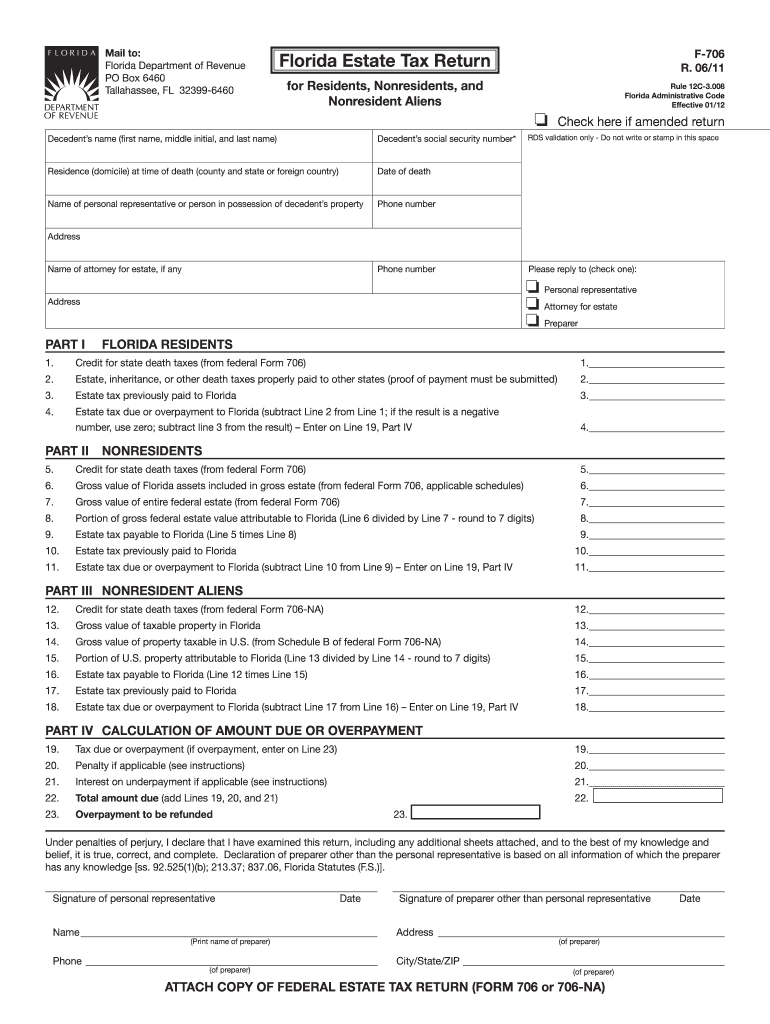
Resentative or person in possession of decedent s property Phone number Check here if amended return RDS validation only - Do not write or stamp in this space Address Name of attorney for estate, if any Phone number Personal representative Attorney for estate Preparer Address PART I Please reply to (check one): FLORIDA RESIDENTS 1. Credit for state death taxes (from federal Form 706) 1. 2. Estate, inheritance, or other death taxes p.
Loading

Open form follow the instructions

Easily sign the form with your finger

Send filled & signed form or save
How to fill out the FL F-706 online
The FL F-706 is the Florida estate tax return used by various parties to report an estate's value and calculate tax obligations. This guide provides clear and step-by-step instructions for completing this form online, ensuring you can navigate the process with confidence.
Follow the steps to fill out the FL F-706 online effectively.
- Click ‘Get Form’ button to obtain the form and open it in your editor.
- Enter the decedent’s name, ensuring you include the first name, middle initial, and last name. This information is essential for identification.
- Provide the decedent’s social security number. Remember that this information is confidential and used solely for tax administration purposes.
- Indicate the decedent’s residency at the time of death by specifying the county and state or foreign country.
- Include the date of death. Accurate recording is crucial for calculating tax obligations.
- Fill in the name of the personal representative or the person in possession of the decedent’s property.
- Provide a contact phone number for the personal representative.
- If this is an amended return, check the box provided.
- Complete the attorney information section if applicable, including name and contact phone number.
- In Part I, for Florida residents, complete the required calculations regarding state death taxes and any estate taxes previously paid.
- For nonresidents, proceed to Part II and fill out the relevant sections regarding the gross value of Florida assets and the estate tax payable to Florida.
- If applicable, complete Part III for nonresident aliens, detailing the gross value of taxable property in Florida and relevant calculations.
- In Part IV, calculate the total amount due or any overpayment by following the instructions provided in the form.
- Sign the form in the required sections for both the personal representative and any preparer, ensuring that names and dates are included.
- After completing the form, save your changes. You may then choose to download, print, or share the document as necessary.
Complete your FL F-706 form online today to ensure compliance with Florida estate tax requirements.
Experience a faster way to fill out and sign forms on the web. Access the most extensive library of templates available.
Related content
May 23, 2025 — The executor of a decedent's estate uses Form 706 to figure the estate...
... Florida Estate Tax Return for Residents, Nonresidents and Nonresident Aliens (form...
by J McKiernan · 2018 · Cited by 287 — Background: Discriminating indolent from...
Get answers to your most pressing questions about US Legal Forms API.
Do I have to report the sale of inherited property to the IRS?
Yes, you typically need to report the sale of inherited property to the IRS, even if it’s sold at a loss. The IRS requires all property sales to be reported correctly, which includes establishing the basis for the sale. Utilizing resources like USLegalForms can simplify the reporting process and help ensure compliance.
What is the 7 year rule for partnerships?
The 7-year rule for partnerships allows certain tax elections to be reconsidered after this period. This rule helps partnerships make necessary adjustments based on changing situations. It’s vital for partners to stay informed about this rule to maximize tax efficiency and compliance.
What is the required tax year for a partnership?
Partnerships generally must use a calendar year as their tax year unless they meet specific criteria to adopt a fiscal year. This requirement helps ensure uniformity and compliance within the tax system. Partners should keep track of their tax year to avoid potential issues during tax filing.
What is the majority interest rule?
The majority interest rule refers to the principle that the majority of ownership interest in a partnership determines taxation and decision-making. This rule plays a significant role in partnership structures and how profits are distributed. Understanding this rule can help partners make informed tax and operational decisions.
How much can you inherit in Florida without paying taxes?
In Florida, there is no state inheritance tax, which means you can inherit any amount without facing state taxes. However, you may need to file a FL F-706 if the estate exceeds the federal threshold. It's essential to check federal guidelines to ensure proper reporting and compliance.
What does IRS code 706 mean?
IRS code 706 generally refers to the regulations governing estate tax returns. Specifically, it relates to the procedures for valuing an estate at the time of the owner’s death. Knowing about IRS code 706 helps executors navigate the estate tax process and make informed decisions.
What is Section 706 of the tax code?
Section 706 of the tax code pertains to the taxation of partnerships. It outlines how partnerships should report their income, deductions, and other tax items for each tax year. Understanding Section 706 is vital for partners to accurately file their taxes and comply with IRS requirements.
What is a 706 tax return?
A 706 tax return, specifically the FL F-706, is a federal estate tax return used to report an estate's value when it exceeds a certain threshold. This return is crucial for calculating potential estate tax liabilities. By filing it, executors ensure compliance with tax regulations and facilitate the distribution of assets.
How to fill out a withholding exemption form?
Filling out a withholding exemption form requires you to complete several sections accurately. Start by providing your personal information, including your income details and the reason for your exemption. Accurate records and calculations are essential to avoid errors. For additional support, you can reference FL F-706 for best practices.
What is reported on form 706 Schedule F?
Form 706 Schedule F is used to report the value of interests in farms or agricultural property passed on during an estate. This includes details about farm assets, debts related to those assets, and any other pertinent agricultural holdings. For anyone dealing with farm assets, FL F-706 provides valuable guidance to ensure accurate reporting.
Use professional pre-built templates to fill in and sign documents online faster. Get access to thousands of forms.
If you believe that this page should be taken down, please follow our DMCA take down process here.
This form is available in several versions. Select the version you need from the drop-down list below.