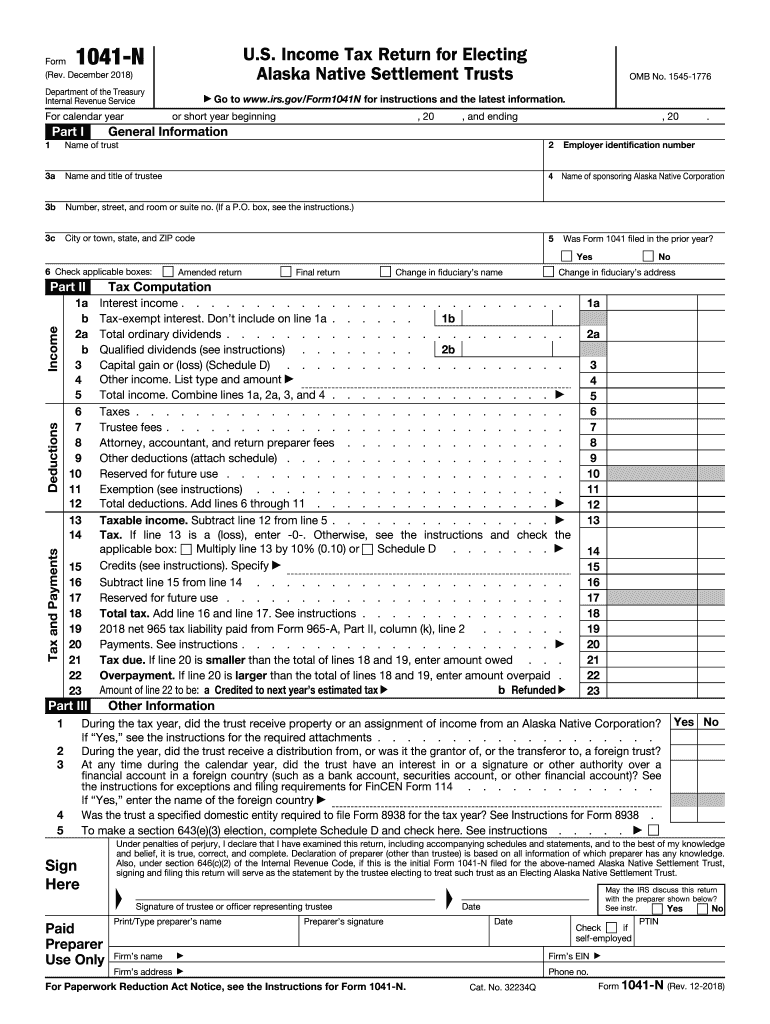
1041NU.S. Income Tax Return for Electing Alaska Native Settlement TrustsForm (Rev. December 2018)Department of the Treasury Internal Revenue ServiceFor calendar yearPart IOMB No. 15451776Go to www.irs.gov/Form1041N.
Loading

Open form follow the instructions

Easily sign the form with your finger

Send filled & signed form or save
How to fill out the IRS 1041-N online
Filling out the IRS 1041-N form is essential for the tax obligations of electing Alaska Native settlement trusts. This guide will provide you with clear, step-by-step instructions to help you complete the form accurately online.
Follow the steps to successfully complete the IRS 1041-N online.
- Press the ‘Get Form’ button to access the IRS 1041-N form and open it in your preferred online editor.
- Complete the general information section. Here you will enter the name of the trust, the trustee's name and title, and the name of the sponsoring Alaska Native corporation, among other details.
- Proceed to Part I, where you will indicate whether Form 1041 was filed in the prior year and check any applicable boxes for the current tax year.
- In Part II, fill out the income, deductions, and tax computation sections. Enter figures for interest income, dividends, capital gains or losses, total income, and allowable deductions.
- Calculate the total tax due by completing the tax computation and entering any credits that apply. Refer to the instructions provided for specific calculations.
- If applicable, complete Part III, answering questions about property received from an Alaska Native corporation and any foreign trust interests.
- Sign the form. Ensure the trustee or an authorized representative signs and dates the form, and include any necessary preparer information.
- Once all sections are complete, save the changes made to the form. You can then download, print, or share the completed IRS 1041-N form as needed.
Start filling out your IRS 1041-N online today for a streamlined tax filing experience.
Experience a faster way to fill out and sign forms on the web. Access the most extensive library of templates available.
Related content
Jan 28, 2025 — This one-time election is made by filing Form 1041-N and the form is used...
This section applies to applications for an automatic extension of time to file an estate...
Feb 1, 2018 — An estate (other than a bankruptcy estate) and a trust filing Form 1041...
Get answers to your most pressing questions about US Legal Forms API.
How to close a trust with the IRS?
Closing a trust with the IRS involves filing the final Form 1041 and ensuring all tax obligations are settled. This includes distributing remaining assets to beneficiaries and reporting any final income or deductions. By comprehensively understanding IRS 1041-N procedures, you can effectively conclude trust administration and align with tax compliance without any issues.
What is the IRS form 1041 N?
The IRS Form 1041-N is essentially a variant of the standard 1041 form, specifically designed for certain types of non-resident trusts and estates. This form allows for unique guidelines in reporting income and deductions related to trusts. Understanding IRS 1041-N will help you navigate the specific filing requirements associated with non-resident entities.
Do I have to file a 1041 for an estate with no income?
If an estate generates no income, filing IRS Form 1041 may not be necessary. However, the personal representative should still evaluate the specific circumstances. It is essential to confirm compliance with IRS regulations, such as IRS 1041-N, to avoid any complications in the future.
Who has to file a 1041 tax return?
A 1041 tax return must be filed by estates or trusts that have a taxable income over $600 or if a beneficiary is a non-resident alien. This requirement closely aligns with the IRS 1041-N provisions, as understanding when a return is due will help you manage fiscal responsibilities efficiently. Consulting resources like uslegalforms can provide clarity on these requirements.
Who must file the IRS form 1041?
Generally, a personal representative or executor of a trust or estate must file IRS Form 1041 if the trust has generated income or is required by law. If the trust's gross income exceeds $600, a return is mandatory. Understanding when to file IRS 1041-N can help you avoid potential penalties and ensure proper management of the trust's obligations.
What is a 1041 for dummies?
The IRS Form 1041 is used to report income, deductions, and tax liability for estates and trusts. Essentially, it helps the IRS track how income generated by a trust or estate is handled for tax purposes. For a simplified understanding, think of IRS 1041-N as a tax form that keeps the IRS informed about the financial activity within a trust or estate.
Are trust capital gains taxed to beneficiary?
Yes, trust capital gains can be taxed to the beneficiary, depending on the type of trust. If a trust distributes income or capital gains to the beneficiary, those amounts may be reported on the beneficiary's tax return. It is important to understand how IRS 1041-N regulations apply in these cases to ensure compliance and avoid unexpected tax implications.
Can I file IRS form 1041 electronically?
Yes, you can file IRS form 1041 electronically through certain approved e-filing systems. This method often accelerates the processing time for your return and can help you avoid common paper-filing mistakes. Using dedicated platforms like US Legal Forms can guide you through the electronic filing process seamlessly.
Who prepares form 1041?
Typically, a personal representative, executor, or administrator of an estate prepares IRS form 1041. This individual ensures that the form accurately reflects any income received by the estate or trust during the tax year. Additionally, you may consider utilizing the US Legal Forms platform to access resources and templates that can simplify this process for you.
What is deductible on a 1041 for an estate?
Deductions on IRS form 1041 typically include expenses related to the administration of the estate, debts, and certain taxes. These deductions can significantly reduce the taxable income of the estate, providing financial relief. For comprehensive guidance, resources like uSlegalforms can assist in maximizing these deductions.
Use professional pre-built templates to fill in and sign documents online faster. Get access to thousands of forms.
If you believe that this page should be taken down, please follow our DMCA take down process here.
This form is available in several versions. Select the version you need from the drop-down list below.