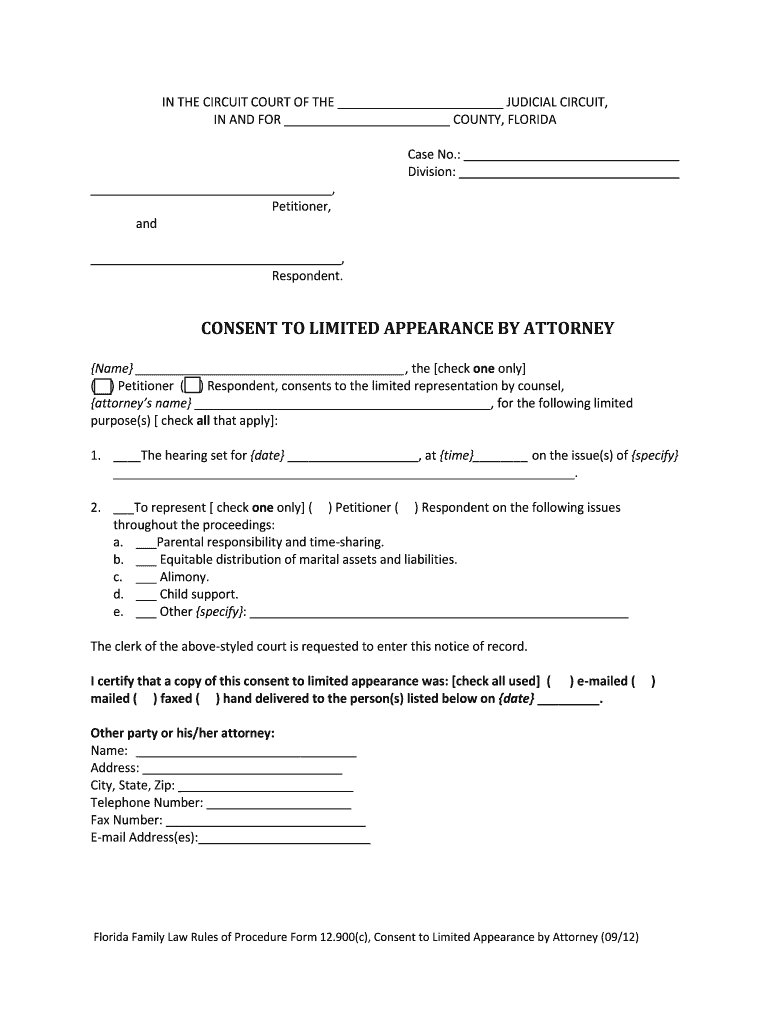
Give consent when an attorney is making a limited appearance for the client under Florida Family Law Rule of Procedure 12.040. This form should be typed or printed in black ink. After completing this form, the client should sign it. The attorney or client should then file it with the clerk of the circuit court in the county in which the action is pending. The attorney and client should each keep a copy for his or her records. What should I do next? A copy of this form must be served on the othe.

Open form follow the instructions

Easily sign the form with your finger

Send filled & signed form or save
How to fill out the FL 12.900(c) online
This guide provides clear and comprehensive instructions on how to successfully fill out the FL 12.900(c), a consent to limited appearance by attorney form. Designed for users with varying levels of legal experience, this guide ensures that you can complete the form accurately and confidently.
Follow the steps to complete the FL 12.900(c) form effectively.
- Press the ‘Get Form’ button to obtain the FL 12.900(c) and open it in your editor.
- Begin by entering the name of the Petitioner or Respondent in the designated space, ensuring to select one option accurately by checking the appropriate box.
- Fill in the attorney's name who will be representing the client for limited purposes.
- Specify the limited purpose(s) of the representation by checking all relevant options provided, including details of any upcoming hearings.
- Indicate if the attorney will represent either the Petitioner or Respondent on specified issues by checking the appropriate box.
- If applicable, list any additional issues under 'Other' that the attorney will represent the client.
- Request the clerk to enter the notice of record by following any instructions given within the form.
- Certify that a copy of the consent form was served on the other party or attorney by checking the appropriate method of service and filling in the date.
- Complete the sections for the other party or their attorney, including all required contact information.
- Sign the document as the Petitioner or Respondent, including printed name and contact details.
- If a non-lawyer assisted you, ensure they fill out their information in the blank provided at the bottom of the form.
- Once all fields are completed, save your changes, and consider downloading, printing, or sharing the form as necessary.
Complete your documents online today for a streamlined experience.
Experience a faster way to fill out and sign forms on the web. Access the most extensive library of templates available.
Related content
This form should be used for a client to give consent when an attorney is making a limited...
Florida Family Law Rules of Procedure Form 12.900(b), Notice of Limited ... 12.900(c)...
Accurate for Pressure-Factor Measurement. Applications—Pilot action controls pressure to...
Get answers to your most pressing questions about US Legal Forms API.
How do I file a petition in Florida?
Filing a petition in Florida involves completing the relevant legal forms, such as the FL 12.900(c), depending on your type of case. After filling out the forms, submit them to the appropriate court along with any filing fees. It is also advisable to check local court rules regarding additional documentation or notices that may be required.
Who can file a petition for administration in Florida?
In Florida, any interested party, such as an heir or a beneficiary, can file a petition for administration. This process is guided by legal forms, including FL 12.900(c), which streamline filing procedures. It's essential to demonstrate your interest in the estate to proceed, ensuring that all parties receive fair consideration under the law.
How do I petition someone to court?
To petition someone to court, you start by drafting a petition that outlines your claims and desired outcomes. Ensure you follow legal guidelines, including using forms like FL 12.900(c) if applicable. Once completed, file the petition at your local courthouse and serve it to the other party. Proper service of documents is crucial for the court to consider your case.
What is the difference between a motion and a petition in Florida?
In Florida, a petition is a formal request to the court asking for a specific action, while a motion is typically a request to the court for a ruling on a procedural matter. The FL 12.900(c) form is commonly used in petitions, especially for matters like name changes. Understanding this distinction can help you approach your legal issues more effectively.
How to file a petition for name change in Florida?
To file a petition for a name change in Florida, you need to complete the appropriate forms, including the FL 12.900(c) form. After filling out the form, submit it to your local court along with any required fees. You may also need to file a notice of hearing. This process ensures that your name change is legally recognized in the state.
What is the rule 12.280 of the Florida family law rules of procedure?
Rule 12.280 addresses the disclosure of financial information and the procedure for obtaining evidence in family law matters. This rule helps ensure that all parties share relevant financial details, promoting transparency in proceedings. Notably, understanding FL 12.900(c) can bolster your preparation efforts. For comprehensive resources, including forms, look into USLegalForms.
Do financial affidavits need to be notarized in Florida?
Typically, financial affidavits do not need notarization in Florida unless a specific judge's order states otherwise. While notarization can add assurance, understanding your specific situation is key. Knowing the details of FL 12.900(c) can guide you through the requirements. For further clarity and templates, USLegalForms is an excellent resource.
Is a financial affidavit a legal document?
Yes, a financial affidavit is recognized as a legal document in Florida. It is utilized in family law matters to provide detailed information about a person's financial status. This information is crucial for the court to make informed decisions regarding support, division of assets, and similar issues. To ensure its proper structure, reference FL 12.900(c) and check with resources like USLegalForms.
Does a financial affidavit need to be notarized in Florida?
In Florida, a financial affidavit does not necessarily need to be notarized unless specified by a court requirement or local rule. However, notarization can enhance the document's legal weight, especially in family law cases. Referring to FL 12.900(c) could guide you in ensuring your financial documents meet legal standards. For templates and advice, consider visiting USLegalForms.
What is the 12.490 rule of the Florida family law Rules of Procedure?
Rule 12.490 governs the process by which parties can submit requests for temporary relief in family law cases. It outlines the required procedures for filing motions, including affidavits and other supporting documentation. Understanding FL 12.900(c) in conjunction with this rule can help streamline your legal process. If you need clarity, check out the resources available at USLegalForms.
Use professional pre-built templates to fill in and sign documents online faster. Get access to thousands of forms.
If you believe that this page should be taken down, please follow our DMCA take down process here.